Alex in Japan — Episode 05
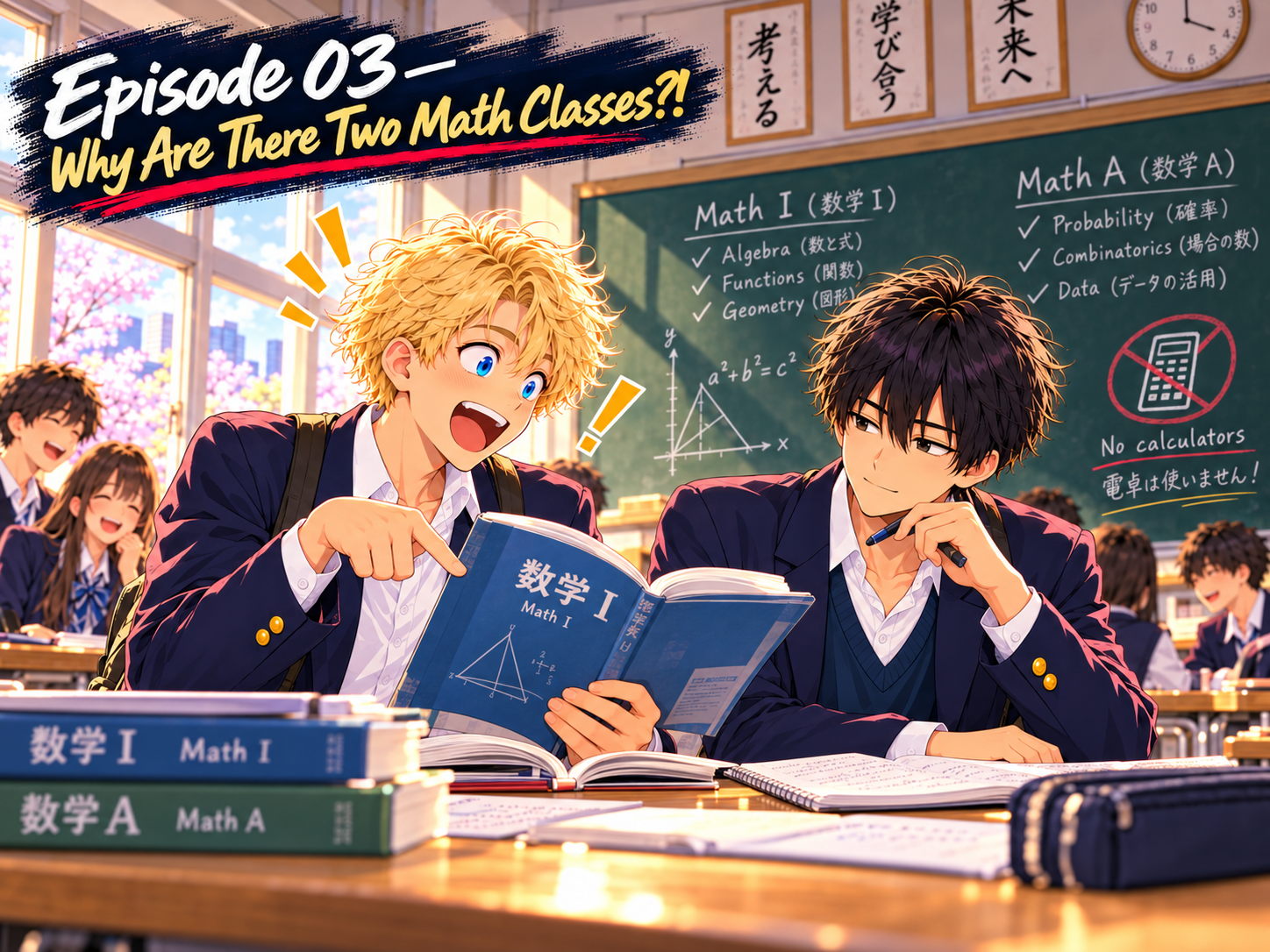
Math I, Math A, and the Mystery of the Missing Calculator
Chapter 1 — Two Math Classes in One Day?!
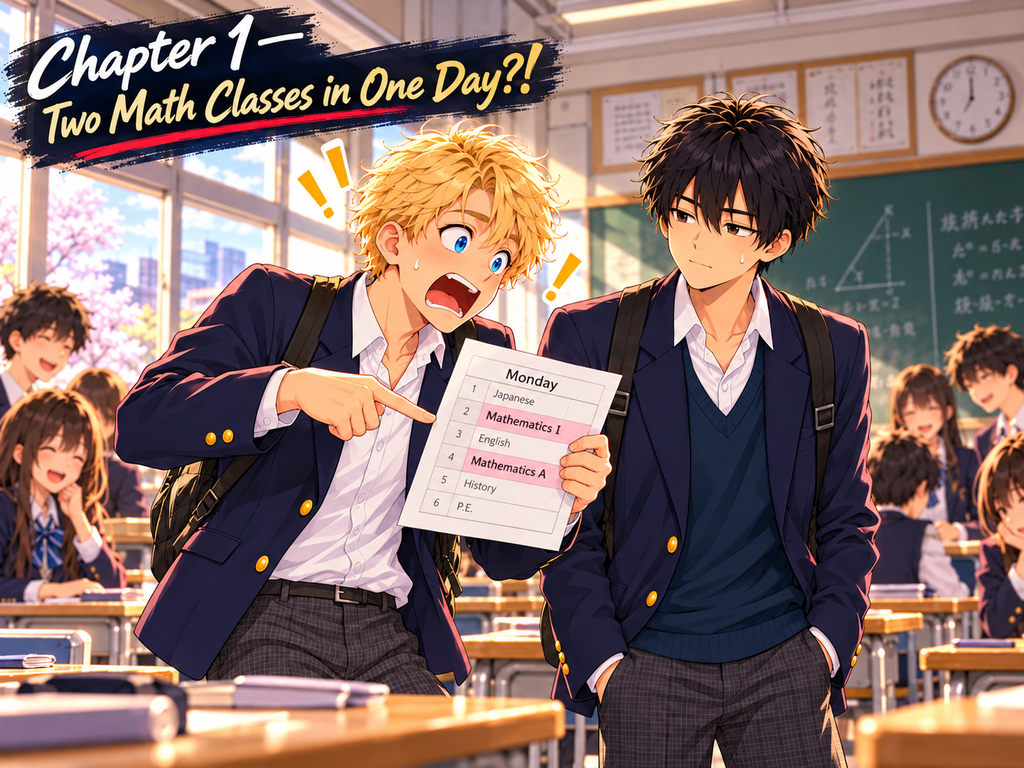
Monday morning.
I walked into our classroom feeling pretty good.
Yesterday, I’d carried a mikoshi through the neighborhood, shouted “Wasshoi!” with everyone, and made some wonderful new friends.
My shoulders were still sore.
But my mood?
Excellent.
Until I looked at the class schedule.
I stopped.
Blink.
Blink.
Then I leaned closer.
“No…”
I rubbed my eyes.
“No, no, no…”
Haru looked up from his desk.
Haru: “Alex? What’s wrong?”
I pointed at the schedule.
“THERE’S A MISTAKE!”
Haru: “A mistake?”
“YES! A TERRIBLE MISTAKE!”
Haru walked over.
Haru: “What are you talking about?”
“LOOK!”
I pointed to the second period.
Mathematics I.
Then I pointed to the fifth period.
Mathematics A.
“WE HAVE MATH TWICE TODAY!”
Haru: “Yeah.”
“YEAH?!”
Haru: “What’s wrong with that?”
“WHAT’S WRONG WITH THAT?!”
I stared at him.
“HARU! MATH IS SUPPOSED TO BE ONE SUBJECT!”
Haru tilted his head.
Haru: “Well, we have different math courses.”
“Different math courses?”
Haru: “Yes. Mathematics I and Mathematics A.”
I looked back at the schedule.
“Wait…”
I raised one finger.
“Math ONE…”
Then another.
“Math A…”
I looked at Haru.
“WHAT HAPPENED TO MATH TWO?!”
Haru covered his face.
Haru: 「……そういう順番ちゃうねん。」
(…That’s not how the numbering works.)
I shook my head.
“At my old school, I had classes called Algebra and Geometry.”
Haru: “We study algebra and geometry too.”
“THEN WHY DON’T YOU JUST CALL THEM ALGEBRA AND GEOMETRY?!”
Haru: “Because the subjects are organized differently.”
I stared at him.
“So Math I and Math A aren’t the same thing?”
Haru: “Right.”
“And A doesn’t mean the first level?”
Haru: “Right.”
“And Math II exists?”
Haru: “Yes.”
“WHAT?!”
A few classmates started laughing.
Haru sighed.
Haru: 「……まだ一時間目も始まってへんのに。」
(…The first period hasn’t even started yet.)
I slowly sat down.
Japan had already surprised me with indoor shoes.
School cleaning.
School lunch routines.
And now…
Apparently, even math had a different naming system.
I looked at my schedule one last time.
“Fine.”
Haru raised an eyebrow.
Haru: “Fine?”
“I’LL SURVIVE TWO MATH CLASSES!”
Haru: “Good.”
“PROBABLY!”
Chapter 2 — What Is Math I?
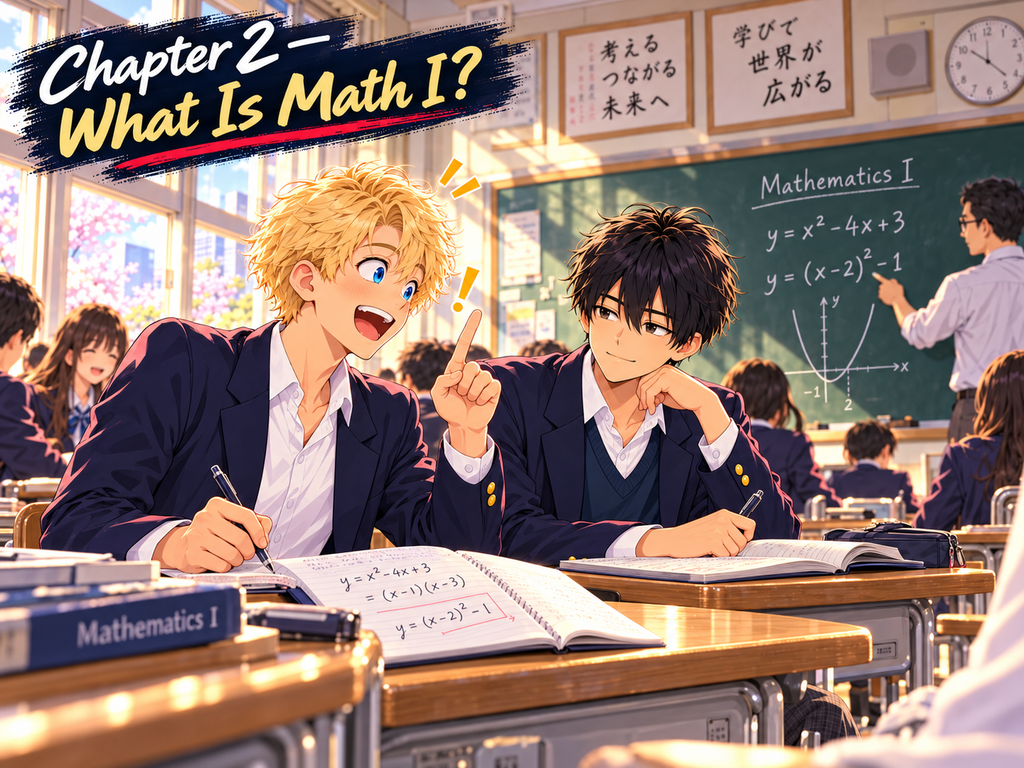
Second period.
Mathematics I.
Our teacher, Ms. Sato, entered the classroom.
Ms. Sato: 「みなさん、おはようございます。」
(Good morning, everyone.)
The class greeted her.
She turned toward the blackboard and wrote:
数学Ⅰ — 二次関数
Haru whispered to me.
Haru: “We’re studying quadratic functions.”
I looked at the board.
Then smiled.
“OH!”
Haru: “What?”
“I KNOW THIS!”
Ms. Sato wrote:
y = x² − 4x + 3
I grinned.
“That’s algebra!”
Haru: “It’s part of Mathematics I here.”
“But I’ve seen equations like that before!”
Haru smiled.
Haru: “Good. Then today’s lesson might be familiar.”
Ms. Sato began explaining how the graph changed depending on the equation.
She wrote another expression:
y = (x − 2)² − 1
I looked back and forth between the two equations.
“Wait!”
Haru turned toward me.
Haru: “What?”
“THOSE ARE THE SAME FUNCTION!”
A few students looked up.
Ms. Sato noticed.
Ms. Sato: 「アレックス君、何か気づきましたか?」
(Alex, did you notice something?)
Haru quickly translated.
I stood up a little too fast.
“YES!”
Then I realized something.
I knew the math.
But I didn’t know how to explain it in Japanese.
“Oh…”
I looked at Haru.
“HELP.”
Haru smiled.
Haru: 「……こういう時だけ声ちっちゃいな。」
(…Funny how you get quiet only at times like this.)
Haru explained to the teacher that I recognized the two forms of the quadratic function.
Ms. Sato nodded.
Ms. Sato: 「そうですね。展開すると同じ式になります。」
(That’s right. Expanding it gives the same expression.)
She continued the lesson, showing how the second form made the vertex easier to identify.
I copied the equations into my notebook.
Then I looked around.
Everyone was writing.
Listening.
Thinking.
Solving problems.
It felt surprisingly familiar.
After a while, I whispered to Haru.
“So Mathematics I includes algebra?”
Haru: “Yes. It also includes topics such as trigonometric ratios and data analysis.”
“ALL IN ONE COURSE?”
Haru: “Different topics, yes.”
I leaned back in my chair.
“So Japan takes different kinds of math and puts them into these courses?”
Haru: “That’s one way to think about it.”
I nodded seriously.
“Interesting.”
Haru looked surprised.
Haru: “You’re being unusually quiet.”
“I’m thinking.”
Haru: “About math?”
I shook my head.
“ABOUT HOW MANY DIFFERENT MATH SUBJECTS JAPAN HAS.”
Haru sighed.
Haru: 「……まだ気にしてたんか。」
(…You’re still thinking about that?)
Chapter 3 — Math A? There’s More?!
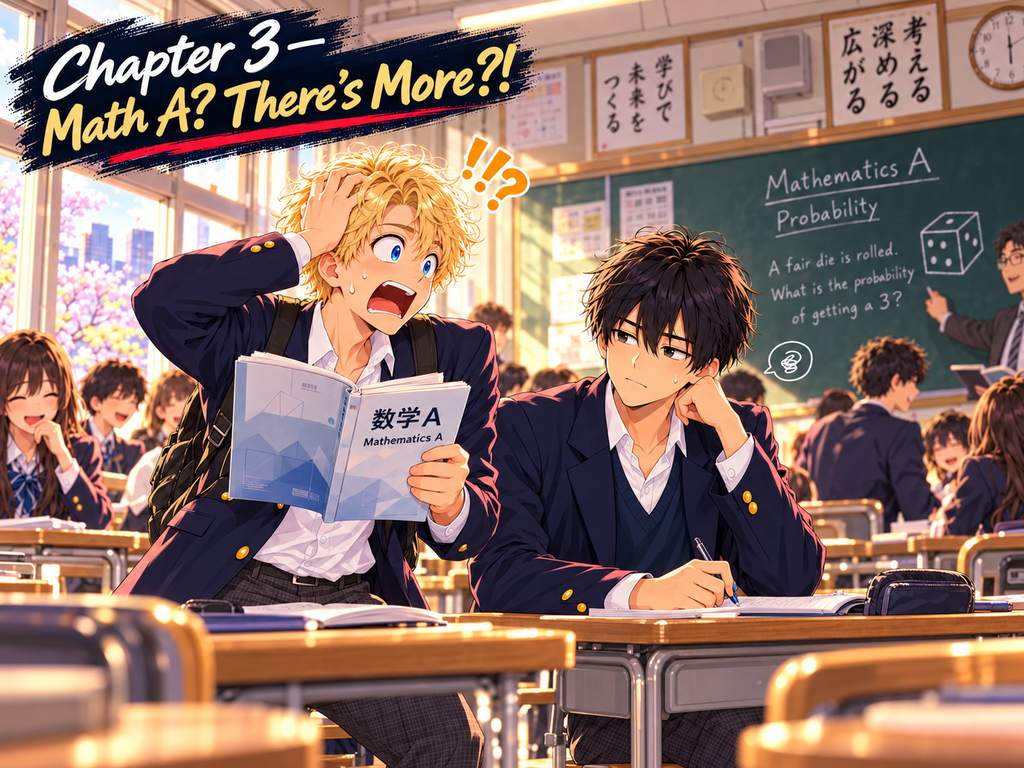
Fifth period.
I was ready to go home.
Unfortunately, the schedule disagreed.
Mathematics A.
I looked at Haru.
“AGAIN?!”
Haru: “Alex, we discussed this in the morning.”
“I KNOW!”
Haru: “Then why are you surprised?”
“BECAUSE IT’S STILL MATH!”
Haru quietly opened his notebook.
Haru: 「……もう慣れてくれへんかな。」
(…Could you please get used to it already?)
Ms. Sato walked into the classroom again.
She wrote on the board:
数学A — 場合の数と確率
Haru leaned toward me.
Haru: “Today we’re doing probability.”
I blinked.
“Probability?”
Haru: “Yes.”
I smiled.
“OH! I LIKE PROBABILITY!”
Haru looked relieved.
Haru: “Good.”
“FINALLY! A MATH SUBJECT WITH GAMES!”
Haru: “It’s not exactly a game.”
But Ms. Sato was already drawing a die on the board.
A six-sided die.
She wrote:
What is the probability of rolling a six?
I leaned forward.
“OH! OH! I KNOW THIS!”
Ms. Sato looked toward us.
Ms. Sato: 「アレックス君、分かりますか?」
(Alex, do you know the answer?)
Haru translated.
I nodded enthusiastically.
“ONE OUT OF SIX!”
Haru translated my answer.
Ms. Sato smiled.
Ms. Sato: 「正解です。」
(Correct.)
I pumped my fist.
“YES!”
Haru gave me a look.
Haru: “It’s one question, Alex.”
“ONE CORRECT QUESTION!”
Ms. Sato moved on to another example.
She explained that if a fair six-sided die is rolled, each face has the same probability of appearing.
Then she wrote:
P(rolling a six) = 1/6
I stared at the board.
A fraction.
Numbers.
A symbol.
And somehow…
I understood everything.
I turned to Haru.
“So Mathematics A includes probability?”
Haru: “Yes. It also includes topics like counting methods and properties of figures.”
I nodded.
“Okay.”
Then I paused.
“WAIT.”
Haru closed his eyes.
Haru: “What now?”
“IF WE HAVE MATH I AND MATH A…”
Haru: “Yes?”
“DO WE ALSO HAVE MATH B?!”
Haru: “Yes.”
“AND MATH C?!”
Haru: “Yes.”
I stared into the distance.
“Japan has an entire alphabet of math…”
Haru shook his head.
Haru: 「……アルファベット全部あるわけちゃうで。」
(…It’s not the entire alphabet.)
I slowly opened my notebook.
“This country really loves math.”
Haru: “Or maybe you just love being dramatic.”
“THAT TOO!”
Chapter 4 — Where’s My Calculator?!
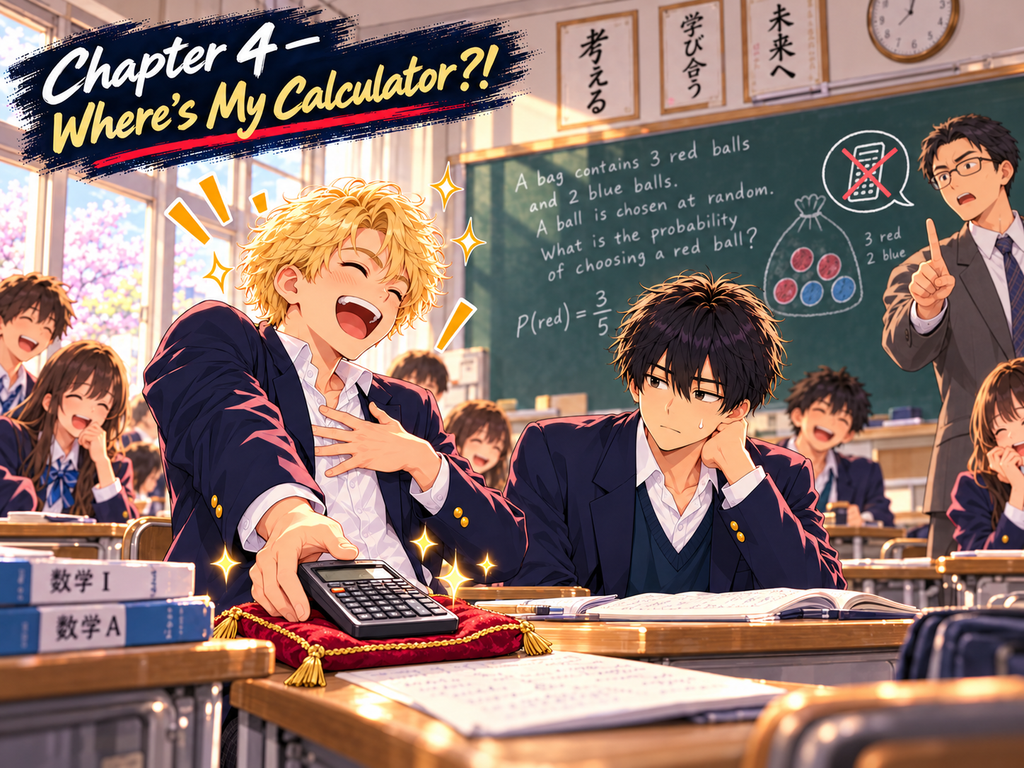
Ms. Sato wrote another probability problem on the blackboard.
A bag contains three red balls and two blue balls. If you choose one ball at random, what is the probability of choosing a red ball?
I looked at the question.
Three red balls.
Two blue balls.
Five in total.
Then I reached into my schoolbag.
And pulled out my calculator.
My faithful companion.
My trusted mathematical assistant.
I placed it proudly on my desk.
Haru looked at it.
Then at me.
Haru: “Alex.”
“Yes?”
Haru: “Why do you have a calculator?”
“For math.”
Haru: “I can see that.”
“THEN WHAT’S THE PROBLEM?”
Haru pointed at the board.
Haru: “You don’t need it for this question.”
I looked offended.
“YOU DON’T KNOW THAT!”
Haru: “There are three red balls out of five.”
“Yes?”
Haru: “So the probability is three-fifths.”
I looked down at my calculator.
Then back at Haru.
“But…”
Haru: “But what?”
“IT’S MY TRUSTED PARTNER!”
Haru rubbed his forehead.
Haru: 「……電卓に友情感じんといて。」
(…Please don’t develop a friendship with your calculator.)
At that moment, Ms. Sato noticed the calculator on my desk.
Ms. Sato: 「アレックス君、今日は電卓を使わずに解いてみましょう。」
(Alex, let’s try solving today’s problems without a calculator.)
Haru translated.
I froze.
“WITHOUT…?”
I stared at the calculator.
“YOU CAN’T BE SERIOUS!”
A few classmates laughed.
Ms. Sato smiled patiently.
Ms. Sato: 「計算だけでなく、考え方も大切ですよ。」
(The reasoning matters, not just the calculation.)
Haru translated.
I slowly put the calculator away.
“Okay…”
Then I leaned toward Haru.
“At my old school, we used calculators for some lessons and assignments.”
Haru: “That makes sense.”
“So why can’t I use one now?”
Haru: “Because Ms. Sato wants us to practice reasoning through these problems ourselves.”
I looked at the board again.
Three red balls.
Two blue balls.
Five total.
I didn’t need a calculator to know the answer.
I knew that.
But I still sighed dramatically.
“GOODBYE, OLD FRIEND.”
Haru looked at me.
Haru: “You’re going to see it again after class.”
I nodded sadly.
“WE’LL MEET AGAIN.”
Haru: 「……ほんまに大げさやな。」
(…You really are dramatic.)
And for the first time that day, I solved the problem without reaching for my calculator.
3/5.
Simple.
Clear.
And completely correct.
I looked at Haru.
“HEY!”
Haru: “What?”
“I DID IT!”
Haru smiled.
Haru: “You did.”
“WITHOUT MY PARTNER!”
Haru: “Congratulations.”
I raised my fist.
“THE HUMAN BRAIN STILL WORKS!”
Haru laughed.
Haru: 「……そらよかったな。」
(…Well, that’s good to hear.)
Chapter 5 — The Probability Challenge
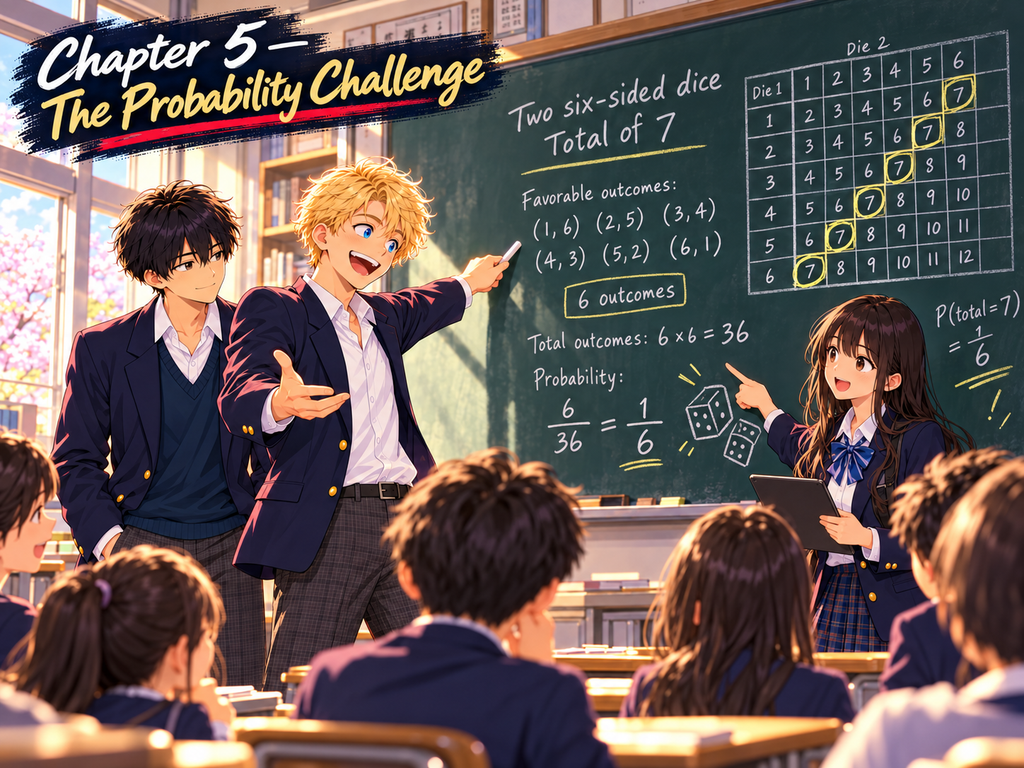
Just when I thought the lesson was almost over, Ms. Sato drew two dice on the board.
Ms. Sato: 「では、次の問題を考えてみましょう。」
(Now, let’s think about the next problem.)
She wrote:
Two fair six-sided dice are rolled. What is the probability that their sum is seven?
I leaned forward.
“OHHH!”
Haru looked at me.
Haru: “You like this one?”
“THIS IS A REAL CHALLENGE!”
He smiled.
Haru: “Try solving it.”
I began counting on my fingers.
One and six.
Two and five.
Three and four.
Four and three.
Five and two.
Six and one.
Six possible combinations.
Then I looked at Haru.
“Six ways!”
Haru: “Good. How many possible outcomes are there in total?”
I thought.
Six possibilities for the first die.
Six for the second.
Six times six.
Thirty-six.
I wrote in my notebook:
6/36 = 1/6
“ONE-SIXTH!”
Haru checked my answer.
Haru: “Correct.”
I grinned.
“YES!”
Then Ms. Sato asked whether anyone would like to explain their reasoning.
My hand shot up.
“HERE!”
The classroom turned toward me.
Ms. Sato smiled.
Ms. Sato: 「アレックス君、前で説明してみますか?」
(Alex, would you like to explain it at the front?)
Haru translated.
I stood up.
“OF COURSE!”
Then I remembered the language problem.
I glanced at Haru.
“…Can you help translate?”
He sighed, but stood up beside me.
Haru: 「……最初からそう言うてくれたらええのに。」
(…You could’ve just said that from the beginning.)
At the blackboard, I wrote the six pairs:
(1,6), (2,5), (3,4), (4,3), (5,2), (6,1)
Then:
6 ÷ 36 = 1/6
I explained in English that there were 36 equally likely ordered outcomes when rolling two dice.
Six of them had a sum of seven.
Haru translated my explanation into Japanese.
Ms. Sato nodded.
Ms. Sato: 「いいですね。順番を区別して、きちんと数えられています。」
(Very good. You’ve correctly counted the outcomes while distinguishing their order.)
A classmate, Mio, raised her hand.
Mio: 「表にすると、もっと分かりやすいと思います。」
(I think it would be even clearer with a table.)
Haru translated.
Mio came to the board and drew a six-by-six grid.
She marked the six combinations that added up to seven.
I stared at the table.
“OH!”
Each row represented the first die.
Each column represented the second.
And the six winning combinations formed a diagonal pattern.
“THAT’S REALLY COOL!”
Mio smiled.
Haru looked at her table.
Haru: “Same answer. Different way of showing it.”
I looked from my list to her grid.
“That’s amazing.”
Ms. Sato pointed to both solutions.
Ms. Sato: 「同じ問題でも、考え方や表し方はいろいろありますね。」
(There can be different ways to think about and represent the same problem.)
Haru translated.
I looked at my answer.
Then Mio’s.
We’d approached the same question differently.
But both explanations made sense.
I smiled.
“SO THERE’S MORE THAN ONE WAY TO THINK!”
Haru: “Exactly.”
I raised a hand dramatically.
“AND MORE THAN ONE WAY TO BE A MATH HERO!”
Haru lowered his head.
Haru: 「……最後の一言、いらんかったな。」
(…That last sentence was unnecessary.)
The class laughed.
Even Ms. Sato smiled.
Chapter 6 — Math Has No Borders
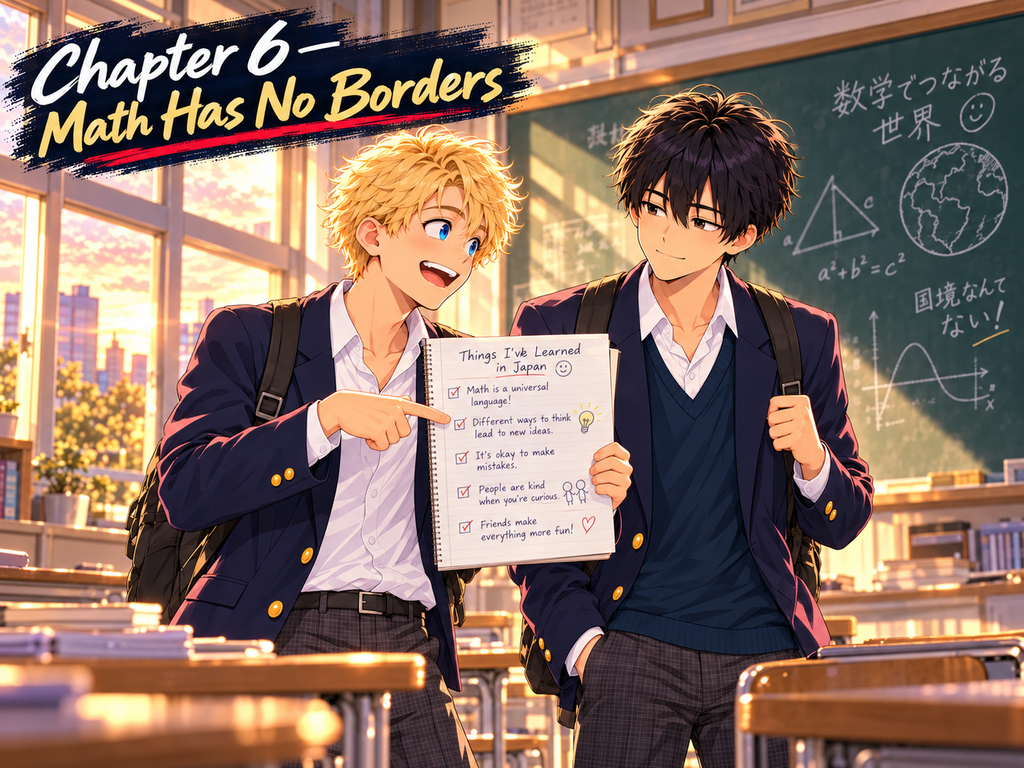
The final bell rang.
I stretched my arms.
“FINALLY!”
Haru closed his notebook.
Haru: “Long day?”
“TWO MATH CLASSES, HARU!”
Haru: “I know. I was there.”
I looked down at my notebook.
In the morning, I’d learned about quadratic functions.
In the afternoon, we’d worked on probability.
I’d even survived an entire lesson without my beloved calculator.
And somehow…
I’d enjoyed it.
I turned to Haru.
“Hey.”
Haru: “What?”
“Can I ask you something?”
Haru: “Sure.”
“At my old school, I had Algebra and Geometry.”
Haru: “Right.”
“And here, we have Mathematics I and Mathematics A.”
Haru: “Right.”
“But we still solve equations.”
Haru: “Yes.”
“And we still study probability.”
Haru: “Of course.”
I thought about it.
“So the names are different…”
Haru nodded.
“But math is still math.”
Haru: “Exactly.”
I smiled.
“That’s actually pretty cool.”
Haru looked surprised.
Haru: “You really mean that?”
“Yeah.”
I pointed to the equations in my notebook.
“The teacher speaks Japanese.”
Haru: “Yes.”
“And sometimes I don’t understand what she’s saying.”
Haru: “I know.”
“But when I look at the numbers…”
I tapped the page.
“I recognize them.”
Haru smiled.
Haru: “Numbers don’t change just because you’re in another country.”
I laughed.
“RIGHT!”
Then I looked at the probability problem we’d solved with Mio.
“And sometimes, another person can show you a better way to understand something.”
Haru nodded.
Haru: “That’s why explaining your reasoning can be useful.”
I stared at him.
“What?”
Haru: “What?”
“YOU JUST SAID SOMETHING REALLY WISE!”
Haru sighed.
Haru: 「……普段から賢いこと言うてるつもりやけど。」
(…I’d like to think I say intelligent things all the time.)
I grinned.
“DON’T WORRY, HARU. I’LL WRITE IT DOWN!”
Haru: “Please don’t.”
I opened my notebook.
At the top of a clean page, I wrote:
Things I’ve Learned in Japan
Then underneath:
1. Shoes have rules.
2. Students help clean their classrooms.
3. Festivals are better together.
4. Japan has more math course names than I expected.
5. My brain can survive without a calculator.
Haru looked over my shoulder.
Haru: “That last one seems important.”
“VERY IMPORTANT.”
I thought for a moment.
Then added one more line.
6. Different countries. Different classrooms. Same curiosity.
Haru read it.
He was quiet for a moment.
Then he smiled.
Haru: 「……ええこと言うやん。」
(…That’s actually a pretty good thing to say.)
I smiled proudly.
“THANK YOU!”
Haru picked up his bag.
Haru: “Come on. Let’s go.”
I followed him toward the classroom door.
Then stopped.
“HEY, HARU!”
He turned around.
Haru: “What now?”
“WHAT’S MATHEMATICS II LIKE?!”
Haru stared at me.
Then slowly turned back toward the door.
Haru: 「……それはまた今度な。」
(…Let’s save that for another time.)
I hurried after him.
“WAIT! WHAT ABOUT MATH B?!”
“HARU!”
“IS THERE A MATH C?!”
Haru kept walking.
But I could see him smiling.
And for once, I wasn’t afraid of the next surprise waiting for me in Japan.
I was looking forward to it.
Alex’s Discovery — Math Classes in Japan
1. What are Mathematics I and Mathematics A?
Japanese high schools organize mathematics into several subjects.
Mathematics I (数学Ⅰ) includes:
- Numbers and algebraic expressions
- Geometry and measurement, including trigonometric ratios
- Quadratic functions
- Data analysis
Mathematics A (数学A) includes:
- Properties of geometric figures
- Counting methods and probability
- Mathematics and human activities
The exact order of lessons and topics taught depends on the school.
2. How is this different from mathematics in the United States?
Many American high schools offer courses such as Algebra I, Geometry, and Algebra II. Some schools use integrated mathematics courses instead.
Which subjects students take can depend on their school, state, and previous mathematics experience.
Japanese and American students study many overlapping mathematical ideas, even though the subjects may have different names and structures.
3. Do Japanese students use calculators?
Calculator use varies by school, teacher, subject, and activity.
Some Japanese mathematics lessons emphasize solving problems by hand, while calculators, computers, and other digital tools may be used when appropriate.
American schools also differ in when and how calculators are permitted.
In Alex’s story, his teacher simply asks the class to solve that day’s problems without calculators.
4. Why are there Mathematics II, B, and C?
Japan’s high school mathematics curriculum includes additional subjects such as Mathematics II, Mathematics III, Mathematics B, and Mathematics C.
These cover further mathematical concepts, depending on the course.
Not every student takes all of them.
5. Is there only one correct way to solve a problem?
A mathematical problem can sometimes be solved or explained in different valid ways.
Comparing methods can help students understand why an answer is correct.
In Alex’s lesson, listing possible outcomes and using a table both lead to the same probability.
Japanese Words to Remember
| Japanese | Meaning |
|---|---|
| 数学Ⅰ (Sūgaku I) | Mathematics I |
| 数学A (Sūgaku A) | Mathematics A |
| 二次関数 (Niji kansū) | Quadratic function |
| 確率 (Kakuritsu) | Probability |
| 場合の数 (Baai no kazu) | Counting methods / number of possible cases |
| 電卓 (Dentaku) | Calculator |
| 方程式 (Hōteishiki) | Equation |
| 正解 (Seikai) | Correct answer |
| 黒板 (Kokuban) | Blackboard |
| 授業 (Jugyō) | Class / lesson |
About Alex in Japan
Alex in Japan is an original illustrated story series about Alex, a 16-year-old American student discovering Japanese culture and school life in Osaka alongside his Japanese classmate Haru.
Every episode explores everyday differences through friendship, curiosity, and humor.
Explore more chapters and illustrations:
Alex in Japan — Official Story Archive
Alex in Japan — Episode 05: The End
Different classrooms. Different languages. Same curiosity.
Two cultures. One unforgettable friendship. A new discovery every day.