Alex in Japan — Episode 03
The Night Before the Festival
October 14, 2026
Chapter 1 — Two Boys in Yukata
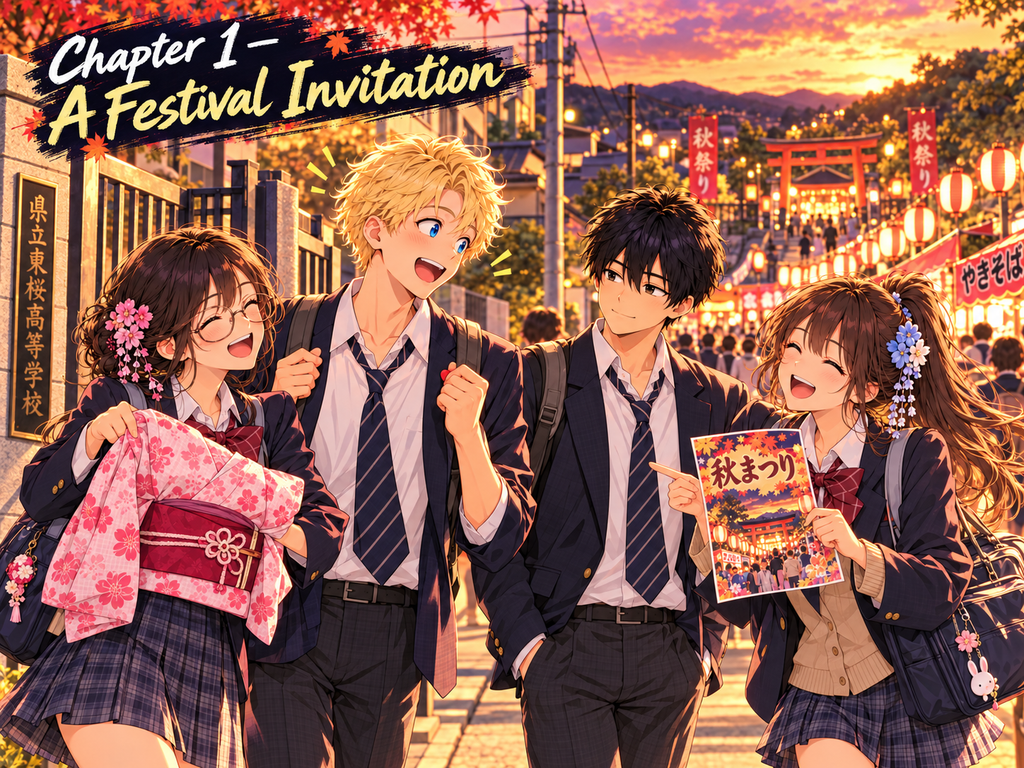
Wednesday afternoon.
I was packing my schoolbag when Haru walked over.
Haru: “Alex, are you free tonight?”
I froze.
“Haru.”
Haru: “What?”
“ARE YOU INVITING ME SOMEWHERE?”
Haru: “Could you please stop shouting?”
“Sorry. But this is a historic moment.”
Haru showed me a flyer.
Red lanterns. Food stalls. A beautiful shrine.
Haru: “There’s an autumn festival near my house. Tonight is the yoimiya, the evening before the main festival.”
“A FESTIVAL?!”
Haru: “Yes.”
“WITH FOOD?!”
Haru: “Obviously.”
“THEN I’M COMING!”
Haru hesitated.
Haru: “Actually, I have something else.”
He looked a little embarrassed.
Haru: “We have an extra yukata at home. You could wear it if you want.”
“A what?”
Haru: “A yukata. It’s a traditional Japanese garment. People sometimes wear them to festivals.”
I imagined myself wearing something from a samurai movie.
“DOES IT COME WITH A SWORD?”
Haru: “Absolutely not.”
Haru: 「……なんでそうなるねん。」
(…How did you even get that idea?)
That evening, after getting permission from Dad, I arrived at Haru’s house.
His family had prepared a dark blue yukata for me.
Haru wore a simple gray one.
After a few minutes of struggling with the sash, I looked in the mirror.
“WOW.”
Haru: “What?”
“I LOOK AMAZING!”
Haru smiled.
Haru: “It’s actually a good fit.”
I struck a dramatic pose.
“CALL ME ALEX THE GREAT!”
Haru: 「……調子乗りすぎやろ。」
(…He’s getting carried away.)
We headed toward the festival together.
And for the first time since arriving in Japan, I felt like I wasn’t just watching Japanese culture.
I was becoming part of it.
Chapter 2 — Wait… Is That Our Classmate?!
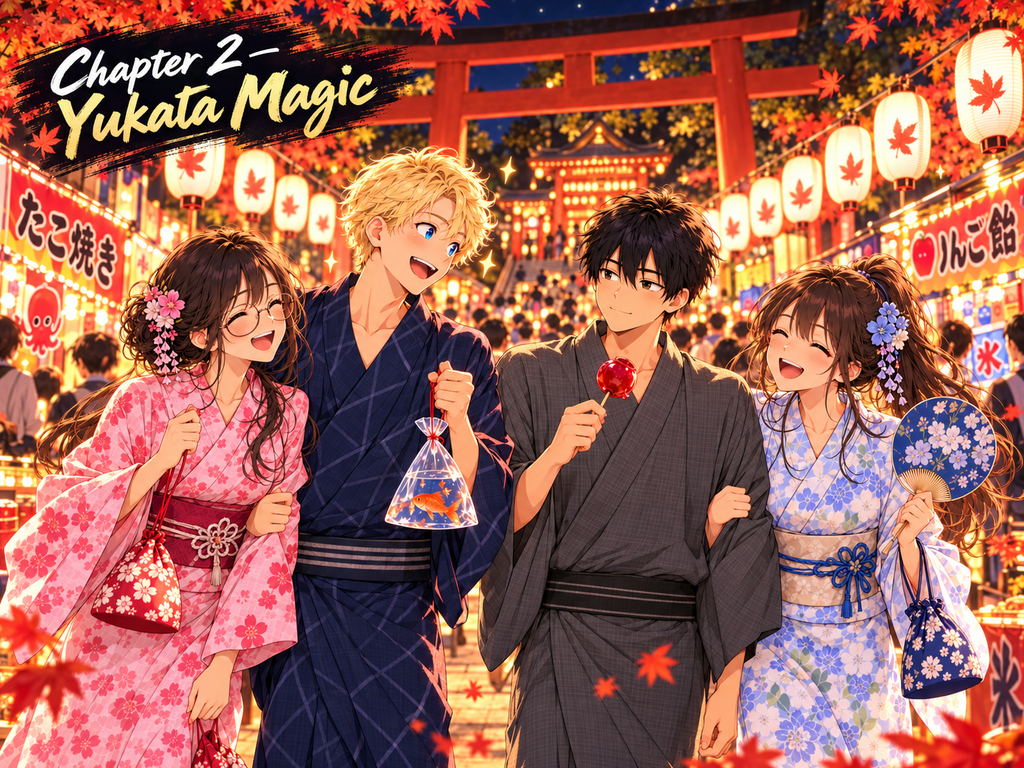
The streets were glowing with lanterns.
The smell of grilled food floated through the evening air.
Children ran past carrying colorful festival prizes.
“THIS IS AMAZING!”
Haru: “You’ve said that three times already.”
“AND I’LL SAY IT AGAIN!”
Just then, someone called out.
“Alex? Haru?”
We turned around.
Two girls were standing near a candy-apple stall.
One wore a pale pink yukata decorated with small flowers.
The other wore a light blue yukata with a white pattern.
They looked familiar.
But I couldn’t work out why.
The girl in pink smiled.
Mio: “It’s us! Mio and Saki! From your class!”
I stared at them.
“WAIT. WHAT?!”
Haru nodded.
Haru: “They’re our classmates.”
I looked from Mio to Saki.
Then back at Haru.
“NO WAY!”
Mio burst out laughing.
Mio: “What’s wrong?”
“I’ve only seen you in school uniforms!”
Saki laughed too.
Saki: “Well, we’re not at school anymore.”
“I KNOW, BUT—”
I stopped.
Then I grinned.
“YOU BOTH LOOK REALLY NICE!”
Mio smiled.
Mio: “Thank you! Your yukata looks good too!”
Haru translated the parts I didn’t understand.
I turned toward him.
“Haru! I got a compliment!”
Haru: “Congratulations.”
“THIS IS THE BEST FESTIVAL EVER!”
Haru: 「……まだ始まったばっかりやで。」
(…It’s barely even started.)
Mio looked at Haru.
Mio: 「せっかくやし、一緒に回らへん?」
(Since we’re all here, why don’t we walk around together?)
Haru translated.
My eyes lit up.
“REALLY? ALL FOUR OF US?”
Mio nodded enthusiastically.
Mio: “Of course!”
I looked at Haru.
“DID YOU HEAR THAT?”
Haru: “I’m standing right here.”
Suddenly, tonight wasn’t just about two boys visiting a festival.
There were four of us now.
And something told me things were about to get interesting.
Chapter 3 — The Great Festival Challenge
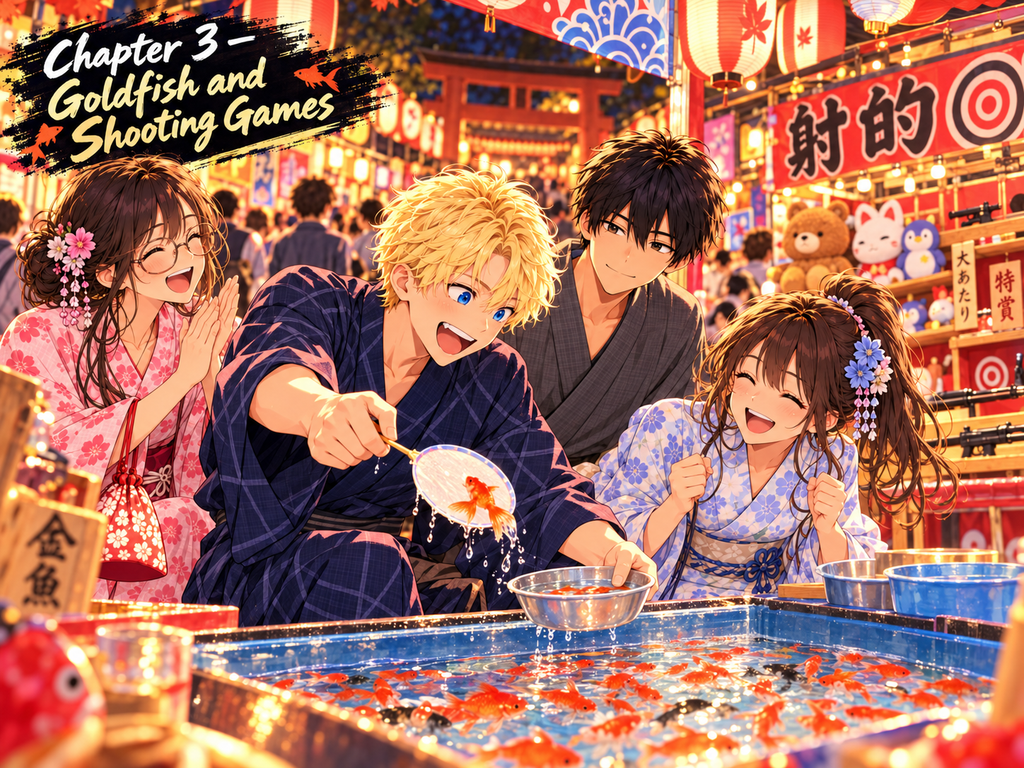
Our first stop was a goldfish-scooping stall.
Small orange fish swam around a shallow pool.
“WAIT. WHAT IS THIS?”
Saki: “Kingyo-sukui. Goldfish scooping.”
Mio held up a small paper scoop.
Mio: “You try to catch a goldfish with this.”
I examined it carefully.
“WITH PAPER?”
Haru nodded.
Haru: “The paper tears easily when it gets wet.”
I smiled confidently.
“Don’t worry. I have excellent reflexes.”
Thirty seconds later—
Splash.
My paper scoop broke.
The goldfish swam away.
I stared at the empty frame.
“MY WEAPON!”
Mio laughed so hard that she nearly dropped her own scoop.
Mio: “Alex! You’re moving too fast!”
Haru sighed.
Haru: 「……魚相手にも全力なんやな。」
(…He even goes all out against fish.)
Saki carefully dipped her scoop into the water.
Slowly.
Gently.
And then—
She caught one!
“WHAAAT?!”
Saki: “You have to be patient.”
I nodded seriously.
“Patience. Understood.”
I tried again.
This time, I moved slowly.
Very slowly.
Painfully slowly.
And then—
A goldfish slipped onto my scoop.
“I GOT ONE!”
Everyone cheered.
I immediately tried to celebrate with both hands.
The fish slipped back into the water.
Silence.
Then everyone burst out laughing.
“THAT DOESN’T COUNT?!”
Haru: “Not if it goes back into the pool.”
Haru: 「……最後まで油断したらあかん。」
(…You can’t let your guard down until the end.)
The stallholder smiled and offered us a fish according to the stall’s rules.
Saki checked that we had somewhere suitable to care for it.
Haru explained that his family had an aquarium available at home.
“Good,” Saki said. “Then let’s make sure it gets home safely.”
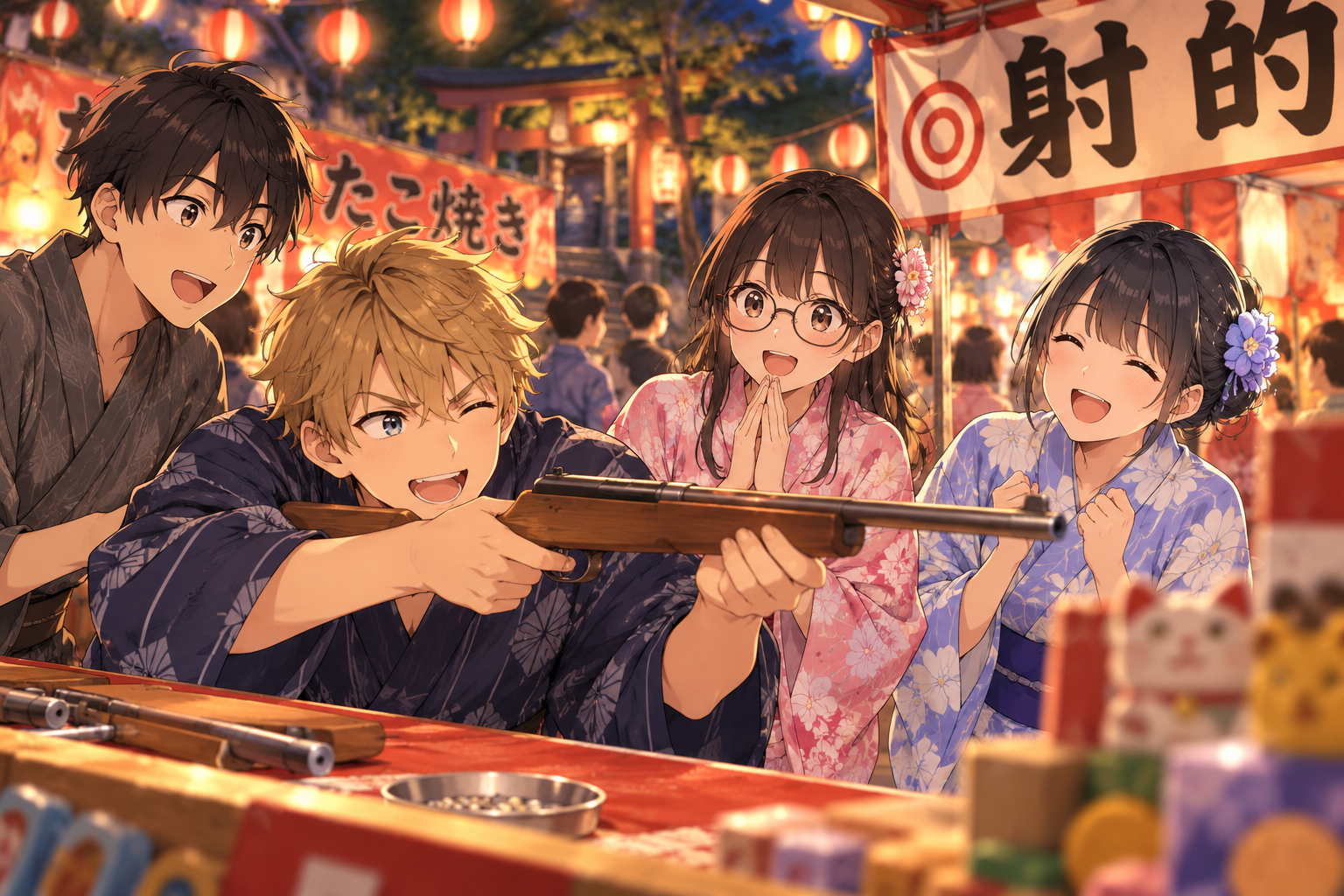
Our next challenge was shateki — a festival shooting game.
Small prizes were lined up at the back of the stall.
I picked up the toy cork gun.
“NOW THIS IS MY SPECIALTY!”
Haru looked suspicious.
Haru: “You’ve never played this before.”
“THAT’S WHY IT’S EXCITING!”
I aimed at a small prize.
Fired.
Missed.
Again.
Missed.
Mio giggled.
Mio: “Want some help?”
I handed her the toy gun.
“Show me your secret technique.”
She aimed carefully.
Pop!
A small prize fell backward.
“NO WAY!”
Saki applauded.
Haru smiled.
And I pointed dramatically at Mio.
“YOU’RE A FESTIVAL CHAMPION!”
Mio: “You’re exaggerating!”
“NEVER!”
By the time we left the stall, we were all laughing.
I had lost nearly every challenge.
But somehow, I felt like the biggest winner.
Chapter 4 — Five Yen and Good Connections
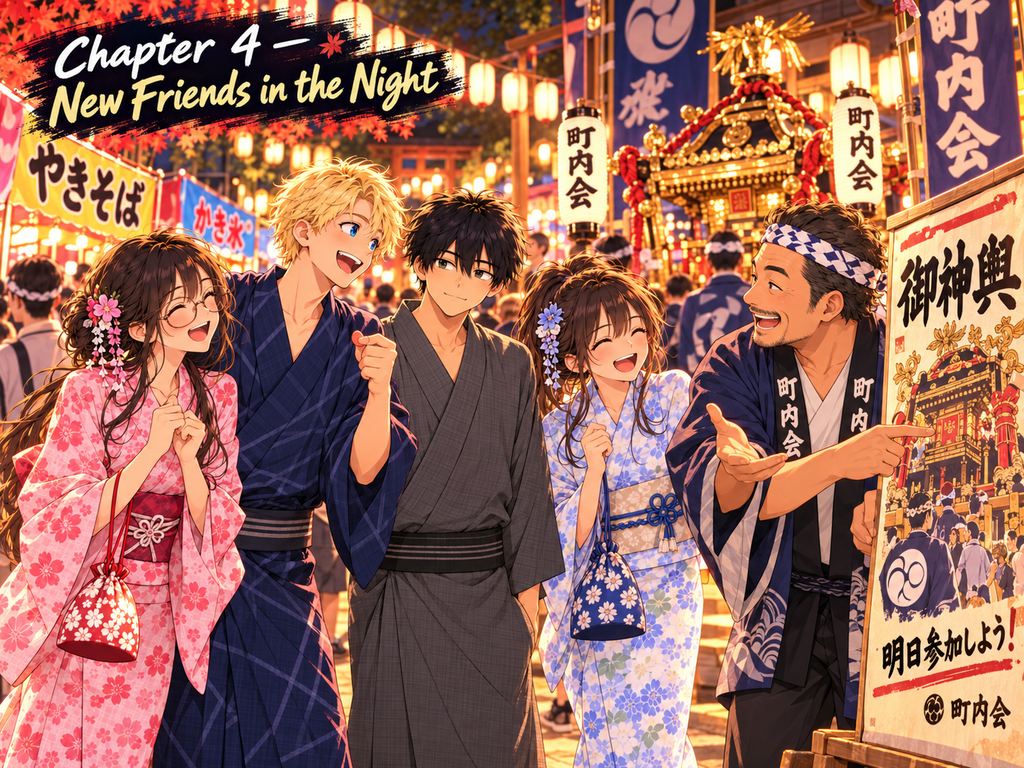
After the games, we explored the food stalls.
Takoyaki.
Yakisoba.
Grilled chicken skewers.
Candy apples.
Everywhere I looked, there was something new.
“HARU! LOOK!”
Haru: “I know.”
“THAT LOOKS DELICIOUS!”
Haru: “I know.”
Mio smiled.
Mio: “Have you ever tried takoyaki?”
I shook my head.
“Not yet.”
She bought a portion for us to share.
Haru warned me.
Haru: “Be careful. The inside is really hot.”
I nodded.
Then took a huge bite.
A terrible decision.
“HOOOT! HOT! HOT!”
Everyone burst out laughing.
Haru: 「……言わんこっちゃない。」
(…I told you so.)
Once I recovered, we walked toward the shrine.
Haru showed me the torii gate.
Haru: “This marks the entrance to the shrine.”
He gave a small bow.
The others followed.
I copied them.
Near the entrance, Haru also showed me the temizuya, where visitors can ritually cleanse their hands.
Then we walked toward the shrine building.
I reached into my pocket.
“How much do I need for the offering?”
Haru: “There’s no fixed amount.”
Saki held up a five-yen coin.
Saki: “But some people like using these.”
“WHY?”
Saki: “Because five yen is pronounced go-en. It sounds like goen, meaning a connection or relationship.”
I stared at the coin.
“SO FIVE YEN MEANS FRIENDSHIP?”
Haru: “It’s a wordplay. It doesn’t mean you can buy friendship.”
Mio smiled.
Mio: “Some people also connect fifteen yen with a playful wish for plenty of good connections.”
I counted on my fingers.
“Five yen… fifteen yen…”
Then I looked at all three of them.
“So how much do I need for THREE new friends?”
Haru sighed.
Haru: 「……友情に値段つけんといて。」
(…Please don’t put a price on friendship.)
Mio and Saki laughed.
But I kept looking at the coin.
Goen.
A connection.
A meaningful encounter.
Before coming to Japan, I’d never heard the word.
Now, I felt like I was beginning to understand it.
Chapter 5 — A Name for Our New Friend
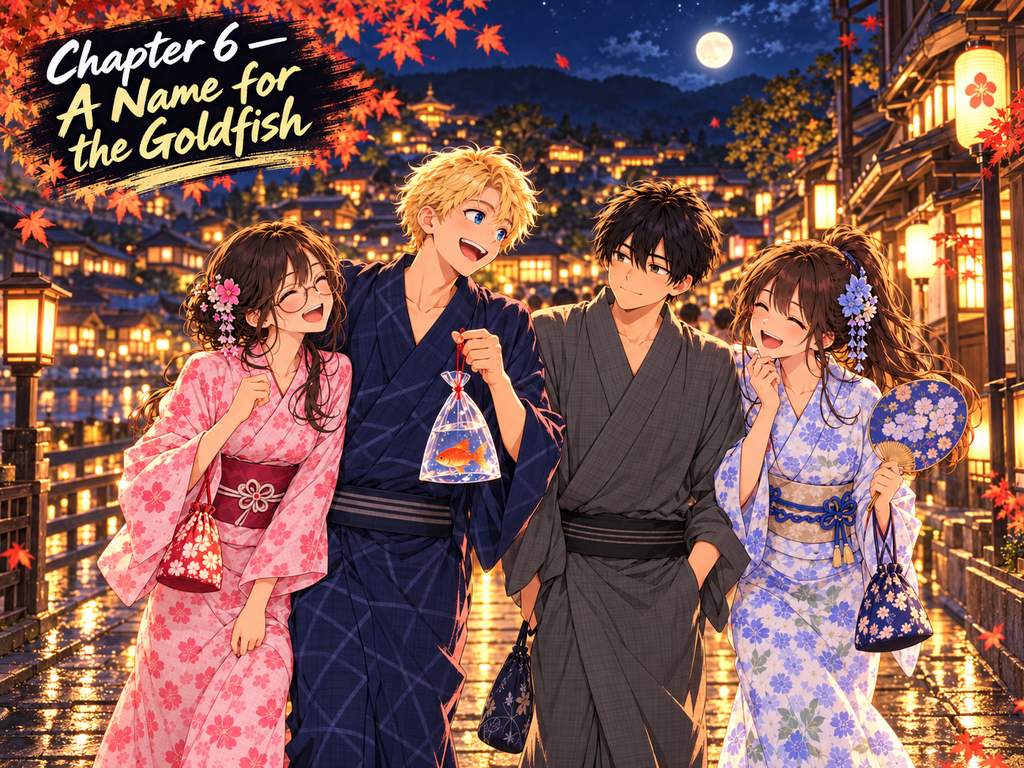
The festival was slowly winding down.
We walked beneath rows of glowing lanterns.
Haru was carefully carrying the goldfish from the stall.
Inside its temporary bag, the little orange fish moved gently through the water.
I leaned closer.
“Hey.”
Haru: “What?”
“We need to name it.”
Mio smiled.
Mio: “That’s true!”
Saki nodded.
Saki: “What should we call it?”
I thought for a moment.
“SUPER GOLDEN FESTIVAL CHAMPION!”
Haru stopped walking.
Haru: “Absolutely not.”
“Why not?!”
Haru: “That’s not a name. That’s an entire speech.”
Haru: 「……名前呼ぶだけで日が暮れるわ。」
(…It’d take all day just to call its name.)
Mio laughed.
Mio: “What about Mikan?”
“Mikan?”
Mio: “It means mandarin orange. Look at its color!”
I studied the little fish.
Orange.
Round little face.
Tiny fins.
I smiled.
“MIKAN!”
Saki clapped.
Saki: “That’s cute!”
Haru: “Mikan it is.”
I leaned toward the bag.
“WELCOME TO THE FAMILY, MIKAN!”
Haru: “Please don’t shout at the fish.”
We laughed again.
Haru explained that the fish would live in his family’s aquarium, where it could receive proper care.
I promised to visit.
Frequently.
Possibly every day.
Haru looked worried.
Haru: “The fish lives with us. That doesn’t mean you do.”
I pretended not to hear him.
Then Mio spoke.
Mio: “Alex, you know, you should talk to us more at school.”
I blinked.
“At school?”
Mio: “Yeah! You always seem to be with Haru.”
Saki nodded.
Saki: “If you need help, you can ask us too.”
For a moment, I didn’t know what to say.
Until now, Haru had been my guide to almost everything.
The classrooms.
The school rules.
The strange Japanese words.
Even the food.
But tonight, I had laughed with Mio and Saki without worrying about every word I didn’t understand.
I looked at them.
“REALLY?”
Mio smiled.
Mio: “Really.”
“THEN LET’S BE FRIENDS!”
Saki: “I thought we already were.”
I froze.
Then turned toward Haru.
“DID YOU HEAR THAT?!”
Haru: “Yes.”
“WE’RE ALREADY FRIENDS!”
Haru smiled.
Haru: 「……ほんま、よかったな。」
(…I’m really happy for you.)
And for the first time, I realized something.
Japan was starting to feel less like a foreign country.
And more like somewhere I belonged.
Chapter 6 — Thank You for Today
We were almost ready to go home when an older man called out to Haru.
Neighbor: 「おお、ハル! 久しぶりやな!」
(Hey, Haru! Long time no see!)
Haru bowed slightly.
Haru: 「こんばんは!」
(Good evening!)
The man noticed me.
Neighbor: 「おっ、その子が噂の留学生か?」
(Oh, is that the exchange student I’ve heard about?)
Haru translated.
I straightened my back.
“HELLO! I’M ALEX!”
The man laughed.
Neighbor: 「元気ええなあ!」
(You’ve got plenty of energy!)
Then he pointed toward a beautifully decorated mikoshi.
Neighbor: 「明日、神輿出すんや。よかったら来てみいひんか?」
(We’re bringing out the mikoshi tomorrow. Why don’t you come?)
Haru explained what a mikoshi was.
A portable shrine.
Carried through the neighborhood during certain festivals.
My eyes widened.
“PEOPLE CARRY THAT?!”
The man nodded.
Neighbor: 「担ぎたいんやったら、準備や決まりがあるから相談してな!」
(If you want to help carry it, we’ll need to talk about the preparations and rules!)
I looked at Haru.
“HARU.”
Haru: “I know.”
“CAN WE COME BACK TOMORROW?”
Haru: “Let’s ask your dad and find out what the organizers allow.”
“BEST. FESTIVAL. EVER!”
Before we left, Mio looked toward the shrine.
Mio: “Should we go say one last thank-you?”
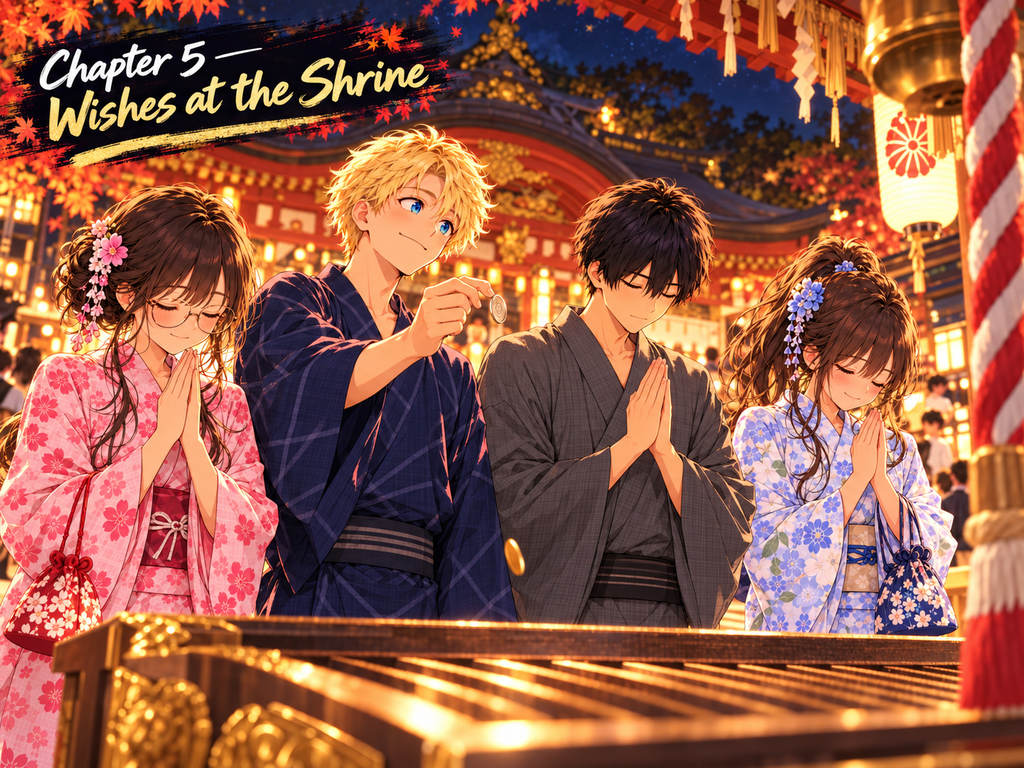
We returned to the main worship area.
The four of us stood quietly before the shrine.
We made our offerings and followed the shrine’s customary bows and claps.
This time, I watched carefully.
No jokes.
No shouting.
Just the quiet sounds of the evening.
Mio bowed her head.
Saki did the same.
Haru stood beside me.
I lowered my head and thought about the day.
When I first came to Japan, everything had felt unfamiliar.
The language.
The school.
Even the shoes.
I had worried about whether I’d ever fit in.
But tonight, I’d worn a yukata.
Eaten festival food.
Played games with classmates.
Met people from Haru’s neighborhood.
And made new friends.
I closed my eyes.
Thank you for giving me this chance.
Thank you for the people I met today.
And thank you for helping me find a place here.
When I opened my eyes, Haru was waiting for me.
Haru: “Ready?”
I nodded.
“Yeah.”
Mio waved.
Mio: “See you at school!”
Saki smiled.
Saki: “And maybe at the festival tomorrow!”
I waved back.
“SEE YOU TOMORROW!”
Haru sighed.
Haru: “You’re shouting again.”
I grinned.
“Sorry!”
Then I looked toward the glowing lanterns one last time.
When I arrived in Japan, I had wondered whether I would ever belong.
Tonight, I wasn’t wondering anymore.
And tomorrow?
Tomorrow, there was a mikoshi waiting.
Alex’s Discovery — Japanese Autumn Festivals
1. What is a yoimiya?
A yoimiya (宵宮) is associated with the evening before the main day of some Japanese shrine festivals. Traditions vary by region and shrine.
2. What is a yukata?
A yukata (浴衣) is a casual traditional Japanese garment. People sometimes wear yukata during summer festivals, fireworks events, and other seasonal celebrations, including some early-autumn festivals.
3. What are kingyo-sukui and shateki?
Kingyo-sukui (金魚すくい) is a traditional festival game in which players use a delicate paper scoop to catch goldfish.
Shateki (射的) is a game where players use a toy gun to try to knock down prizes.
If taking home a live goldfish, it’s important to arrange proper aquarium care rather than keeping it in a small temporary bag.
4. Why do people use five-yen coins at shrines?
The Japanese word for five yen, go-en, sounds like goen, which means a connection or relationship.
Because of this wordplay, some visitors associate five-yen coins with hopes for good relationships.
Fifteen yen is also sometimes playfully connected with wishes for plenty of good relationships.
These are popular wordplays, not official rules. Shrine offerings do not have a required amount.
5. How do people pray at a shrine?
At many Shinto shrines, the customary sequence is two bows, two claps, and one final bow, although practices vary.
Visitors may express gratitude, make wishes, or reflect quietly.
6. What is a mikoshi?
A mikoshi (神輿) is a portable shrine used in certain Shinto festivals.
Participants may carry it through the neighborhood, but eligibility, clothing, safety procedures, and other rules depend on the festival organizers.
Japanese Words to Remember
- 浴衣 (Yukata): A casual traditional Japanese garment.
- 秋祭り (Akimatsuri): Autumn festival.
- 宵宮 (Yoimiya): The evening before a shrine’s main festival.
- 屋台 (Yatai): Food stall or festival stand.
- 金魚すくい (Kingyo-sukui): Goldfish-scooping game.
- 射的 (Shateki): Festival shooting game.
- ご縁 (Goen): A meaningful connection or relationship.
- お賽銭 (Osaisen): A monetary offering at a shrine.
- 神輿 (Mikoshi): A portable shrine used during festivals.
Next Episode: Can I Carry a Japanese Mikoshi?!
Alex’s first autumn festival isn’t over yet. Tomorrow, he’ll discover that carrying a mikoshi takes much more than enthusiasm.
Two cultures. One unforgettable friendship. A new discovery every day.