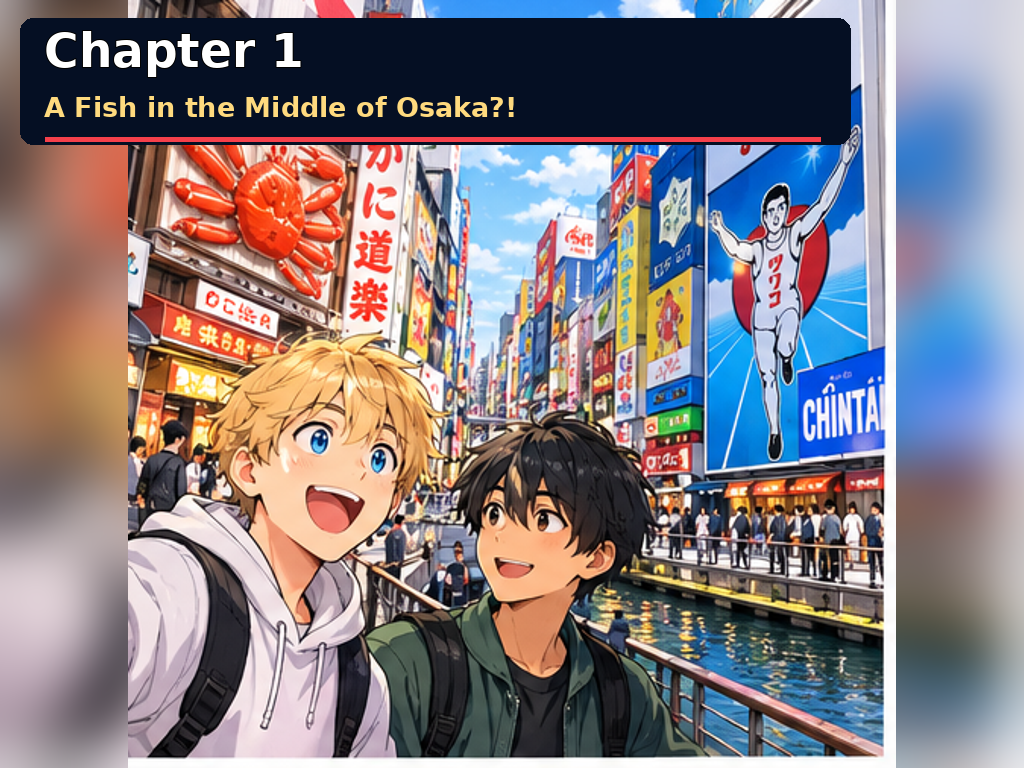
Alex in Japan — Episode 08
A Sweet Adventure in Osaka: Taiyaki, Takoyaki, and Two Very Different Tastes of Japan
- Chapter 1 — A Fish in the Middle of Osaka?!
- Chapter 2 — Red Beans or Custard?!
- Chapter 3 — Why a FISH?!
- Chapter 4 — HOT! HOT! HOT!
- Chapter 5 — Another Round, Different Shape!
- Chapter 6 — The Sweetest Fish in Osaka
- 1. What Is Taiyaki?
- 2. Why Is Taiyaki Shaped Like a Fish?
- 3. What Is Anko?
- 4. What Flavors of Taiyaki Can You Try?
- 5. What Makes Naruto Taiyaki Honpo Special?
- 6. What Is Takoyaki?
- Japanese Words to Remember
- Discover More of Osaka
- About Alex in Japan
Chapter 1 — A Fish in the Middle of Osaka?!
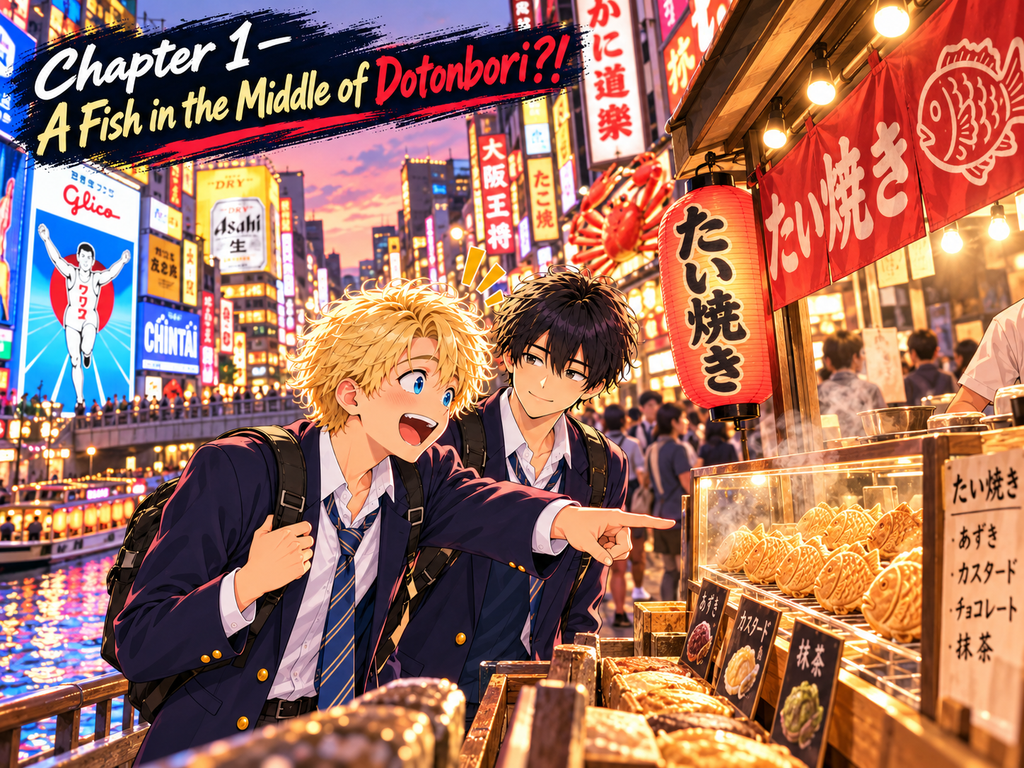
It was a sunny afternoon in Osaka.
Haru and I were walking through Namba toward the famous streets of Dotonbori.
Colorful signs were everywhere.
Giant advertisements hung above the shops.
Tourists were taking photographs.
And the smell of delicious food filled the air.
“HARU!”
Haru: “What?”
“I LOVE THIS PLACE!”
Haru smiled.
Haru: “You’ve said that three times already.”
“BECAUSE THERE’S FOOD EVERYWHERE!”
Haru: 「……やっぱり食べ物なんやな。」
(…Of course it’s about the food.)
We passed shops selling grilled snacks, sweets, and all kinds of Osaka specialties.
Then something caught my attention.
A shop was selling what looked like little golden fish.
I stopped walking.
“HARU…”
Haru: “What?”
I pointed at the display.
“WHY ARE THERE FISH IN A DESSERT SHOP?!”
Haru looked.
Then smiled.
Haru: “Oh. That’s taiyaki.”
“TAIYAKI?”
Haru: “Yeah. A traditional Japanese sweet.”
I stared at the golden fish.
“WAIT.”
Haru: “What?”
“IS IT MADE FROM FISH?!”
Haru shook his head.
Haru: “No.”
“DOES IT TASTE LIKE FISH?!”
Haru: “No.”
“THEN WHY DOES IT LOOK LIKE A FISH?!”
Haru laughed.
Haru: 「……まあ、気になるわな。」
(…Well, I can see why you’d wonder.)
He pointed toward the shop.
Haru: “Come on. Let’s get one.”
I grinned.
“FINALLY! A FISH I CAN EAT FOR DESSERT!”
Chapter 2 — Red Beans or Custard?!
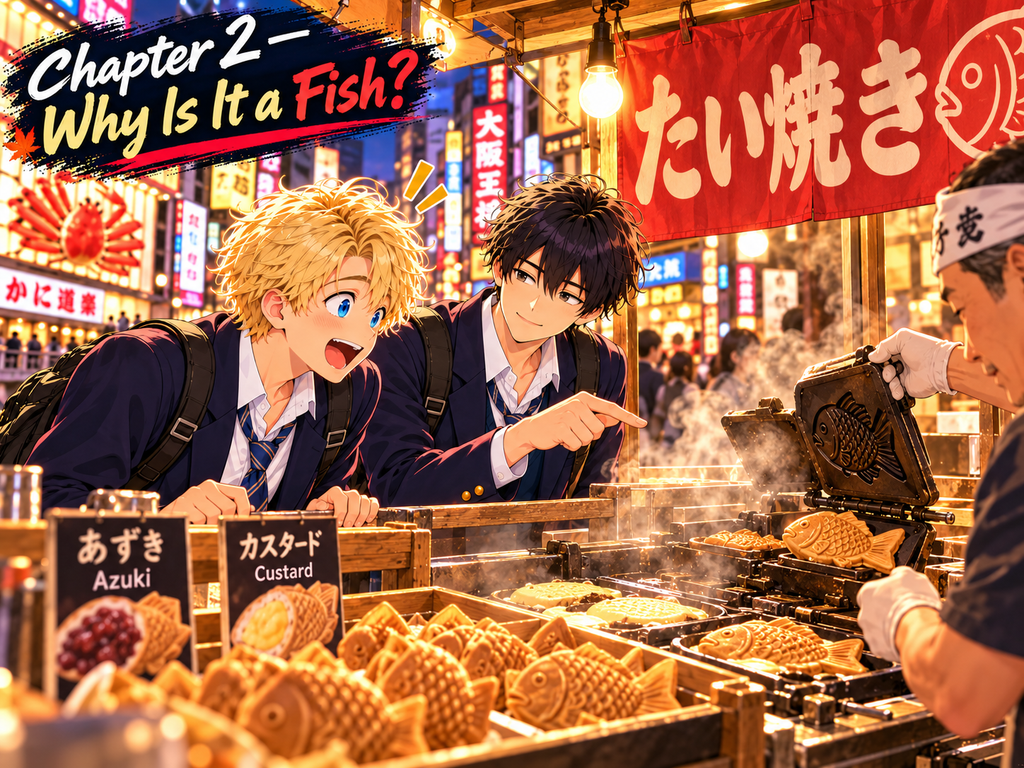
We stopped at a shop called Naruto Taiyaki Honpo.
I leaned toward the display.
Behind the counter, fish-shaped cakes were being prepared in special metal molds.
The smell was wonderful.
Warm batter.
Sweet fillings.
Freshly baked pastry.
“HARU!”
Haru: “What now?”
“THE FISH ARE COOKING!”
Haru: “They’re taiyaki.”
“THE TAIYAKI ARE COOKING!”
Haru laughed.
We looked at the menu.
There were several flavors.
Haru: “The traditional filling is anko.”
“ANKO?”
Haru: “Sweet red bean paste.”
I blinked.
“BEANS?”
Haru: “Yeah. Azuki beans cooked with sugar.”
I stared at him.
“BEANS ARE DESSERT?!”
Haru smiled.
Haru: “They can be. Anko is used in lots of Japanese sweets.”
I thought about that.
Back home, I’d usually eaten beans in savory dishes.
But sweet beans?
Inside a fish-shaped cake?
Japan had surprised me again.
“WHAT ELSE IS THERE?”
Haru pointed at another option.
Haru: “Custard cream.”
My eyes widened.
“CUSTARD?!”
Haru: “Yeah.”
“NOW THAT I UNDERSTAND!”
Haru laughed.
Haru: “There’s also a sweet potato filling made with Naruto Kintoki.”
I looked at the menu again.
“SO…”
Haru: “What?”
“THIS FISH CAN HAVE BEANS, CREAM, OR SWEET POTATO INSIDE?!”
Haru: “Exactly.”
I looked impressed.
“THAT’S A VERY TALENTED FISH!”
Haru: 「……魚ちゃうけどな。」
(…It’s not actually a fish, though.)
Haru chose the traditional red bean filling.
I chose custard.
Then we waited as the taiyaki were prepared.
I watched the metal molds.
“HEY, HARU.”
Haru: “Yeah?”
“WHY DO THEY MAKE THEM ONE AT A TIME?”
Haru: “This shop uses a traditional method called itchō-yaki.”
“ITCHŌ-YAKI?”
Haru: “Each taiyaki is baked individually in its own metal mold.”
I watched the shop staff work.
The molds were carefully handled over the heat.
The batter turned golden.
And the sweet smell grew stronger.
“WOW…”
I looked at Haru.
“SO EVERY FISH GETS PERSONAL ATTENTION?!”
Haru smiled.
Haru: 「……まあ、そういうことにしとこか。」
(…Well, let’s put it that way.)
Chapter 3 — Why a FISH?!
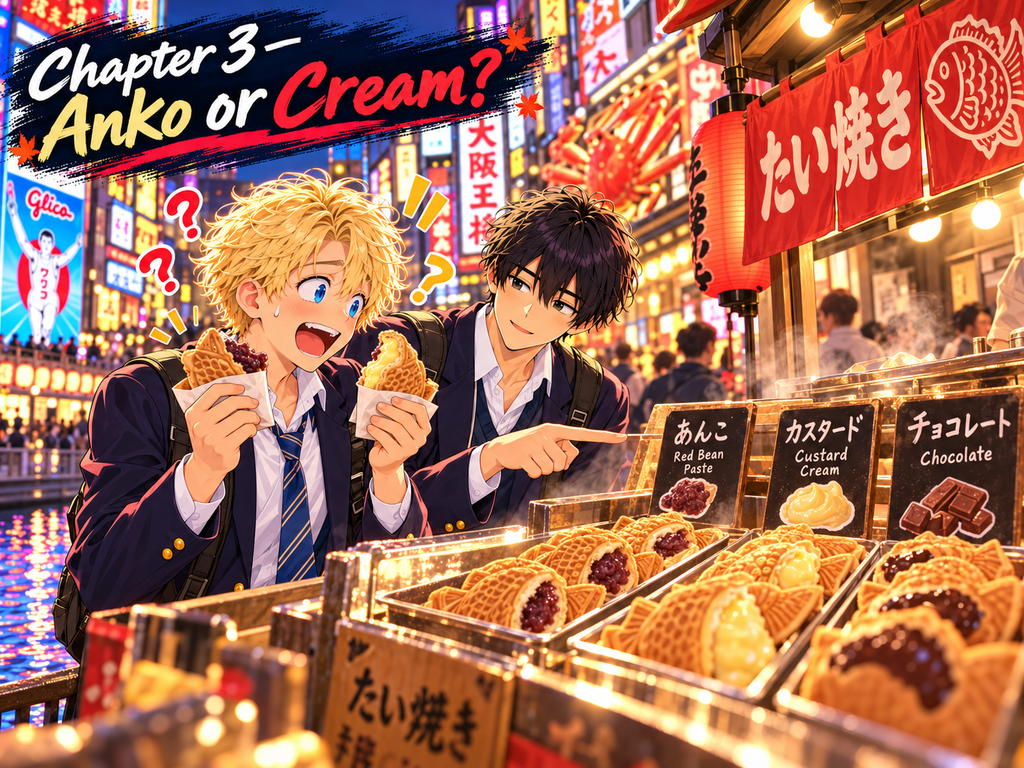
While we waited, I remembered my most important question.
“HEY, HARU!”
Haru: “What?”
“WHY A FISH?!”
Haru thought for a moment.
Haru: “The fish is called tai in Japanese. It’s sea bream.”
“SEA BREAM?”
Haru: “Yeah. It’s traditionally associated with good fortune and celebrations.”
I nodded.
“OKAY…”
Haru: “And there’s a wordplay connection.”
My eyes widened.
“JAPANESE WORDPLAY?!”
Haru smiled.
Haru: “The word medetai means something like ‘auspicious’ or ‘worth celebrating.’”
I repeated it carefully.
“ME-DE-TAI.”
Haru: “Right.”
“TAI…”
Haru: “Yeah.”
“MEDETAI…”
Haru: “Exactly.”
I gasped.
“THE FISH IS HIDING INSIDE THE WORD?!”
Haru burst out laughing.
Haru: 「……言い方おもろいな。」
(…That’s a funny way to put it.)
He explained that sea bream had long been associated with special occasions in Japan.
And that the fish-shaped sweet became popular in the early twentieth century.
Haru: “One famous story says the shape helped make an ordinary sweet feel special and lucky.”
I thought about it.
“A LUCKY FISH…”
Haru: “Kind of.”
“THAT YOU CAN EAT…”
Haru: “Yes.”
“FOR DESSERT!”
Haru nodded.
I crossed my arms.
“JAPAN HAS INVENTED THE PERFECT CELEBRATION.”
Haru: 「……大げさやなぁ。」
(…You’re exaggerating again.)
Then I smiled.
“WAIT. IF IT’S LUCKY, DOES THAT MEAN EATING TWO MAKES ME TWICE AS LUCKY?!”
Haru sighed.
Haru: 「……ただ二個食べたいだけやろ。」
(…You just want to eat two, don’t you?)
He knew me too well.
Chapter 4 — HOT! HOT! HOT!
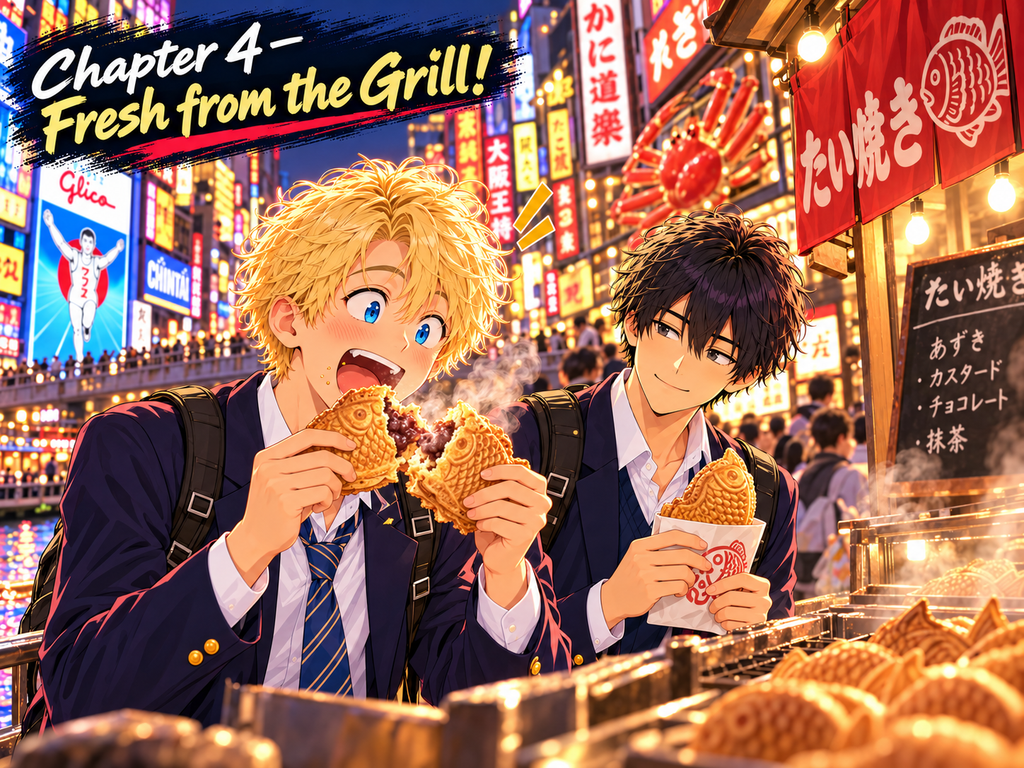
Finally, our taiyaki were ready.
The shop staff handed us two freshly baked treats.
Golden brown.
Beautifully shaped.
And wonderfully fragrant.
I held mine carefully.
“LOOK!”
Haru smiled.
Haru: “Looks good, right?”
“IT’S BEAUTIFUL!”
I examined the fish shape.
The head.
The fins.
The tail.
Every little detail was pressed into the crispy surface.
I grinned.
“HELLO, LITTLE FISH!”
Haru looked at me.
Haru: “Please don’t start talking to your food.”
I laughed.
Then took a bite.
“MM—!”
I immediately stopped.
The filling was hot!
“HOT! HOT! HOT!”
Haru stared at me.
Haru: “Alex! It’s freshly baked!”
“I NOTICED!”
Haru: 「……できたてやから気ぃつけなあかんって。」
(…You need to be careful. It’s freshly made.)
I waited a moment and blew gently on the taiyaki.
Then I tried again.
Crunch.
The outside was wonderfully crisp.
Inside was smooth, sweet custard cream.
My eyes widened.
“WHOA…”
Haru smiled.
Haru: “Good?”
I nodded enthusiastically.
“SO GOOD!”
Haru took a bite of his red bean taiyaki.
I watched him carefully.
“HOW’S THE BEAN FISH?”
Haru: “The anko taiyaki is great.”
“IS IT REALLY SWEET?”
Haru: “Sweet, but you can still taste the azuki beans.”
I looked curious.
“CAN I TRY A BITE?”
Haru held out a piece.
Haru: “Sure.”
I tasted it.
The filling was different from custard.
It had a soft texture and a gentle sweetness.
And there was a rich, comforting flavor I hadn’t expected.
“WAIT…”
Haru: “What?”
“BEANS CAN BE THIS GOOD?!”
Haru laughed.
Haru: 「……あんこ、見直したやろ?」
(…You’ve got a new appreciation for anko now, haven’t you?)
I nodded.
“DEFINITELY!”
I looked at my custard taiyaki.
Then at Haru’s red bean taiyaki.
“WE HAVE A PROBLEM.”
Haru: “What?”
“I CAN’T DECIDE WHICH ONE IS BETTER!”
Haru shrugged.
Haru: “You don’t have to.”
I paused.
Then smiled.
“YOU’RE RIGHT!”
I raised my taiyaki.
“THEY’RE BOTH WINNERS!”
Haru: 「……また勝手に大会始めてる。」
(…You’re starting another competition on your own.)
Chapter 5 — Another Round, Different Shape!
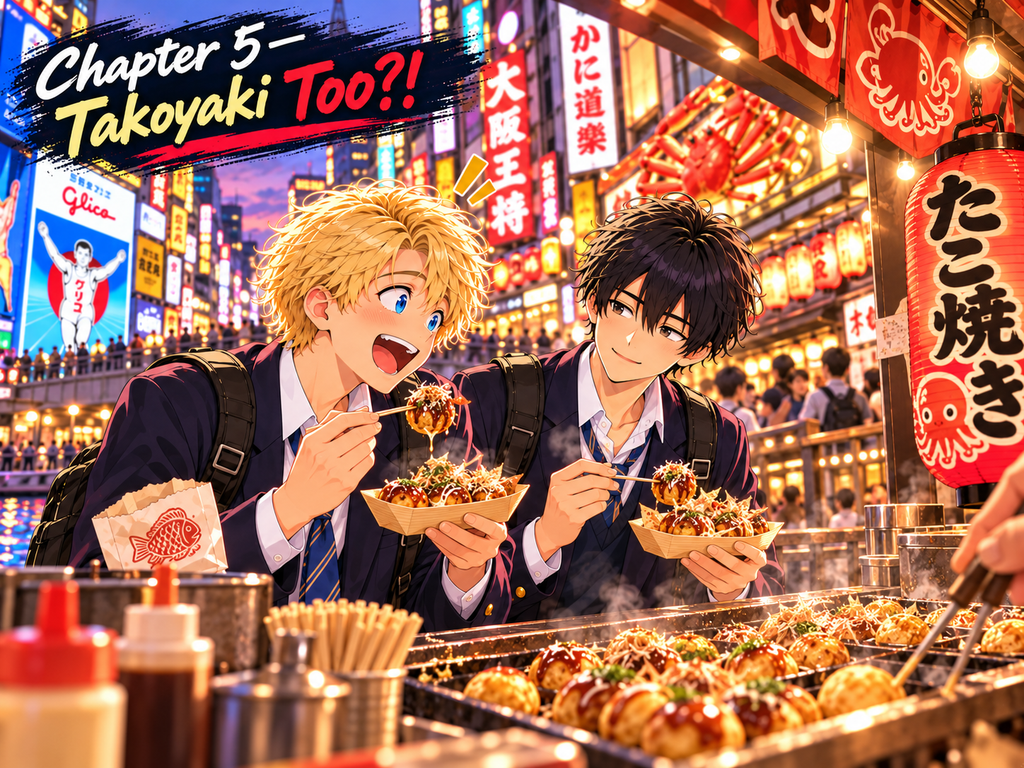
After finishing our taiyaki, we continued walking through Dotonbori.
The streets were crowded and lively.
People were taking pictures near the canal.
Huge restaurant signs towered above us.
And then…
I smelled something familiar.
“WAIT…”
Haru looked at me.
Haru: “What?”
“DO YOU SMELL THAT?!”
He smiled.
Haru: “Takoyaki.”
I stopped.
“TAKOYAKI?!”
Haru: “Yeah.”
I pointed toward a nearby food stall.
Golden balls were cooking in a special metal pan.
The staff moved them quickly, turning each one with a pick.
I watched in fascination.
“THEY’RE SPINNING!”
Haru laughed.
Haru: “That’s how they cook them evenly.”
I looked at the pan.
“WHY ARE THESE ROUND?”
Haru raised an eyebrow.
Haru: “What?”
“TAIYAKI LOOKS LIKE FISH…”
Haru: “Yeah?”
“AND TAKOYAKI LOOKS LIKE LITTLE BALLS!”
Haru nodded.
Haru: “Right.”
“DOES JAPANESE FOOD HAVE A SHAPE COMPETITION?!”
Haru sighed.
Haru: 「……何でも大会にすな。」
(…Stop turning everything into a competition.)
We ordered some takoyaki.
A little while later, the staff handed us a tray.
The takoyaki were covered with sauce and toppings.
Steam rose into the air.
I smiled.
“MY FAVORITE!”
Haru looked at me.
Haru: “Careful.”
“WHAT?”
Haru: “They’re hot.”
I nodded confidently.
“DON’T WORRY!”
Haru folded his arms.
Haru: “You said that about the taiyaki.”
I paused.
Then looked at the steaming takoyaki.
“…GOOD POINT.”
Haru laughed.
Haru: 「……ちょっとは学習したな。」
(…At least you’ve learned something.)
We waited for the takoyaki to cool.
Then I took a careful bite.
The outside was soft.
The inside was creamy and hot.
And there was a piece of octopus inside.
I grinned.
“DELICIOUS!”
Haru smiled.
Haru: “Now you understand why people love Osaka food.”
I looked at the takoyaki.
Then remembered the taiyaki.
“HEY, HARU.”
Haru: “What?”
“TAIYAKI AND TAKOYAKI SOUND ALMOST THE SAME!”
Haru nodded.
Haru: “They both end in yaki, meaning cooked or grilled.”
I pointed at the takoyaki.
“AND TAKO MEANS OCTOPUS?!”
Haru: “Exactly.”
Then I pointed back toward the taiyaki shop.
“AND TAI MEANS SEA BREAM!”
Haru smiled.
Haru: “You got it.”
I gasped.
“WAIT…”
Haru: “What now?”
“SO ONE HAS A FISH SHAPE BUT NO FISH…”
Haru: “Right.”
“AND THE OTHER HAS NO OCTOPUS SHAPE BUT ACTUALLY HAS OCTOPUS?!”
Haru froze.
Then burst out laughing.
Haru: 「……確かに、そう言われたらおもろいな!」
(…You know, that actually sounds funny when you put it that way!)
I raised both hands.
“JAPANESE FOOD IS FULL OF SURPRISES!”
Chapter 6 — The Sweetest Fish in Osaka
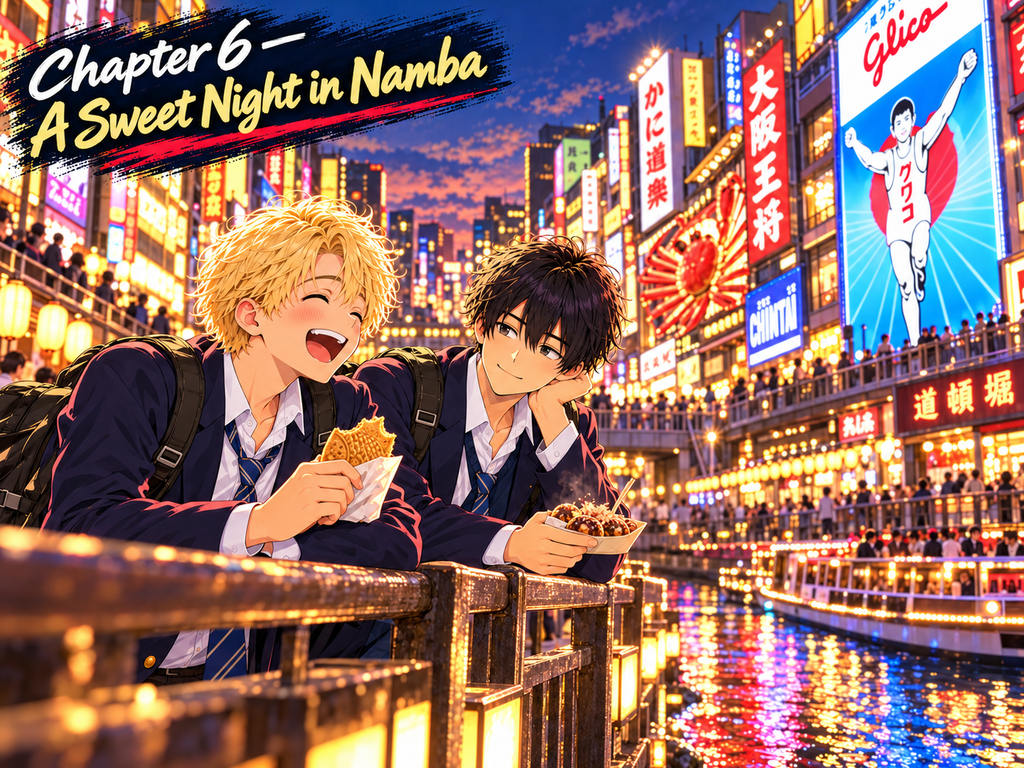
The afternoon was turning into evening.
Dotonbori’s lights were beginning to shine even brighter.
The canal reflected the colorful signs.
People hurried through the streets carrying shopping bags and food.
Haru and I stopped near the river.
I looked at the photographs on my phone.
A giant restaurant sign.
The crowded streets.
The taiyaki shop.
My first bite of hot custard.
And Haru laughing while holding his red bean taiyaki.
I smiled.
“HEY, HARU.”
Haru: “Yeah?”
“YOU KNOW WHAT I LEARNED TODAY?”
Haru sighed.
Haru: “What?”
“FIRST…”
I raised one finger.
“NOT EVERY FISH-SHAPED FOOD CONTAINS FISH!”
Haru laughed.
Haru: “True.”
“SECOND…”
Another finger.
“BEANS CAN BE DESSERT!”
Haru: “Also true.”
“THIRD…”
I raised a third finger.
“FRESHLY BAKED FOOD IS VERY, VERY HOT!”
Haru nodded seriously.
Haru: 「……それが一番大事かもしれんな。」
(…That might actually be the most important lesson.)
I grinned.
Then I looked down at the canal.
“You know, back home, I never imagined I’d be walking around Osaka eating lucky fish-shaped cakes.”
Haru smiled.
Haru: “And?”
I looked at him.
“AND I’M REALLY GLAD I DID.”
For a moment, Haru looked a little embarrassed.
Then he smiled.
Haru: 「……また美味しいもん探しに行こか。」
(…Let’s go find something else delicious sometime.)
I turned toward him.
“REALLY?!”
Haru: “Yeah.”
I raised my fist.
“OPERATION OSAKA FOOD ADVENTURE!”
Haru shook his head.
Haru: 「……また作戦名つけてる。」
(…There you go naming another operation.)
We started walking toward the station.
Then I stopped.
“HARU!”
Haru: “What now?”
“ONE LAST QUESTION!”
Haru sighed.
Haru: “Go ahead.”
“IF WE HAVE TAIYAKI AND TAKOYAKI…”
Haru: “Yeah?”
“IS THERE A SHARK-YAKI?!”
Haru stared at me.
Then started laughing.
Haru: 「……知らんけど、探してみたら?」
(…I don’t know, but why don’t you look for one?)
I grinned.
“CHALLENGE ACCEPTED!”
And just like that, another delicious adventure in Japan had begun.
Alex’s Discovery — Taiyaki and Takoyaki in Osaka
1. What Is Taiyaki?
Taiyaki (たい焼き) is a Japanese fish-shaped baked sweet.
It is traditionally made by pouring batter into a special mold and adding a sweet filling.
Although it looks like a fish, ordinary taiyaki doesn’t contain fish.
2. Why Is Taiyaki Shaped Like a Fish?
The shape represents tai, or sea bream.
In Japanese culture, sea bream is associated with celebrations and good fortune.
One reason is the similarity between tai and the Japanese word medetai, meaning auspicious or worthy of celebration.
Taiyaki became popular in the early twentieth century, with its fish shape turning an everyday sweet into something distinctive.
3. What Is Anko?
Anko (あんこ) is sweet bean paste, commonly made from azuki beans and sugar.
It is used in many Japanese sweets, including taiyaki, dorayaki, and mochi.
There are different textures, including:
- Tsubuan: Sweet bean paste with pieces of beans.
- Koshian: Smooth, strained sweet bean paste.
4. What Flavors of Taiyaki Can You Try?
Common varieties include:
- Sweet red bean paste
- Custard cream
- Sweet potato
Other shops may offer additional flavors or seasonal variations.
5. What Makes Naruto Taiyaki Honpo Special?
Naruto Taiyaki Honpo is known for its traditional itchō-yaki method.
Each taiyaki is prepared individually using a dedicated metal mold.
The shop emphasizes crisp pastry and fillings such as Tokachi azuki red bean paste, premium custard, and Naruto Kintoki sweet potato.
Official website: Naruto Taiyaki Honpo
6. What Is Takoyaki?
Takoyaki (たこ焼き) is one of Osaka’s best-known foods.
It is made by cooking batter with pieces of octopus in a special pan containing round molds.
Takoyaki is commonly served with sauce and toppings such as mayonnaise, dried bonito flakes, and seaweed powder.
The name combines tako (octopus) and yaki (cooked or grilled).
Because the inside can remain extremely hot, let freshly cooked takoyaki cool before eating.
Japanese Words to Remember
| Japanese | Meaning |
|---|---|
| たい焼き (Taiyaki) | Fish-shaped Japanese sweet |
| 鯛 (Tai) | Sea bream |
| めでたい (Medetai) | Auspicious / celebratory |
| あんこ (Anko) | Sweet bean paste |
| 小豆 (Azuki) | Red beans used in Japanese sweets |
| カスタード (Kasutādo) | Custard |
| 一丁焼き (Itchō-yaki) | Individual-mold baking method |
| たこ焼き (Takoyaki) | Osaka-style octopus-filled balls |
| たこ (Tako) | Octopus |
| 焼きたて (Yakitate) | Freshly baked or cooked |
| 食べ歩き (Tabearuki) | Exploring places by trying foods along the way |
Discover More of Osaka
Namba and Dotonbori are wonderful places to explore Osaka’s lively food culture.
From sweet taiyaki to savory takoyaki, even a short stroll can turn into a delicious cultural adventure.
When eating in busy areas, follow local signs and shop guidance about where food may be consumed, and dispose of packaging responsibly.
About Alex in Japan
Alex in Japan is an original illustrated fiction series about Alex, a 16-year-old American student discovering everyday Japanese culture in Osaka alongside his Japanese classmate Haru.
Through funny misunderstandings, local food, school traditions, and unexpected adventures, Alex slowly discovers what makes his new home special.
Read more stories and illustrations:
Alex in Japan — Official Story Archive
Alex in Japan — Episode 08: The End
One fish-shaped cake. Two very different fillings. And a friendship made sweeter by every new discovery.
Two cultures. One unforgettable friendship. A new discovery every day.