Alex in Japan — Episode 06
Piano Lessons, Cram School, and the Mystery of the Abacus
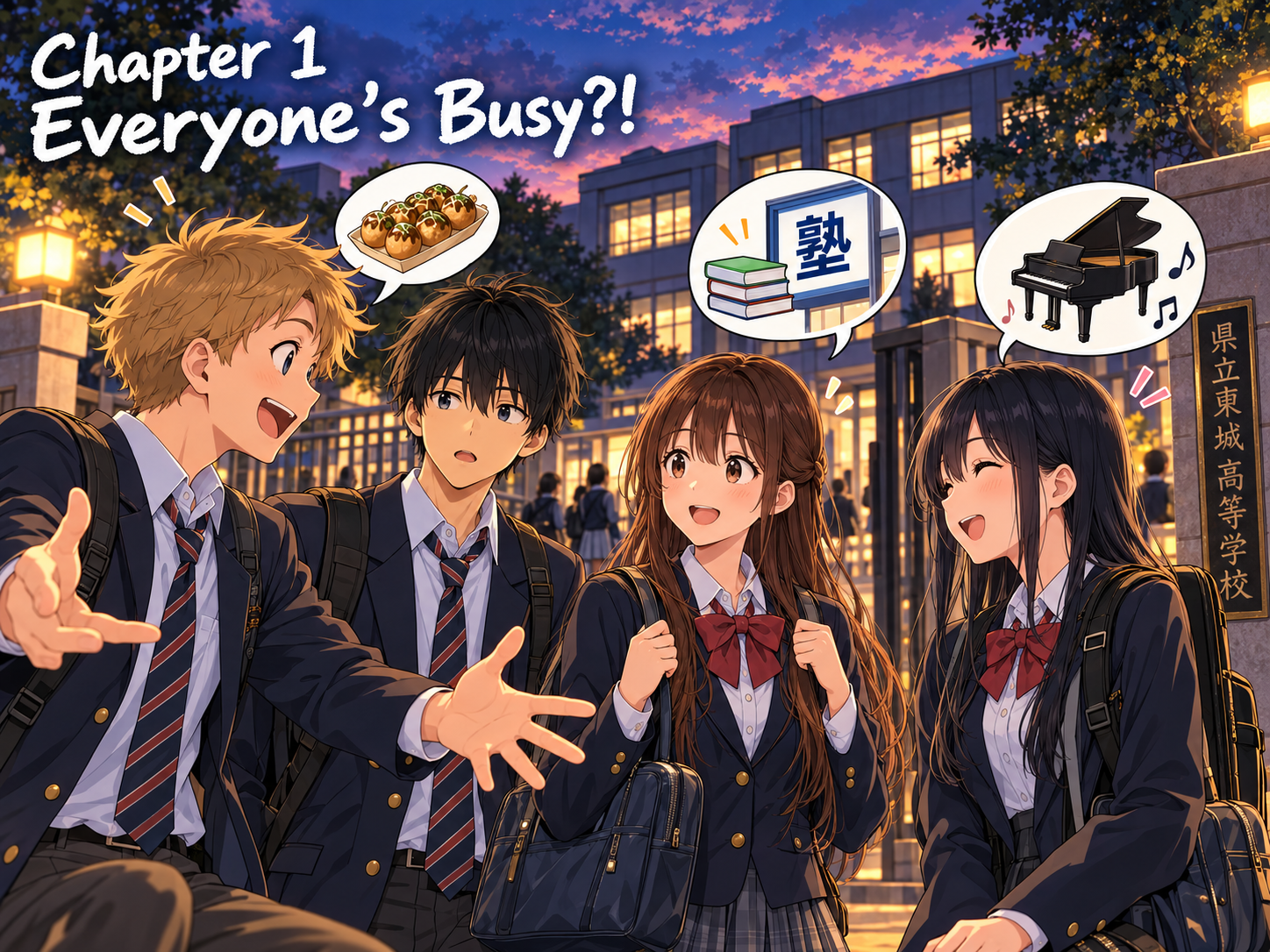
Chapter 1 — Everyone’s Busy?!
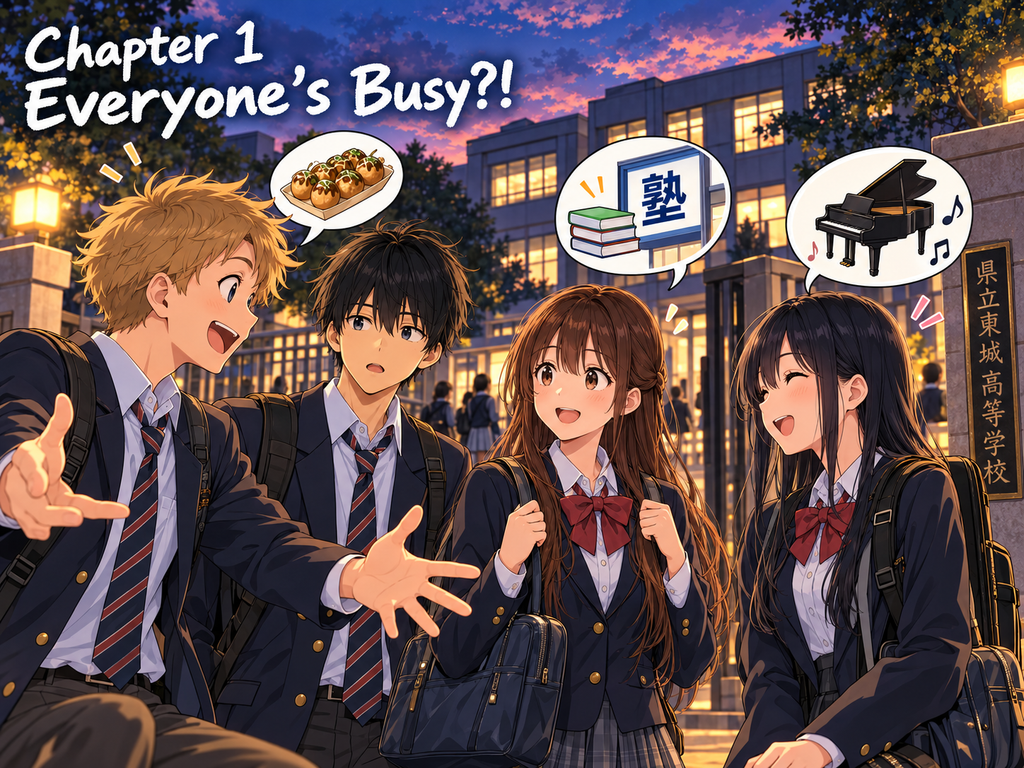
7:00 PM.
Finally.
After a long day of classes and after-school activities, I was standing outside the school gate.
The sky was turning dark.
Streetlights were beginning to glow.
And I had one very important thing on my mind.
“TAKOYAKI!”
Haru, standing beside me, sighed.
Haru: “Alex, you just said that out of nowhere.”
“I’M HUNGRY!”
Haru: “I noticed.”
I spotted two familiar faces near the gate.
Mio and Saki!
Both were still wearing their school uniforms.
“HEY! MIO! SAKI!”
They turned around.
Mio: “Alex! Hi!”
Saki: “What’s up?”
I grinned.
“PERFECT TIMING!”
Haru looked suspicious.
Haru: “For what?”
“LET’S ALL GO GET TAKOYAKI!”
Mio smiled apologetically.
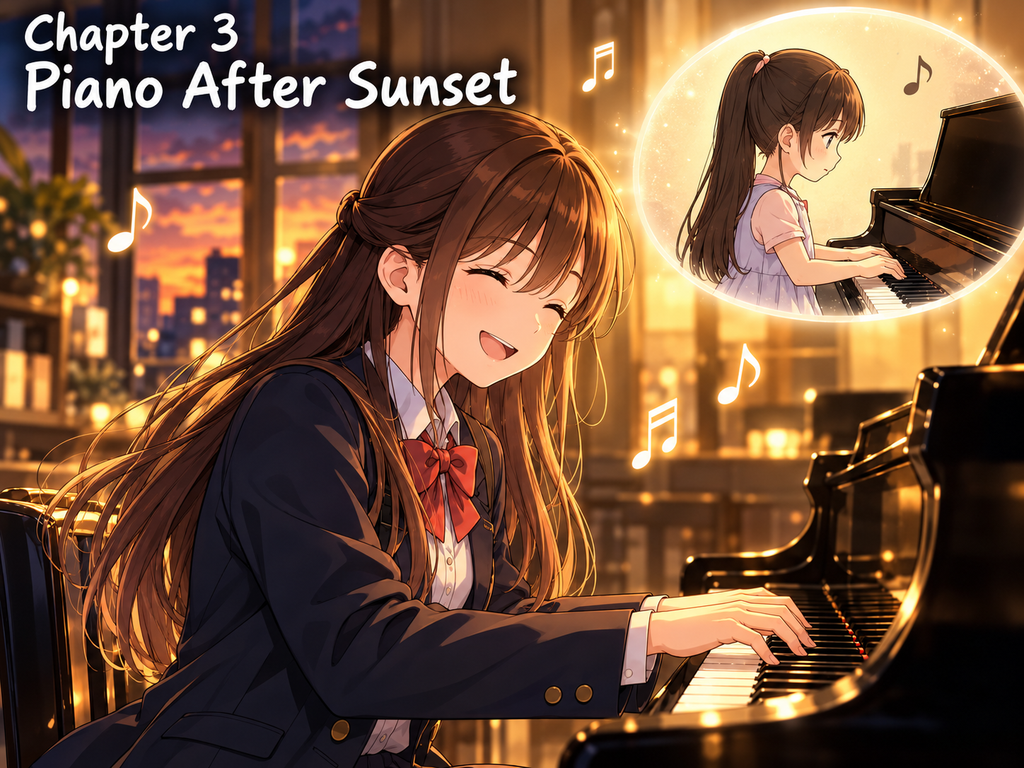
Mio: “Sorry, Alex. I have a piano lesson tonight.”
I blinked.
“A PIANO LESSON?”
Mio: “Yeah. I’ve been taking lessons since I was little.”
I looked at the sky.
Then at my watch.
Then back at Mio.
“BUT IT’S SEVEN O’CLOCK!”
Mio: “I know.”
“AT NIGHT!”
Mio laughed.
Mio: “My lesson starts later this evening.”
I turned toward Saki.
“SAKI! YOU’RE FREE, RIGHT?!”
Saki shook her head.
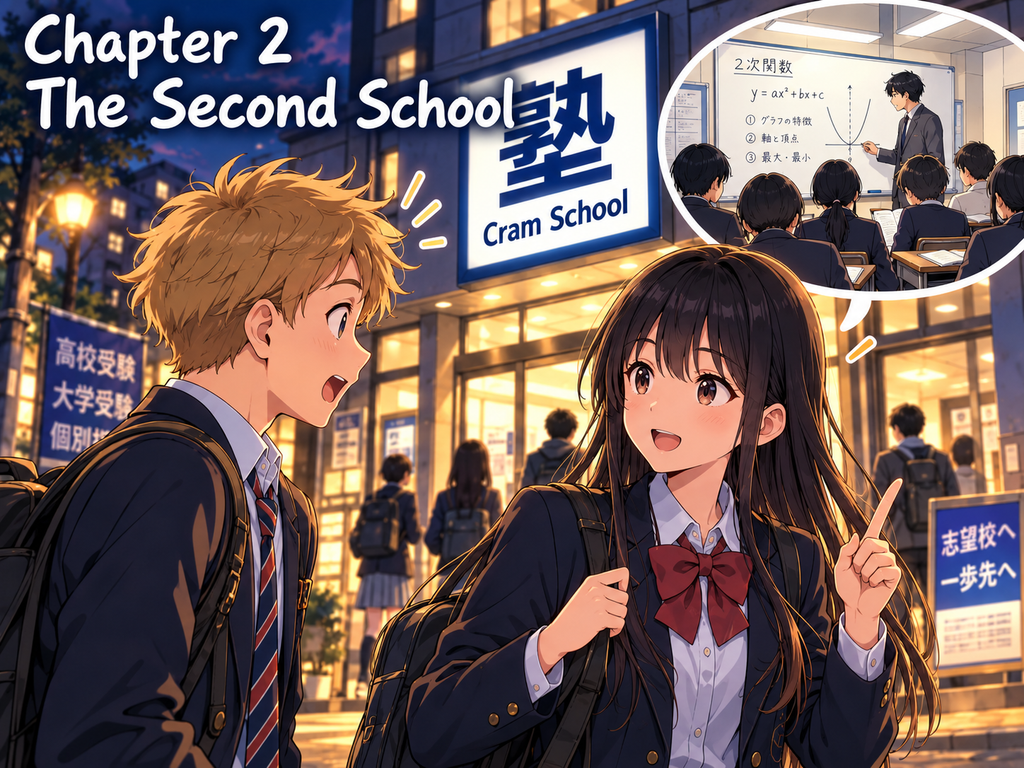
Saki: “Sorry! I have juku.”
I stopped.
“JUKU?”
Saki: “Cram school.”
I stared at her.
“CRAM SCHOOL?”
Saki: “It’s where I take extra lessons after school.”
I slowly turned toward Haru.
“WAIT.”
Haru: “What?”
“SCHOOL JUST ENDED.”
Haru: “Yes.”
“AND NOW SAKI IS GOING TO ANOTHER SCHOOL?!”
Haru nodded.
Haru: “Well, it’s not exactly the same as regular school.”
I put both hands on my head.
“JAPAN HAS SCHOOL SEQUELS?!”
Haru closed his eyes.
Haru: 「……映画みたいに言うな。」
(…Stop talking about it like it’s a movie.)
Mio and Saki burst out laughing.
Then I turned back to Saki.
“WAIT! WHAT TIME DOES YOUR CRAM SCHOOL FINISH?”
Saki: “Around ten.”
I smiled.
“Oh! Ten in the morning?”
Everyone stared at me.
Haru spoke quietly.
Haru: “Alex.”
“Yes?”
Haru: “Ten at night.”
Silence.
I looked at Saki.
Then Haru.
Then Saki again.
“TEN?!”
Saki nodded.
“10 PM?!”
She nodded again.
I raised both arms.
“YOU’RE GOING TO STUDY UNTIL TEN O’CLOCK AT NIGHT?!”
Haru sighed.
Haru: 「……夜の七時やで。もうちょい静かにして。」
(…It’s seven in the evening. Could you be a little quieter?)
I looked at my three friends.
Mio had piano.
Saki had cram school.
And Haru was standing there looking completely unsurprised.
Apparently, I was the only person who thought this was unusual.
“Does anyone in Japan ever go home?!”
Haru shook his head.
Haru: 「……普通に帰る人もおるわ。」
(…Of course some people just go home.)
I sighed dramatically.
“AND HERE I WAS, DREAMING OF TAKOYAKI.”
Chapter 2 — The Second School
Saki checked the time on her phone.
Saki: “I should get going soon.”
“WAIT!”
She looked up.
Saki: “What?”
“I HAVE QUESTIONS!”
Haru muttered something under his breath.
Haru: 「……質問攻め始まったな。」
(…Here comes the interrogation.)
I turned toward Saki.
“So what do you do at juku?”
Saki: “Study.”
I stared at her.
“THANK YOU, THAT WAS VERY INFORMATIVE.”
Saki laughed.
Saki: “Okay, okay. We review school subjects and work on problems that prepare us for exams.”
“Like tutoring?”
Saki: “Kind of. There are different types of juku.”
Haru joined the conversation.
Haru: “Some have small-group lessons. Others have larger classes or one-on-one teaching.”
Saki nodded.
Saki: “The place I go to has evening classes. I usually study English and math there.”
“MORE MATH?!”
Haru looked at me.
Haru: “You survived two math classes yesterday.”
“BARELY!”
Saki: “I actually like solving math problems.”
I stared at her.
“YOU LIKE EXTRA MATH?”
Saki: “When I finally understand something difficult? Yeah.”
I thought about the probability problem I’d solved with Mio at school.
The dice.
The thirty-six possible outcomes.
And that wonderful moment when the answer finally made sense.
“Okay,” I admitted. “I kind of understand that.”
Saki smiled.
Saki: “And I want to keep my options open for university.”
I tilted my head.
“So you’re studying for your future?”
Saki: “That’s one reason.”
“Even if it means getting home late?”
Saki: “Sometimes. But not every day.”
Haru added:
Haru: “And plenty of students don’t go to cram school at all.”
I nodded.
“So it’s a choice.”
Saki: “For me, yes. My family and I decided it would help.”
I looked down the street.
Cars passed.
Bicycles rolled by.
Shop signs glowed under the evening sky.
All around us, the city was getting ready for the night.
But Saki was getting ready to study.
“Wow.”
For once, I said it quietly.
Then I looked at her.
“HEY, SAKI!”
Saki: “Yeah?”
“GOOD LUCK!”
Saki smiled.
Saki: “Thanks!”
I raised my fist.
“DEFEAT THOSE MATH PROBLEMS!”
She laughed and returned the gesture.
Saki: “I’ll try!”
As she started walking toward the station, I shouted one final message.
“AND DON’T FORGET TO SLEEP!”
Haru sighed.
Haru: 「……お前も早よ寝なあかんで。」
(…You need to go to bed early too.)
I looked at him.
“WHY DOES EVERYONE KEEP TELLING ME THAT?!”
Chapter 3 — Piano After Sunset
Mio adjusted the strap of her bag.
Mio: “I should go too.”
I turned toward her.
“WAIT! ONE MORE QUESTION!”
Haru looked at the sky.
Haru: 「……まだ続くんか。」
(…He’s still going?)
I pointed at Mio.
“You’ve been learning piano since you were little?”
Mio: “Yeah.”
“For how long?”
Mio: “Since elementary school.”
My eyes widened.
“THAT’S YEARS!”
Mio laughed.
Mio: “Well, yes.”
“CAN YOU PLAY REALLY DIFFICULT SONGS?!”
Mio: “Some. But I still have plenty to learn.”
I thought about that.
“Isn’t it tiring? School, club activities, and then piano?”
Mio considered the question.
Mio: “Sometimes it is.”
“THEN WHY KEEP DOING IT?”
She smiled.
Mio: “Because I like it.”
I blinked.
“That’s it?”
Mio: “Isn’t that a good enough reason?”
I paused.
Then grinned.
“ACTUALLY, THAT’S A GREAT REASON!”
Mio laughed.
She told us she liked practicing songs that seemed impossible at first.
The first time she tried, she might make mistakes.
Then she would practice.
Little by little.
Until one day, she could play the whole piece.
Mio: “That feeling is really nice.”
I nodded.
“So it’s like learning a new language.”
Mio: “Maybe!”
“OR FINALLY UNDERSTANDING JAPANESE MATH!”
Haru crossed his arms.
Haru: “You understood the math. It was the course names that confused you.”
“EXACTLY!”
Mio smiled again.
Mio: “Do people take piano lessons in America too?”
“Of course! Music lessons, sports, dance, all kinds of things.”
Mio: “So that’s not so different.”
I thought for a moment.
“Yeah. I guess what surprised me was how late your lesson is.”
Mio nodded.
Mio: “My schedule isn’t the same every day. Today just happens to be a busy one.”
I smiled.
“That makes sense.”
Then a wonderful idea entered my mind.
“HEY!”
Haru immediately looked worried.
Haru: “What?”
“WHAT IF WE START A BAND?!”
Mio laughed.
Mio: “A band?”
“MIO ON PIANO!”
I pointed at Haru.
“HARU ON GUITAR!”
Haru: “I don’t play guitar.”
“THEN YOU CAN TAKE PHOTOS OF THE BAND!”
Haru: “That’s not a band member.”
I pointed at myself.
“AND I’LL BE THE LEAD SINGER!”
Haru winced.
Haru: 「……それが一番心配やわ。」
(…That’s the part I’m most worried about.)
Mio burst out laughing.
She checked the time again.
Mio: “I’d better go before I’m late.”
“GOOD LUCK WITH PIANO!”
Mio: “Thanks, Alex!”
She waved and headed down the street.
I waved back.
And then, suddenly, it was just Haru and me.
The busy school gate had grown quiet.
I looked around.
“Saki’s going to cram school.”
Haru: “Yeah.”
“Mio’s going to piano.”
Haru: “Yeah.”
I looked at him.
“SO…”
Haru sighed.
Haru: “So?”
“ARE YOU GOING TO A SECRET THIRD SCHOOL?!”
Haru: 「……そんなもんないわ。」
(…There’s no such thing.)
Chapter 4 — The Boy Who Used an Abacus
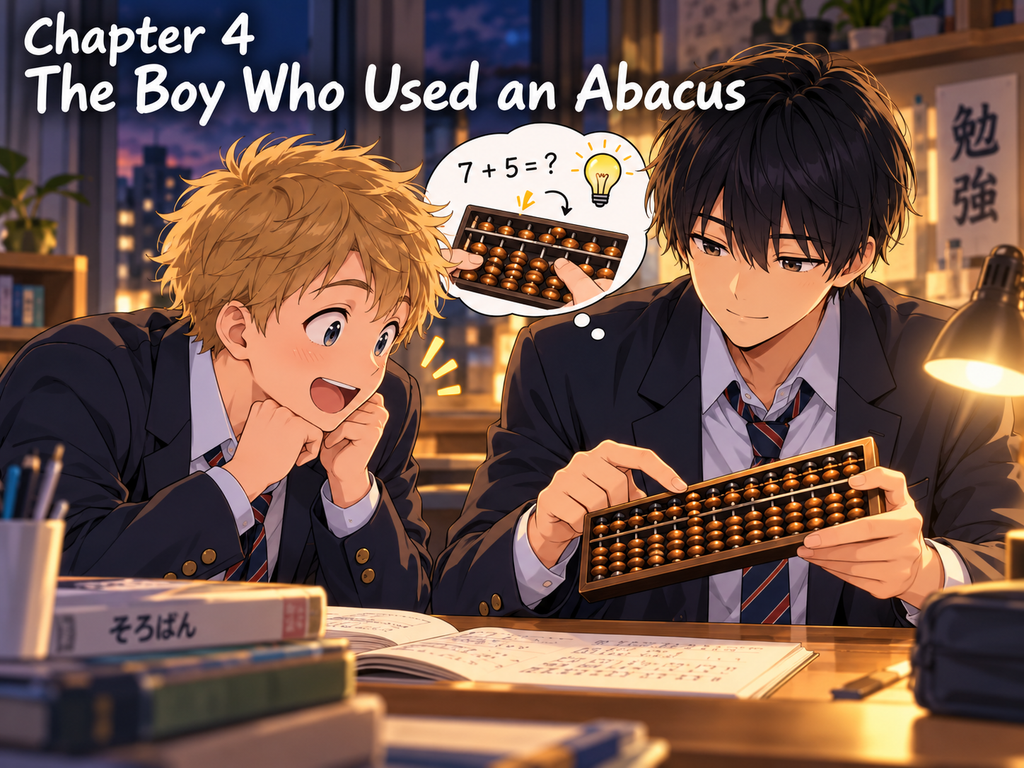
Haru and I began walking toward the station.
The evening air was cool.
Streetlights reflected on the pavement.
A train rumbled in the distance.
For a while, we walked quietly.
Then I asked:
“Hey, Haru?”
Haru: “Yeah?”
“Did you go to cram school when you were little?”
Haru shook his head.
Haru: “Not when I was really young.”
“So what did you do after school?”
He thought for a moment.
Haru: “I used to take soroban lessons.”
I stopped walking.
“SOROBAN?”
Haru: “Yeah.”
I looked at him.
“IS THAT A PERSON?”
Haru stared at me.
Haru: “No.”
“A PLACE?”
Haru: “No.”
“A SECRET JAPANESE MARTIAL ART?!”
Haru sighed.
Haru: 「……なんでそうなるねん。」
(…How did you even come to that conclusion?)
He took out his phone and showed me a picture.
It looked like a wooden frame filled with little beads.
I leaned closer.
“WAIT.”
Haru: “What?”
“IS THAT AN ABACUS?!”
Haru: “Exactly. In Japan, we call it a soroban.”
I studied the picture.
Rows of beads.
Thin rods.
A rectangular frame.
“So what do you do with it?”
Haru: “You move the beads to represent numbers and calculate.”
I blinked.
“WITHOUT A SCREEN?”
Haru: “Yes.”
“WITHOUT BATTERIES?”
Haru: “Yes.”
“WITHOUT EVEN A CHARGING CABLE?!”
Haru looked at me.
Haru: 「……電卓ちゃうねんから。」
(…Because it isn’t an electronic calculator.)
I stared at the picture again.
“THIS IS AMAZING!”
Haru smiled.
Haru: “It’s an old calculating tool, but people still learn how to use it.”
He explained that he had gone to soroban lessons in elementary school.
At first, he had practiced simple addition and subtraction.
Later, he learned faster calculations and more difficult exercises.
Haru: “Some people who practice a lot can even calculate using a mental image of the soroban.”
My eyes widened.
“WAIT.”
Haru: “What?”
“YOU CAN USE AN INVISIBLE ABACUS?!”
Haru laughed.
Haru: “It’s a mental calculation technique.”
I slowly raised both hands.
“JAPAN HAS INVISIBLE MATH MACHINES?!”
Haru shook his head.
Haru: 「……説明するん疲れるわ。」
(…Explaining things to you is exhausting.)
Then I remembered something important.
My calculator.
The loyal friend who had been forbidden from helping me during yesterday’s math lesson.
I looked at Haru.
“SO…”
Haru: “What?”
“THE SOROBAN IS LIKE MY CALCULATOR’S ANCIENT ANCESTOR!”
Haru stopped walking.
Haru: 「……電卓の先祖扱いすな。」
(…Don’t call it your calculator’s ancestor.)
“But they both help people calculate!”
Haru: “True. But they work differently.”
I nodded seriously.
“RIGHT.”
Then I pointed at him.
“CAN YOU STILL USE ONE?”
Haru hesitated.
Haru: “A little. I’m probably rusty.”
I grinned.
“THEN WE NEED A SOROBAN CHALLENGE!”
Haru: “No.”
“ALEX VERSUS HARU!”
Haru: “No.”
“MODERN TECHNOLOGY VERSUS ANCIENT WISDOM!”
Haru: 「……勝手に大会始めんな。」
(…Stop starting competitions on your own.)
I laughed.
But something about the story stayed with me.
Haru had learned to calculate by moving tiny beads.
I’d grown used to pressing buttons on a calculator.
Different tools.
Different experiences.
But the numbers were the same.
“That’s pretty cool,” I said.
Haru glanced at me.
Haru: “What is?”
“That you learned something so different when you were little.”
Haru smiled.
Haru: 「……まあ、ええ思い出やな。」
(…Yeah, those are good memories.)
Chapter 5 — Haru’s Secret Schedule
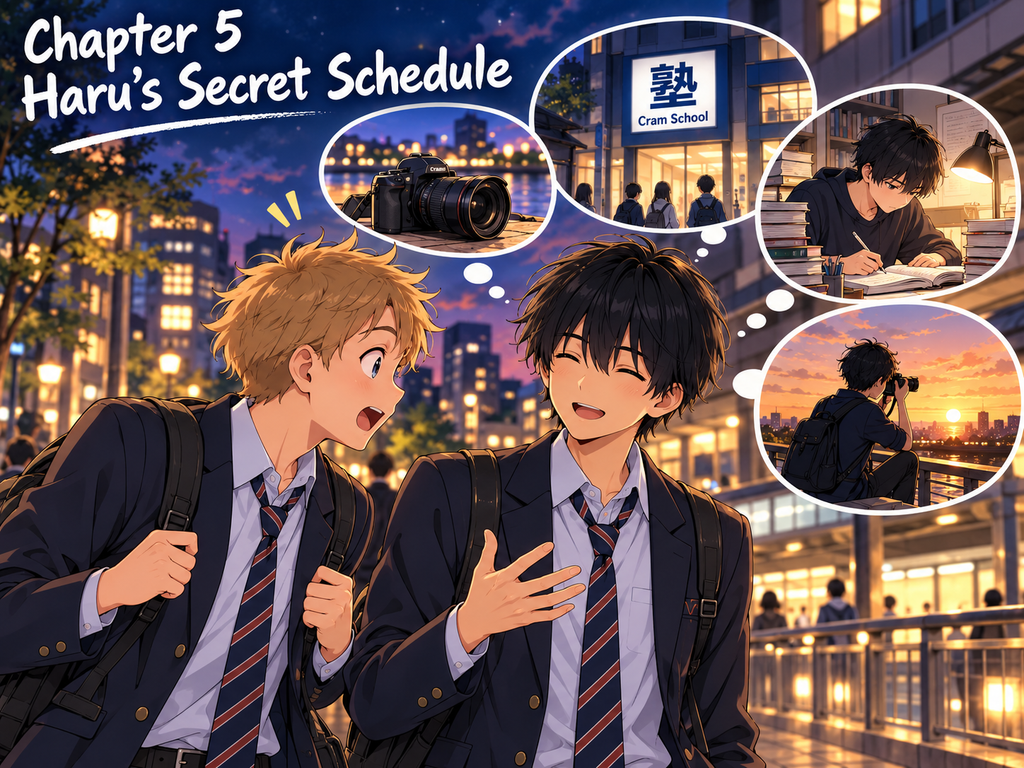
We continued toward the station.
By now, the sky was completely dark.
I looked at Haru.
“Hey.”
Haru: “Yeah?”
“You don’t go to cram school?”
Haru shook his head.
Haru: “I do.”
I stopped.
“WHAT?!”
Haru: “A couple of evenings a week.”
I stared at him.
“YOU TOO?!”
Haru: “Yeah. Just not tonight.”
I looked at the sky.
Then at Haru.
Then at the sky again.
“DO ALL MY FRIENDS HAVE SECRET SECOND LIVES?!”
Haru laughed.
Haru: 「……塾行くだけで大げさすぎやろ。」
(…You’re being way too dramatic about going to cram school.)
I thought about it.
Haru had regular classes.
Photography club.
Homework.
And cram school on certain evenings.
“Isn’t that exhausting?”
Haru considered the question.
Haru: “Sometimes.”
“Then why do you do it?”
Haru: “I want to keep up with my studies. And I’m starting to think more seriously about what I want to do after high school.”
I looked at him.
“What do you want to do?”
Haru hesitated.
Haru: “I’m not completely sure yet.”
“Really?”
Haru: “Yeah. I like photography, but I also want to explore other things.”
I nodded.
“That makes sense.”
We walked quietly for a moment.
Then I spoke again.
“You know, at my old school, some of my friends had packed schedules too.”
Haru: “Sports?”
“Yeah. Sports, music lessons, tutoring, part-time activities…”
Haru nodded.
Haru: “So it’s not completely different.”
“No.”
I thought for a moment.
“But I wasn’t expecting everyone I asked tonight to be busy.”
Haru smiled.
Haru: “That’s because you invited everyone at the last minute.”
I froze.
“WAIT.”
Haru: “What?”
“ARE YOU SAYING THIS IS MY FAULT?!”
Haru: 「……予定聞いてへんかっただけやろ。」
(…You just didn’t ask about their schedules beforehand.)
I opened my mouth.
Then closed it.
He had a point.
An annoyingly good point.
I sighed.
“Fine.”
Haru looked surprised.
Haru: “Fine?”
“NEXT TIME, I’LL MAKE A PLAN!”
Haru: “That would help.”
I pulled out my phone.
“OPERATION TAKOYAKI!”
Haru sighed.
Haru: 「……名前つける必要ある?」
(…Do you really need to give it a name?)
“EVERY GREAT OPERATION NEEDS A NAME!”
Haru shook his head.
But he was laughing.
Then I asked something that had been bothering me.
“Do you ever get time to just relax?”
Haru thought about it.
Haru: “Of course. I take photos, read, listen to music, and spend time with my family.”
“Even with school and cram school?”
Haru: “I try to make time.”
I nodded.
“That sounds important.”
Haru looked at me.
Haru: “It is.”
For the first time that evening, I realized something.
Mio wasn’t practicing piano because she had to fill every minute of her day.
She loved music.
Saki had decided that extra study would help her prepare for the future.
And Haru was balancing his studies with something he genuinely enjoyed.
They were all busy.
But they weren’t busy for exactly the same reasons.
I smiled.
“Everyone has their own thing, huh?”
Haru nodded.
Haru: “Exactly.”
I thought for a moment.
“MY THING IS TAKOYAKI.”
Haru looked at me.
Haru: 「……それは趣味なんか?」
(…Does that even count as a hobby?)
“IT DOES NOW!”
Chapter 6 — A Day Just for Us
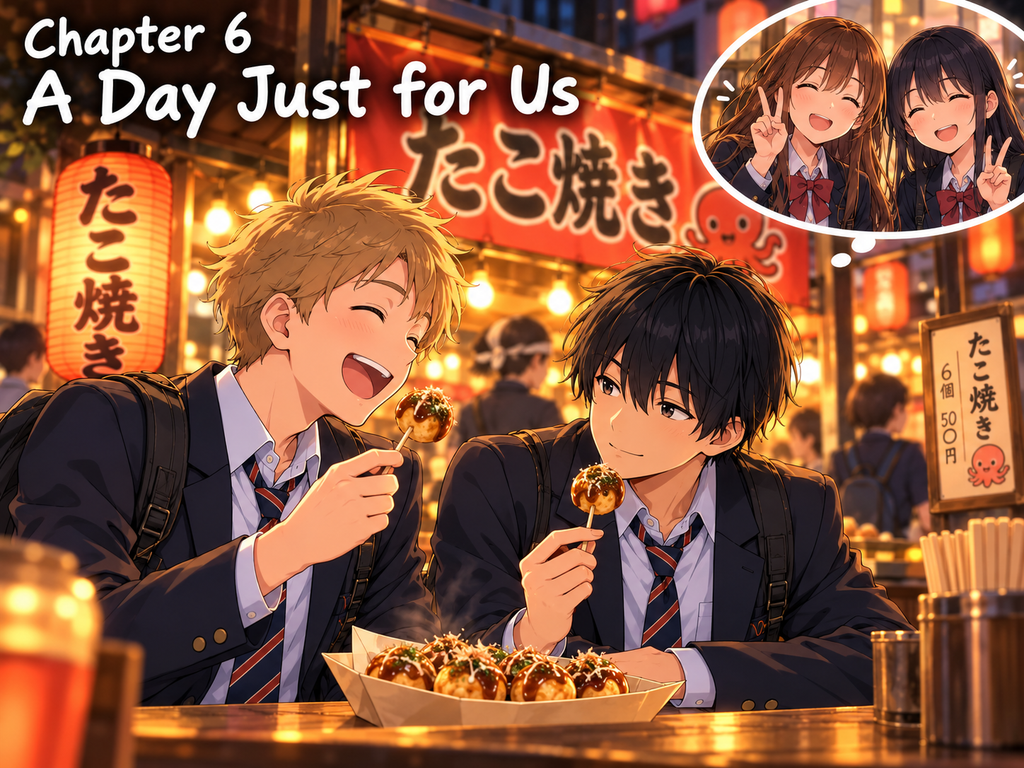
We were almost at the station when I stopped in front of a small takoyaki shop.
Warm light spilled onto the sidewalk.
The smell was incredible.
Golden takoyaki sat in neat rows behind the counter.
I stared.
Haru kept walking.
I stared harder.
“HARU…”
He stopped.
Haru: “What?”
I pointed.
“LOOK.”
Haru glanced at the shop.
Haru: “Takoyaki.”
“BEAUTIFUL TAKOYAKI.”
Haru: “Alex…”
“LONELY TAKOYAKI.”
Haru: “They’re not lonely.”
“THEY NEED US!”
Haru sighed.
Haru: 「……もう好きにしたらええわ。」
(…Just do whatever you want.)
I smiled.
“IS THAT A YES?!”
Haru looked at the time.
He considered it.
Then smiled.
Haru: “I don’t have cram school tonight. We can stop for a little while.”
I gasped.
“REALLY?!”
Haru: “Just a quick stop.”
I raised both arms.
“VICTORY!”
Haru pointed at me.
Haru: “And don’t shout in front of the shop.”
I lowered my arms.
“…Quiet victory.”
We bought a small portion of takoyaki.
Then sat on a nearby bench.
I blew carefully on one piece.
Very carefully.
After the last festival, I’d learned an important lesson about the temperature of takoyaki.
“HOT FOOD IS DANGEROUS,” I muttered.
Haru laughed.
Haru: 「……ちゃんと学習してるやん。」
(…Look at you, actually learning something.)
I finally took a bite.
Delicious.
Absolutely delicious.
For a moment, neither of us spoke.
Cars passed.
A bicycle bell rang.
The lights of Osaka glowed around us.
Then I looked at Haru.
“Hey.”
Haru: “Yeah?”
“I think I understand something now.”
Haru raised an eyebrow.
Haru: “That’s new.”
“HEY!”
He smiled.
I continued.
“At first, I thought it was strange that everyone was going somewhere else after school.”
Haru: “Yeah.”
“But Mio loves piano.”
Haru: “She does.”
“And Saki wants to prepare for university.”
Haru: “Right.”
“And you want to study while still doing photography.”
Haru nodded.
“So everyone’s spending their time on something important to them.”
Haru smiled.
Haru: “That’s a good way to look at it.”
I took another bite of takoyaki.
Then suddenly stood up.
“HARU!”
Haru: “What?!”
“WE NEED A GROUP PLAN!”
He sighed.
Haru: “I knew it.”
“WE’LL ASK MIO AND SAKI WHEN THEY’RE FREE!”
Haru: “Good idea.”
“AND THEN WE’LL ALL GO OUT TOGETHER!”
Haru: “Sounds good.”
I pulled out my phone and opened our group chat.
Alex: Hey! Let’s plan something together when everyone’s free!
A little while later, a reply appeared.
Mio: I’d love that! Let’s compare our schedules.
Then another.
Saki: Yes! I can’t this weekend, but let’s find another day!
I smiled at the screen.
“THEY SAID YES!”
Haru: “They said we should find a day.”
“THAT’S BASICALLY YES!”
Haru laughed.
Haru: 「……相変わらず前向きやな。」
(…You’re as optimistic as ever.)
I sat down again.
The last takoyaki was sitting in the container.
I looked at it.
Then at Haru.
“WANT THE LAST ONE?”
Haru blinked.
Haru: “Really?”
“YEAH!”
Haru smiled and took it.
Haru: “Thanks.”
We sat together for a while longer.
And I thought about everything I’d learned that evening.
Japanese students didn’t all spend their evenings the same way.
Some studied at cram school.
Some practiced music.
Some played sports or took other lessons.
Some went straight home.
And some had a little free time to eat takoyaki with a friend.
I looked at Haru.
“Hey.”
Haru: “What now?”
“THANKS FOR HANGING OUT WITH ME.”
Haru looked surprised.
Then he smiled.
Haru: 「……たまにはええな。」
(…It’s nice once in a while.)
I grinned.
“THEN LET’S DO IT AGAIN!”
Haru: “When we’re both free.”
“DEAL!”
As we headed toward the station, I looked up at the glowing city.
Seven o’clock had seemed terribly late for another lesson.
Ten o’clock had sounded almost unbelievable.
But I’d discovered something important.
The surprising part wasn’t simply how late my friends stayed busy.
It was how much their after-school lives revealed about who they were.
Their interests.
Their goals.
Their dreams.
And the things they wanted to become better at.
I smiled.
Maybe tomorrow I’d learn something new about them.
Or maybe I’d just find another reason to eat takoyaki.
Either way…
I was looking forward to it.
Then a thought struck me.
“HARU!”
Haru: “What?!”
“DO YOU THINK THERE’S A TAKOYAKI-MAKING CLASS?!”
Haru stared at me.
Then sighed.
Haru: 「……明日、調べといたら?」
(…Why don’t you look it up tomorrow?)
I grinned.
“EXCELLENT IDEA!”
And just like that, my next great Japanese adventure had begun.
Alex’s Discovery — After-School Life in Japan
1. What is juku?
Juku (塾) refers to private supplementary education services in Japan.
Students may attend juku to review school lessons, receive help with difficult subjects, or prepare for entrance examinations.
Some juku offer group classes, while others provide individual instruction.
Schedules differ, and some programs for older students run into the evening.
Not every Japanese student attends juku.
2. Is juku the same as tutoring in America?
There are similarities.
In the United States, students may receive private tutoring, attend test-preparation programs, or participate in academic enrichment activities.
However, how these services are organized, scheduled, and used differs by school, family, and region.
Alex’s surprise comes from his friends’ particular evening schedules, not from the idea that studying outside school exists only in Japan.
3. What kinds of lessons do Japanese students take?
Students may take lessons in activities such as:
- Piano and other musical instruments
- English conversation
- Swimming, dance, and sports
- Calligraphy (shodō)
- Abacus calculation (soroban)
- Art and other creative subjects
Some students start these lessons in elementary school and continue for years.
Participation varies widely.
4. What is soroban?
A soroban (そろばん・算盤) is a Japanese abacus used for arithmetic.
It has beads that move along rods to represent numbers.
Students can learn addition, subtraction, multiplication, and division using a soroban.
With practice, some learners also develop mental calculation techniques based on visualizing the beads.
5. Do Japanese teenagers always stay busy until late at night?
No.
After-school schedules vary enormously depending on the student, school, family, and activities.
Some teenagers participate in clubs or private lessons, while others prefer to study at home, relax, spend time with friends, or pursue different interests.
Saki’s 10 PM finish is the schedule of her fictional cram school in this story, not a standard finishing time for all Japanese students.
6. Are American students less busy after school?
Not necessarily.
American teenagers may also balance homework, sports, music lessons, extracurricular activities, tutoring, and other commitments.
The differences are often in how activities are organized and what each student is accustomed to.
Japanese Words to Remember
| Japanese | Meaning |
|---|---|
| 塾 (Juku) | Cram school / supplementary learning center |
| 習い事 (Naraigoto) | Private lessons or extracurricular learning |
| ピアノ教室 (Piano kyōshitsu) | Piano school / piano lessons |
| そろばん (Soroban) | Japanese abacus |
| 暗算 (Anzan) | Mental arithmetic |
| 部活 (Bukatsu) | School club activities |
| 放課後 (Hōkago) | After school |
| 受験 (Juken) | Entrance examination |
| 進路 (Shinro) | Future educational or career path |
| 寄り道 (Yorimichi) | Making a stop on the way somewhere |
About Alex in Japan
Alex in Japan is an original illustrated fiction series about Alex, a 16-year-old American student discovering everyday Japanese life in Osaka alongside his classmate Haru.
From Japanese classrooms and traditional festivals to friendships and unexpected cultural surprises, every episode brings a new discovery.
Explore more stories and illustrations:
Alex in Japan — Official Story Archive
Alex in Japan — Episode 06: The End
Different dreams. Different schedules. One friendship that always makes time for laughter.
Two cultures. One unforgettable friendship. A new discovery every day.