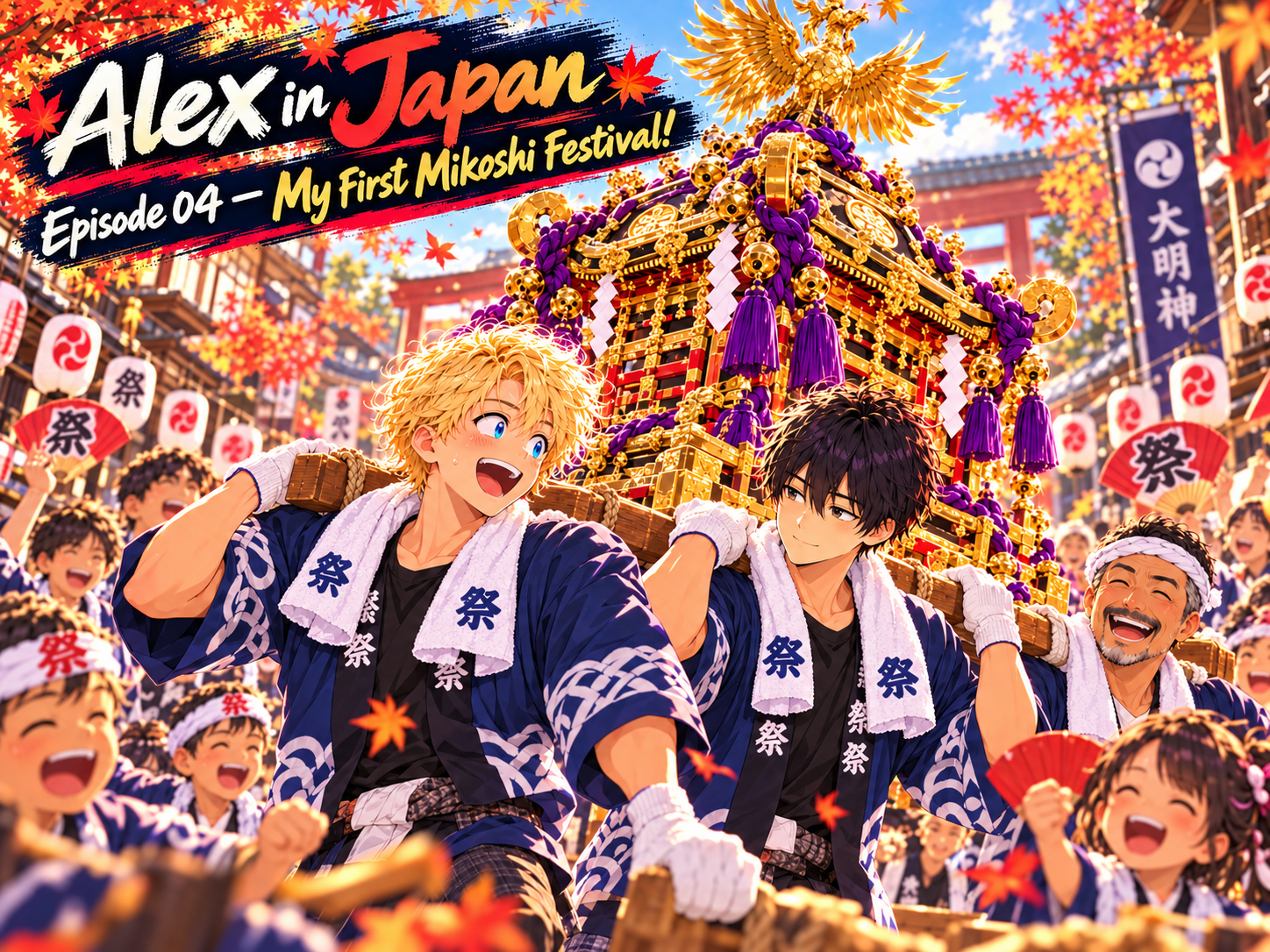
Alex in Japan — Episode 04
Can I Really Carry a Japanese Mikoshi?!
October 18, 2026 — Sunday
Chapter 1 — The Man from Last Night
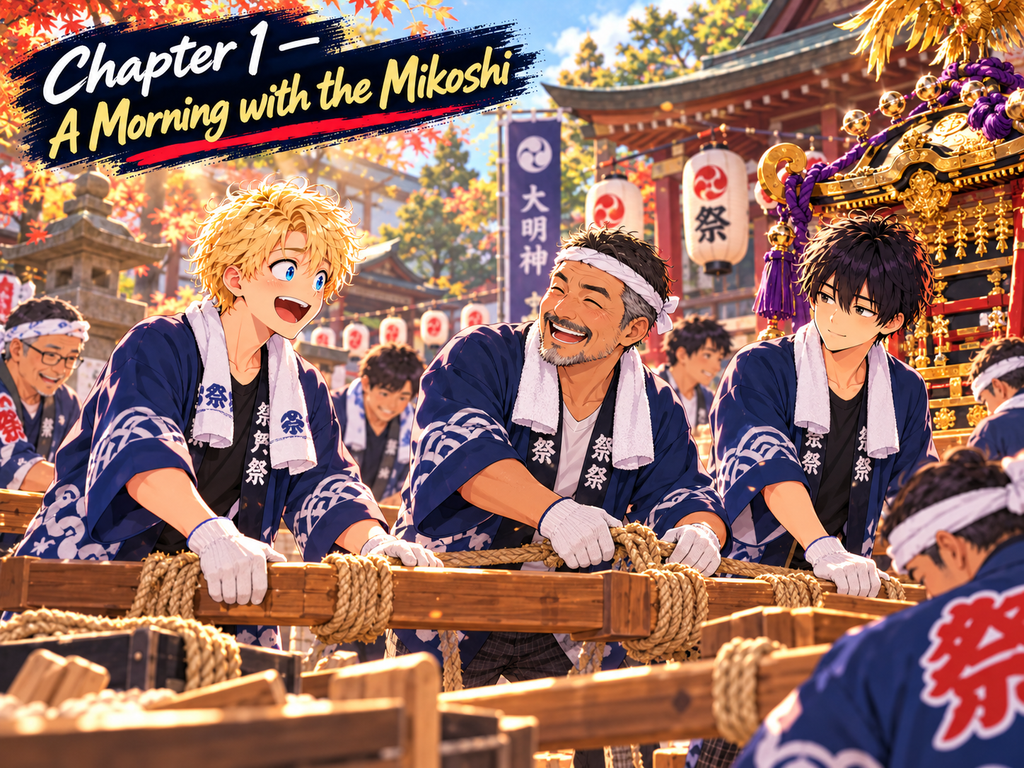
Sunday morning.
I was standing outside Haru’s house much earlier than usual.
There was no school today.
It was the weekend.
A day when most teenagers would probably prefer to sleep in.
But not me.
I’d jumped out of bed even earlier than I did on school days.
There was one very important reason.
The mikoshi.
Last night, I’d seen it beneath the glowing lanterns of the autumn festival.
Today, I might actually get to carry it.
“HARU!”
The front door opened.
Haru appeared, looking half asleep.
Haru: “Alex… it’s Sunday morning.”
“I KNOW!”
Haru: “Then why are you shouting so early?”
“BECAUSE TODAY’S THE DAY!”
Haru sighed.
Haru: 「……日曜の朝から元気すぎやろ。」
(…He’s way too energetic for a Sunday morning.)
We headed toward the neighborhood shrine.
The streets looked completely different in the morning sunlight.
The colorful food stalls were closed.
The lanterns were no longer glowing.
Instead, people were carrying equipment, checking ropes, and preparing for the day’s procession.
Then a familiar voice called out.
Mr. Tanaka: 「おおっ! 昨日の兄ちゃんやないか!」
(Oh! It’s the young man from yesterday!)
I turned around.
It was the friendly older man we’d met at the festival last night.
He waved enthusiastically.
Mr. Tanaka: 「よう来たなぁ! 待っとったで!」
(Glad you came! We’ve been waiting for you!)
Haru translated.
My face lit up.
“YOU REMEMBER ME?!”
Mr. Tanaka burst out laughing.
Mr. Tanaka: 「そら覚えてるわ! あんな元気な子、忘れられへん!」
(Of course I remember you! How could I forget someone that energetic?)
I turned proudly toward Haru.
“SEE? I’M ALREADY FAMOUS!”
Haru: 「……意味がちょっと違うと思うで。」
(…I don’t think that’s quite what he meant.)
Mr. Tanaka was one of the neighborhood festival organizers.
Haru explained that Dad had given me permission to join, and the organizers had agreed to let me help under their supervision.
Mr. Tanaka nodded.
Mr. Tanaka: 「ほな、まずは準備からや! 一緒にやろか!」
(All right, let’s start with the preparations! Come help us!)
I rolled up my sleeves.
“YES, SIR!”
Haru looked at my arms.
Haru: “Alex, you’re wearing a short-sleeved T-shirt.”
“I KNOW! I’M JUST GETTING READY!”
Mr. Tanaka laughed.
And somehow, even though I’d only met him yesterday, I already felt welcome.
Chapter 2 — Building Something Together
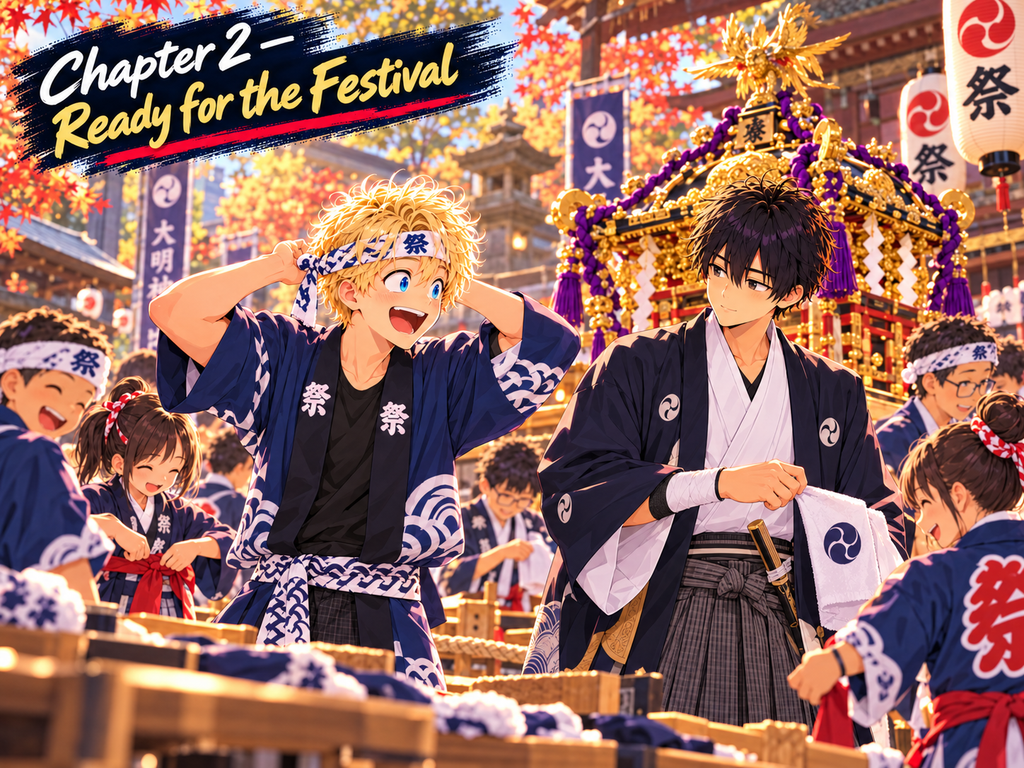
The shrine courtyard was full of activity.
Several adults were gathered around the mikoshi.
Up close, it looked even more impressive than it had the night before.
Polished wooden surfaces.
Beautiful metal decorations.
Thick carrying poles.
And carefully arranged ropes.
“WOW…”
For once, I spoke quietly.
Mr. Tanaka noticed.
Mr. Tanaka: 「どうや、立派やろ?」
(What do you think? Impressive, isn’t it?)
I nodded.
“It’s beautiful.”
Haru translated.
Mr. Tanaka smiled proudly.
Mr. Tanaka: 「この町のみんなで大事にしてる神輿なんや。」
(This mikoshi is something everyone in our neighborhood treasures.)
The experienced members began preparing and securing the carrying poles.
Others checked the ropes and decorations.
I immediately stepped forward.
“CAN I HELP?”
Mr. Tanaka: 「もちろんや! まずはこれ運んでくれるか?」
(Of course! Could you carry these first?)
He handed me some equipment.
I looked at it.
Then at the enormous mikoshi.
Then back at the equipment.
“Can’t I lift something bigger?”
Haru sighed.
Haru: “Alex, not everything is a competition.”
“But I want to help!”
Haru: “You are helping.”
Mr. Tanaka nodded.
Mr. Tanaka: 「小さい仕事も大事やで。みんなでやるから祭りになるんや。」
(Even the small jobs matter. It’s a festival because everyone works together.)
I looked around.
One man was checking the decorations.
Another was securing a rope.
Someone else was preparing water and supplies.
The experienced adults handled the heavy parts while the rest of us supported them.
No single person was doing everything.
Everybody had a job.
And when someone needed help, another person stepped forward.
“It’s like a team,” I said.
Haru: “Exactly.”
“A REALLY BIG TEAM!”
Haru smiled.
Haru: 「……それは間違ってへんな。」
(…Well, he’s not wrong about that.)
I carried supplies.
Helped organize equipment.
Passed ropes to the adults.
And even helped tidy the courtyard.
Slowly, the preparations came together.
The mikoshi stood ready beneath the clear autumn sky.
Mr. Tanaka stepped back.
Mr. Tanaka: 「よし! ええ感じや!」
(All right! Looking good!)
Everyone smiled.
Some people clapped.
I stared at the mikoshi.
A strange feeling grew inside me.
Pride.
I’d only helped with small tasks.
But somehow, it felt like I’d been part of building something important.
Then, from the shrine entrance—
Children: 「おはようございまーす!」
(Good morning!)
I turned around.
A whole group of children was arriving.
And suddenly, the quiet preparations became much livelier.
Chapter 3 — Wait… Is Haru a Samurai?!
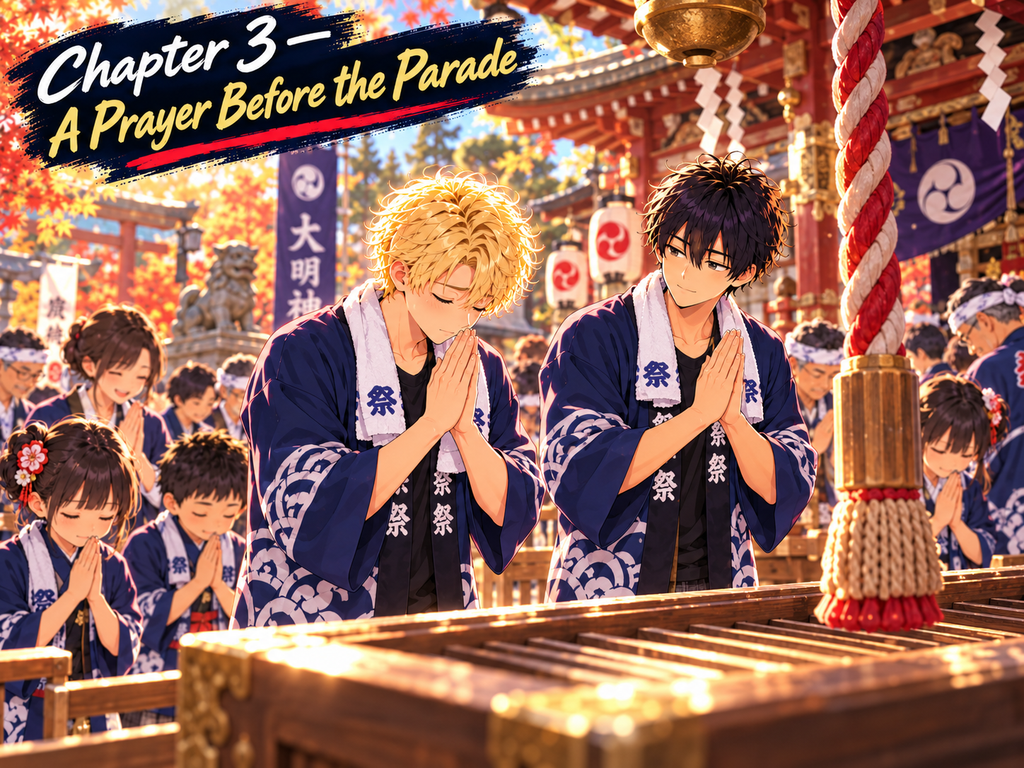
Children gathered throughout the shrine courtyard.
Some wore colorful festival coats.
Others had headbands tied around their foreheads.
Parents and volunteers helped everyone get ready.
I looked around in amazement.
“EVERYONE’S WEARING DIFFERENT CLOTHES!”
Haru: “Different roles sometimes have different outfits.”
Mr. Tanaka approached us carrying a navy-blue coat.
Mr. Tanaka: 「アレックス君、これ着てみい!」
(Alex, try this on!)
Haru translated.
I unfolded the garment.
It was a short traditional coat with bold Japanese characters on the back.
Haru: “It’s called a happi.”
“A HAPPY?”
Haru: “Happi. With an ‘i’.”
I put it on.
Mr. Tanaka checked the fit and helped me adjust it.
Then I turned around dramatically.
“HOW DO I LOOK?!”
A nearby child gave me a thumbs-up.
Child: 「かっこいい!」
(Cool!)
I grinned.
“I’M A FESTIVAL HERO!”
Haru sighed.
Haru: 「……衣装着ただけやろ。」
(…You’ve only put on the outfit.)
Then Haru disappeared to get changed.
A few minutes later, he returned.
I stared at him.
Then stared again.
“HARU?!”
Haru: “What?”
“ARE YOU A SAMURAI?!”
Haru was wearing a traditional-looking festival outfit with a pleated hakama.
It reminded me of the samurai clothing I’d seen in movies.
Haru: “No. This is festival clothing.”
“BUT YOU LOOK LIKE A SAMURAI!”
Haru: “That doesn’t make me one.”
I slowly bowed.
“My lord.”
Haru: “Stop.”
“Oh, great warrior of Osaka—”
Haru: 「……ほんまにやめて。」
(…Seriously, stop.)
The children burst out laughing.
Even Mr. Tanaka chuckled.
Mr. Tanaka: 「なんや、もう仲良しやな!」
(Well, you two certainly get along!)
A little boy tugged at my happi.
Boy: 「お兄ちゃんも神輿担ぐん?」
(Are you carrying the mikoshi too?)
Haru translated.
I crouched to the boy’s level.
“YES!”
The boy smiled.
Boy: 「ほな、頑張ってな!」
(Then do your best!)
I held out my fist.
The boy bumped it with his own.
“LET’S DO THIS!”
I looked around.
Children.
Parents.
Grandparents.
Friends.
Neighbors.
Everyone had gathered for the same reason.
And I was beginning to understand that this wasn’t just a festival.
It was something the entire neighborhood shared.
Chapter 4 — Wasshoi! The Mikoshi Is Moving!
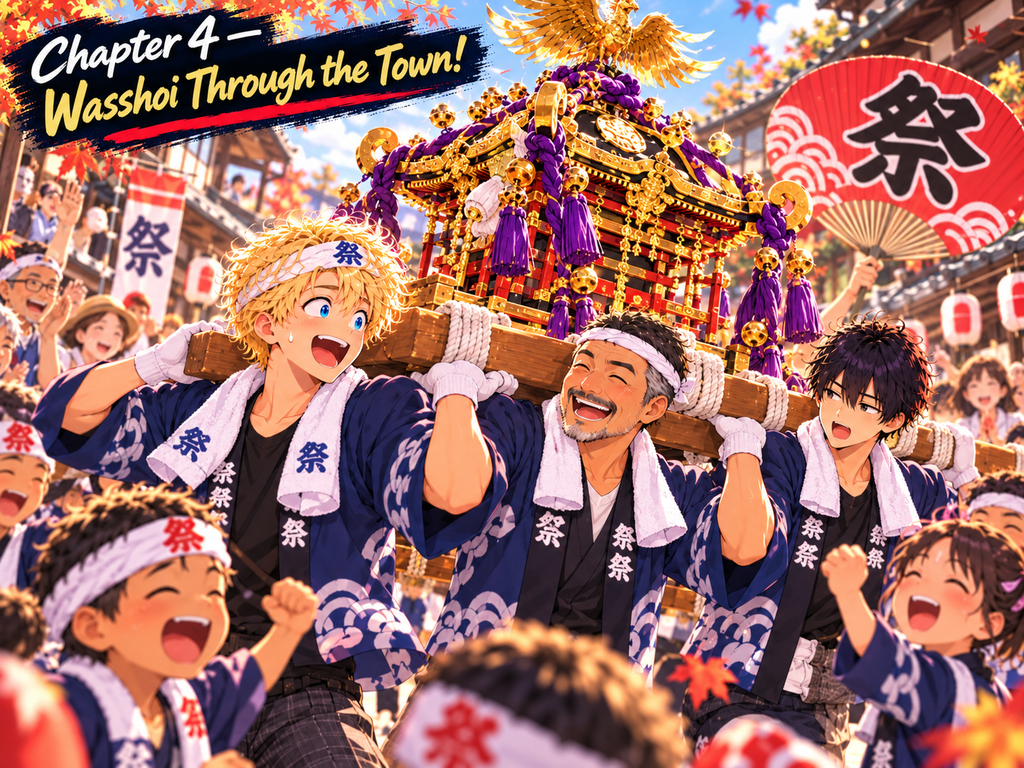
Before the procession began, everyone gathered at the shrine.
Mr. Tanaka reminded us to follow the organizers’ instructions.
Some people would carry the mikoshi.
Others would guide the procession, help children, provide water, or watch for safety.
We stood together near the worship hall.
Everyone offered their respects and prayed for a safe festival.
I remembered what Haru had taught me the night before.
Two bows.
Two claps.
One final bow.
I followed the customary sequence used at this shrine.
Then I quietly thought:
Please help everyone stay safe today.
When the prayers were finished, Mr. Tanaka called the carriers together.
Mr. Tanaka: 「よっしゃ! ほな、行こか!」
(All right! Let’s get going!)
The experienced carriers showed me where to stand.
They explained how to move together and how to keep my position safely.
Mr. Tanaka looked at me seriously.
Mr. Tanaka: 「無理したらあかんで。しんどかったらすぐ言いや!」
(Don’t push yourself. If it gets too hard, tell us right away!)
Haru translated.
I nodded.
“UNDERSTOOD!”
Everyone took their positions.
Mr. Tanaka raised his voice.
Mr. Tanaka: 「せーの!」
(Ready—and!)
We lifted together.
And—
“WHOA!”
The weight pressed down onto my shoulder.
My knees bent.
My eyes widened.
“IT’S SO HEAVY!”
Haru was nearby, helping with the procession.
Haru: “Are you okay?”
“I THINK SO!”
The carriers adjusted their positions.
Several strong adults supported the pole beside me.
Then someone shouted—
Carriers: 「わっしょい!」
(Wasshoi!)
Another voice answered.
「わっしょい!」
Soon, everyone joined in.
“WASSHOI!”
I shouted as loudly as I could.
“WASSHOI!”
The mikoshi began to move.
One step.
Then another.
The weight was still there.
But something strange happened.
When we moved together, it became easier to keep the rhythm.
I wasn’t carrying it alone.
None of us were.
Everyone was sharing the load.
“WASSHOI!”
“WASSHOI!”
From the side of the street, the children shouted with all their strength.
Children: 「わっしょーい! わっしょーい!」
(Wasshooooi! Wasshooooi!)
Their voices were almost louder than ours.
I laughed.
“THOSE KIDS HAVE MORE ENERGY THAN ME!”
Haru grinned.
Haru: 「……やっと負けたな。」
(…Someone finally beat you.)
A volunteer stepped forward carrying an enormous fan.
He waved it toward the participants.
A welcome breeze swept across my face.
Volunteer: 「ほらほら! 気合い入れていこか!」
(Come on, everyone! Keep that energy up!)
The children cheered.
The adults answered.
And the entire street seemed to echo with the same sound.
“WASSHOI!”
For the first time, I wasn’t just watching a Japanese festival.
I was moving with it.
Chapter 5 — A Whole Town Cheering Us On
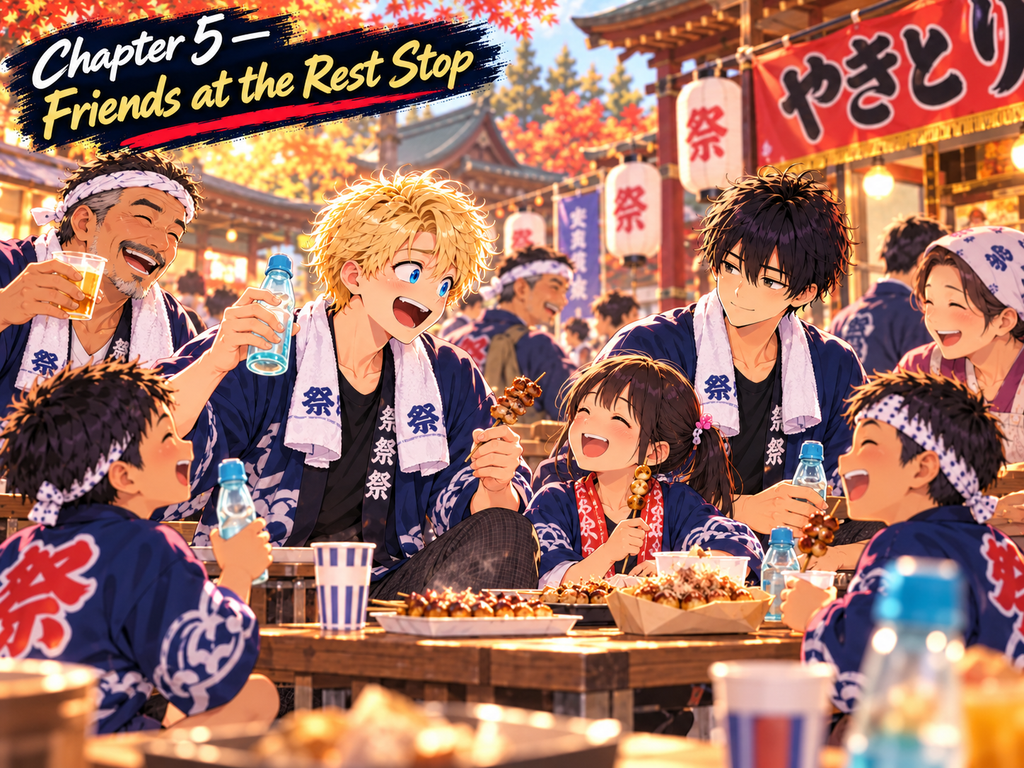
The procession continued through the neighborhood streets.
Slowly.
Carefully.
Step by step.
Mr. Tanaka and the experienced members guided us around corners.
The carriers followed their instructions and took turns when needed.
Along the sidewalks, people had gathered to watch.
An elderly woman smiled and waved.
Woman: 「頑張ってなー!」
(Keep it up!)
A man standing outside a shop shouted—
Shopkeeper: 「わっしょい! わっしょい!」
(Wasshoi! Wasshoi!)
A little girl waved both hands.
Girl: 「お兄ちゃん、頑張れー!」
(You can do it!)
I couldn’t understand every word.
But I understood the smiles.
I understood the waving hands.
And I definitely understood the cheering.
“HARU!”
Haru: “What?”
“EVERYONE’S CHEERING FOR US!”
Haru: “They are.”
“EVEN PEOPLE I’VE NEVER MET!”
Haru smiled.
Haru: “That’s part of what makes a neighborhood festival special.”
Another shout rose from the children.
「わっしょーい!」
We answered.
“WASSHOI!”
The volunteer with the enormous fan appeared again.
Whoosh! Whoosh!
Cool air rushed toward us.
Volunteer: 「ええぞー! その調子や!」
(That’s it! Keep going!)
I laughed.
“This is better than air conditioning!”
Haru shook his head.
Haru: 「……ほんま、何でも楽しむなぁ。」
(…You really find a way to enjoy everything.)
Then my shoulder began to ache.
The mikoshi felt heavier than before.
My steps grew slower.
Mr. Tanaka noticed immediately.
Mr. Tanaka: 「アレックス君、交代しよか!」
(Alex, let’s switch you out!)
I hesitated.
“But I can still—”
Haru interrupted.
Haru: “Alex. You don’t have to prove anything.”
I looked at the other carriers.
They were smiling, ready to take my place.
So I nodded.
“Okay.”
We changed positions safely when the organizers directed us to stop.
A new carrier took my place.
The procession continued.
And I walked alongside it, still shouting.
“WASSHOI!”
Mr. Tanaka laughed.
Mr. Tanaka: 「それでええねん! 声出すんも立派な応援や!」
(That’s the spirit! Cheering is important too!)
I looked around.
People were carrying.
People were guiding.
People were cheering.
People were handing out water.
Everyone had a role.
And nobody had to do it all.
Eventually, we reached a designated rest stop.
The mikoshi was carefully set down by the experienced team.
Everyone was tired.
Some people stretched their shoulders.
Others sat down and drank water.
I took a long drink from a bottle.
Then another.
And another.
Haru: “You okay?”
I nodded.
“I THINK MY SHOULDERS HAVE TURNED INTO NOODLES.”
Haru laughed.
Haru: 「……よう頑張ったな。」
(…You worked really hard.)
The little boy from earlier ran over.
Boy: 「お兄ちゃん! わっしょい上手やったで!」
(Big brother! Your wasshoi was really good!)
Haru translated.
I put a hand on my chest.
“THANK YOU!”
Then another child came over.
And another.
Soon, I was surrounded by children asking me questions.
Where was I from?
Did I like Japan?
Would I come to the next festival?
I answered what I could in English.
Haru helped with the Japanese.
Sometimes the children used gestures to explain what they meant.
And sometimes we simply laughed together.
Other neighbors came over too.
Someone handed me a drink.
Another person asked whether I was enjoying the festival.
A woman smiled and told Haru that she had seen me carrying the mikoshi earlier.
Before I knew it, I was sitting in the middle of a lively conversation.
Nobody had asked me to join them.
Nobody had formally introduced everyone.
They had simply gathered around.
And somehow, I felt completely comfortable.
I looked at Haru.
“Hey.”
Haru: “What?”
“Is it always like this?”
Haru: “Like what?”
I looked around at the smiling faces.
“Everyone just… talking together.”
Haru thought for a moment.
Haru: “At festivals like this, it happens a lot.”
I smiled.
“I like it.”
Haru smiled back.
Haru: 「……そら、よかったな。」
(…Well, I’m glad.)
For the first time since arriving in Japan, I wasn’t worried about finding someone to talk to.
People were coming to talk to me.
Chapter 6 — One More Wasshoi!
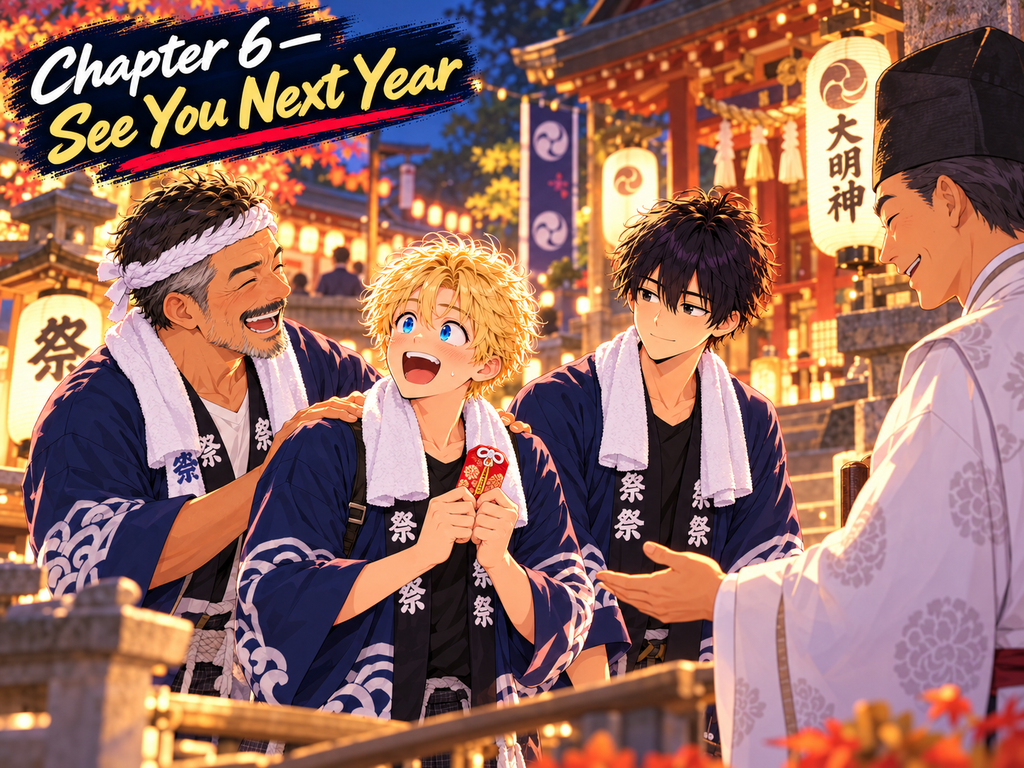
By late afternoon, the procession finally returned to the shrine.
The sun was beginning to sink.
Everyone looked exhausted.
But nobody seemed unhappy.
The children were still laughing.
The adults were smiling.
And I couldn’t stop thinking about the incredible feeling of carrying the mikoshi together.
Mr. Tanaka came over and gave me a friendly pat on the shoulder.
Mr. Tanaka: 「アレックス君、今日はよう頑張ったなぁ!」
(Alex, you did a great job today!)
Haru translated.
I grinned.
“THANK YOU! IT WAS AMAZING!”
Mr. Tanaka laughed.
Mr. Tanaka: 「来年も絶対来てや! 待ってるで!」
(You’d better come back next year! We’ll be waiting for you!)
I blinked.
“Next year?”
Haru: “He wants you to join them again.”
“REALLY?!”
Before I could say anything else, a man dressed in traditional Shinto priest’s clothing approached us.
Haru bowed politely.
Haru: 「宮司さん、こんにちは。」
(Hello, Chief Priest.)
The priest smiled warmly.
Chief Priest: 「今日はお祭りに参加してくれて、ありがとう。」
(Thank you for joining our festival today.)
Haru translated his words.
I stood up straight.
“THANK YOU FOR LETTING ME JOIN!”
The priest looked at the people gathered around the mikoshi.
Chief Priest: 「お祭りは、地域のみなさんの力で続いていくものです。」
(Festivals continue because of the people in the community.)
Then he turned back to me.
Chief Priest: 「ぜひ来年もいらしてくださいね。」
(Please come again next year.)
For a moment, I didn’t know what to say.
Mr. Tanaka wanted me back.
The chief priest wanted me back.
The children were waving at me.
And everyone was smiling.
I looked at Haru.
“Haru…”
Haru: “What?”
“I THINK I’VE BEEN INVITED TO NEXT YEAR’S FESTIVAL!”
Haru laughed.
Haru: “Yes, Alex. You have.”
I raised both fists into the air.
“THEN I’M DEFINITELY COMING BACK!”
Haru: 「……まだ今年の祭りも終わったばっかりやのに。」
(…This year’s festival has only just finished.)
Everyone laughed.
That evening, I finally returned home.
Dad was sitting in the living room when I walked through the door.
Dad: “So, how was the festival?”
I stopped.
How was the festival?
How could I possibly explain it?
“DAD!”
He looked up.
“I CARRIED A SHRINE!”
Dad: “You did what?”
“WITH A WHOLE NEIGHBORHOOD!”
I demonstrated the movement with my shoulders.
“AND EVERYONE WAS SHOUTING WASSHOI!”
Dad: “Wasshoi?”
“WASSHOI!”
Dad started laughing.
I told him everything.
About Mr. Tanaka.
About the children.
About the enormous fan.
About the weight of the mikoshi.
And about the chief priest who had invited me to return next year.
Even after dinner, I couldn’t stop talking.
When I finally went to bed, my shoulders were sore.
My legs were tired.
But my heart was still racing with excitement.
I lay under the covers, staring at the ceiling.
“Wasshoi…”
I whispered.
Then I smiled.
A few days ago, Japan had felt like a place where I didn’t belong.
Now, I had friends at school.
People in the neighborhood knew my name.
And I already had somewhere to go next year.
I thought about Mr. Tanaka’s words.
We’ll be waiting for you.
And the chief priest’s warm smile.
Please come again next year.
I pulled the blanket up and closed my eyes.
But I was still too excited to sleep.
Because I hadn’t just carried a mikoshi today.
I’d been welcomed into a community.
And I couldn’t wait to experience it all again.
“Next year…” I whispered.
Then, just one more time—
“Wasshoi!”
From the next room, Dad called out.
Dad: “Alex! Go to sleep!”
I laughed into my pillow.
“OKAY!”
I waited a moment.
Then whispered one last time.
“…Wasshoi.”
Alex’s Discovery — Japanese Mikoshi Festivals
1. What is a mikoshi?
A mikoshi (神輿) is a portable shrine used during certain Shinto festivals.
It is associated with the presence of a deity during the festival and may be carried through the surrounding community.
Its design and the way it is carried vary between shrines and regions.
2. What does “wasshoi” mean?
Wasshoi (わっしょい) is a traditional chant heard at some Japanese festivals.
It is often shouted rhythmically by people carrying a mikoshi or by people cheering them on.
Not every festival uses the same chant. Some regions have their own distinctive calls.
3. What is a happi?
A happi (法被) is a traditional Japanese short coat commonly worn during festivals and community events.
Festival groups may wear matching happi coats to show their affiliation.
Different participants may wear different kinds of traditional clothing depending on the event and their roles.
4. Does everyone carry the mikoshi?
Not necessarily.
Some people carry it, while others guide the procession, manage safety, help children, distribute refreshments, or cheer.
Organizers decide who may carry the mikoshi and what preparation is required.
Children may participate in specially organized activities, including children’s mikoshi processions, under adult supervision.
5. Why do people use large fans?
At some festivals, volunteers use large fans to encourage participants or provide a breeze.
These fans can add energy and atmosphere to the procession.
Customs differ from one festival to another.
6. Why do neighborhoods organize festivals?
Local festivals may bring together families, neighbors, shrine supporters, and volunteers.
They can be important opportunities to maintain local traditions, strengthen community relationships, and pass customs to younger generations.
Japanese Words to Remember
- 神輿 (Mikoshi): A portable shrine used during certain Shinto festivals.
- わっしょい (Wasshoi): A rhythmic festival chant.
- 法被 (Happi): A traditional short festival coat.
- 袴 (Hakama): A pleated traditional Japanese garment.
- 担ぐ (Katsugu): To carry something on one’s shoulder.
- 扇ぐ (Aogu): To fan someone or something.
- 休憩所 (Kyūkeijo): A rest stop.
- 町内 (Chōnai): A neighborhood or local community.
- 仲間 (Nakama): A companion, teammate, or member of a group.
Alex in Japan — Episode 04: The End
A heavy mikoshi. A thousand voices. And one unforgettable lesson about belonging.
Two cultures. One unforgettable friendship. A new discovery every day.