Wait… Japan Has a Holiday Just for CULTURE?!
Alex in Japan — Episode 10
Culture Day in Kyoto — Discovering 74 Traditional Japanese Crafts
November 3, 2026 — Tuesday
- Chapter 1 — Wait… My Legs Still Hurt?!
- Chapter 2 — Culture Day? What’s That?!
- Chapter 3 — Wait… SEVENTY-FOUR Different Crafts?!
- Chapter 4 — Is That Really Made by Hand?!
- Chapter 5 — The Smallest Knot, the Biggest Surprise
- Chapter 6 — Culture Isn’t Just Something Old
- 1. What Is Culture Day in Japan?
- 2. What Is the Kyoto Museum of Crafts and Design?
- 3. What Are Nishijin Textiles?
- 4. What Is Kyo-yuzen?
- 5. What Are Kyo-yaki and Kiyomizu-yaki?
- 6. What Is Mizuhiki?
- 7. Can Visitors Watch Craftspeople at Work?
- 8. Why Are Traditional Crafts Important?
- Japanese Words to Remember
- Planning a Visit to the Kyoto Museum of Crafts and Design
- About Alex in Japan
Chapter 1 — Wait… My Legs Still Hurt?!
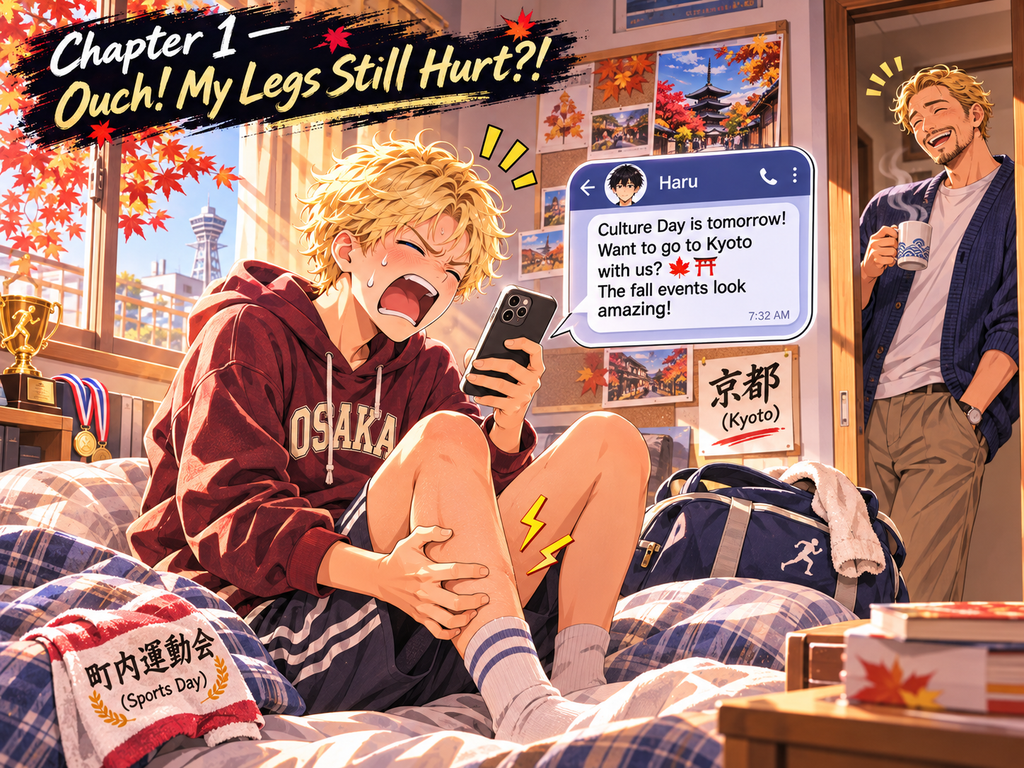
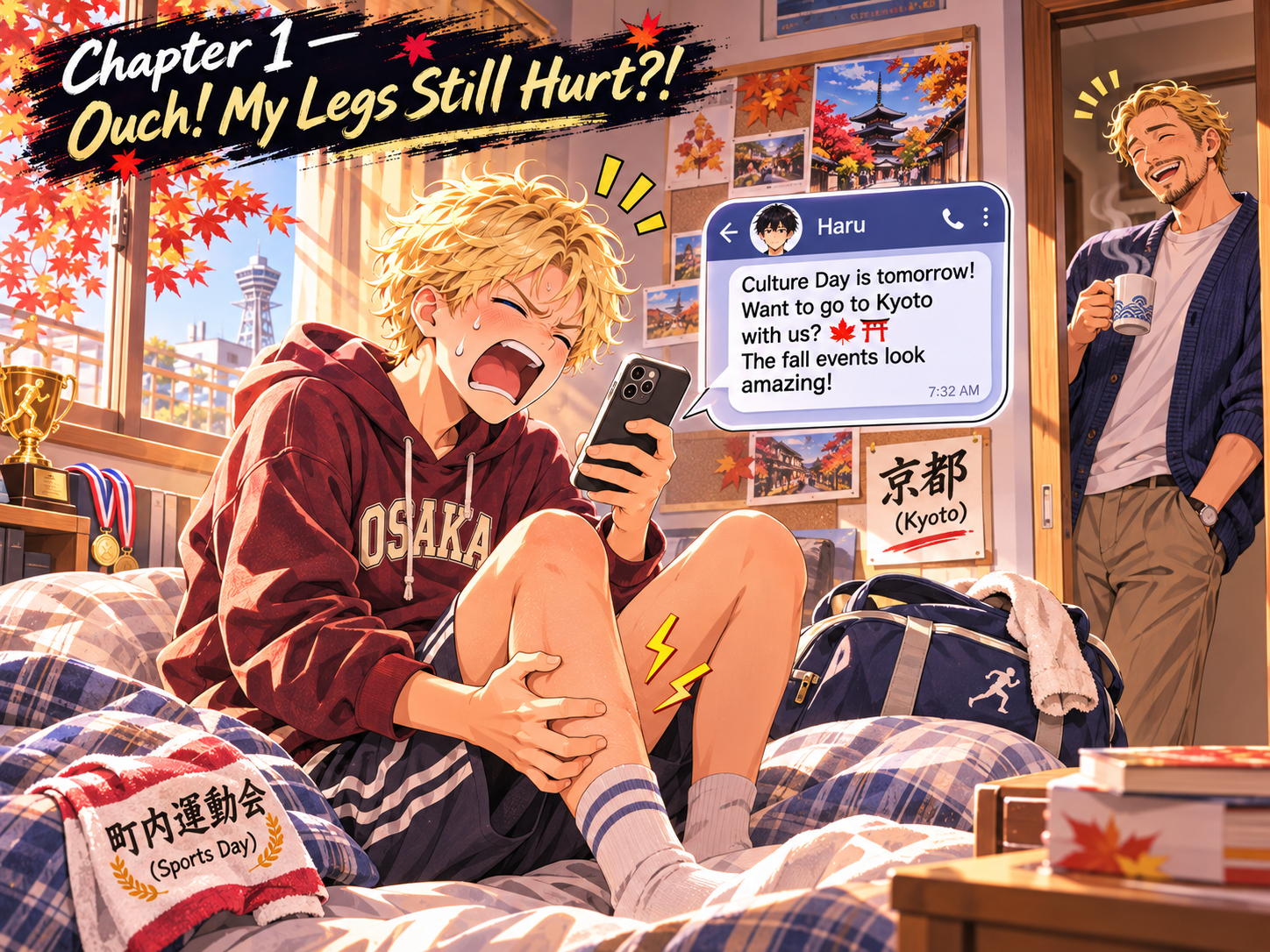
It was a beautiful autumn morning in Osaka.
The sunlight streamed through my bedroom window.
Birds were singing outside.
Everything seemed peaceful.
Except for one problem.
“OUCH!”
I tried to get out of bed.
My legs had other plans.
“WHY ARE MY LEGS STILL ANGRY AT ME?!”
Dad looked into my room.
Dad: “Morning, Alex.”
“DAD! I THINK MY LEGS ARE BROKEN!”
Dad raised an eyebrow.
Dad: “You said the same thing yesterday.”
“THAT DOESN’T MAKE IT LESS SERIOUS!”
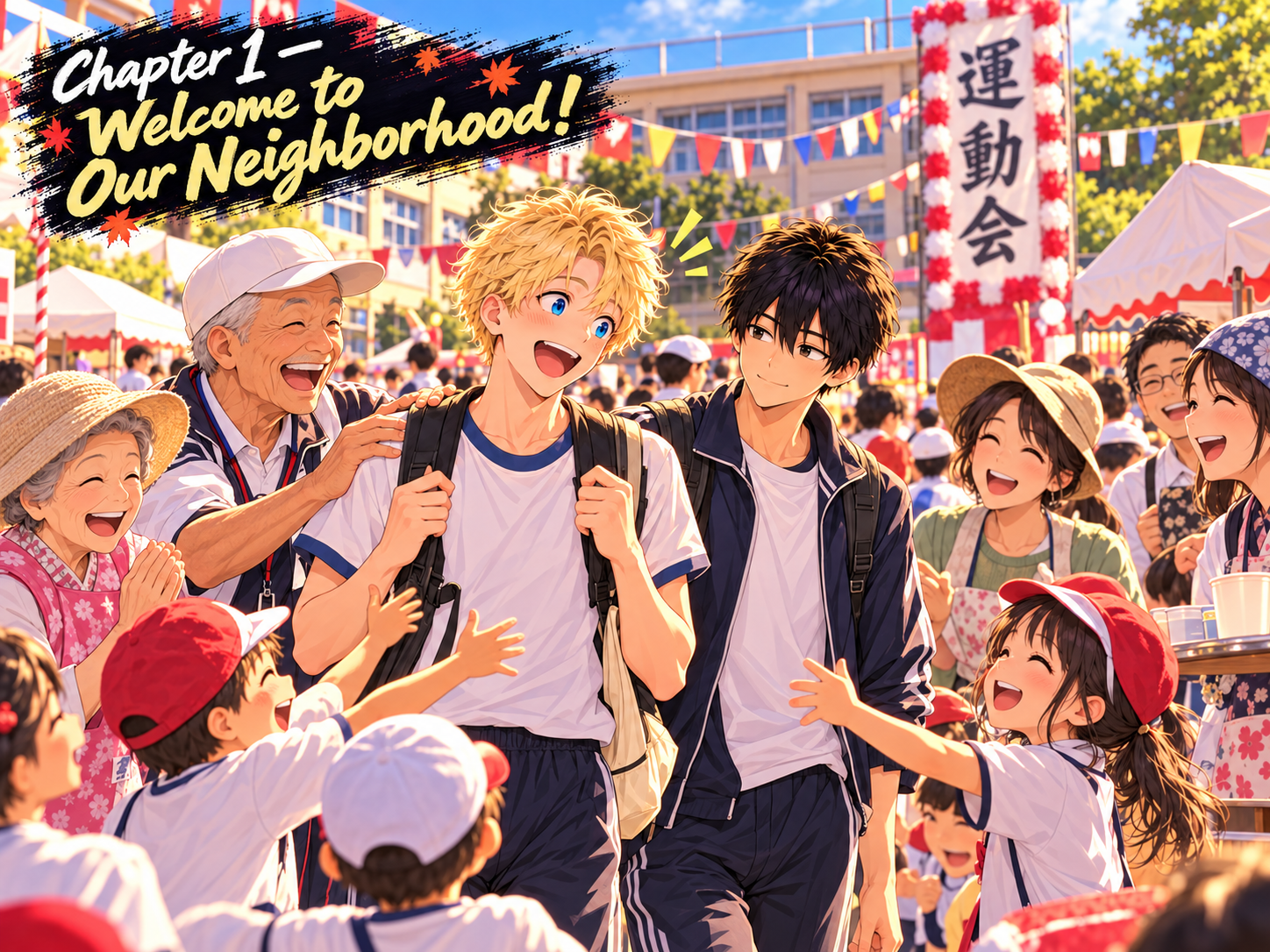
A few days earlier, I’d participated in my first Japanese neighborhood sports day.
I’d competed in games.
Run in the neighborhood relay.
And somehow become emotionally invested in winning a ballpoint pen.
Unfortunately, my muscles had not forgiven me.
Then my phone buzzed.
Haru: Morning! Are you free today?
I typed back.
Alex: My legs are officially retired.
Haru: Perfect. Let’s go to Kyoto.
I stared at the screen.
“KYOTO?!”
Another message arrived.
Haru: It’s Culture Day. There’s somewhere I want to show you.
I called him immediately.
“HARU!”
Haru: “Morning, Alex.”
“YOU WANT ME TO GO SIGHTSEEING WITH THESE LEGS?!”
Haru: “We’re visiting a museum.”
“A MUSEUM?!”
Haru: “Yeah.”
I thought about it.
Quiet rooms.
Interesting exhibits.
No relay races.
No adults sprinting for notebooks.
“DO I HAVE TO RUN?!”
Haru: “No.”
“DO I HAVE TO CARRY A SHRINE?!”
Haru: “No.”
“DO I HAVE TO COMPETE AGAINST A GRANDPA?!”
Haru sighed.
Haru: 「……まだ運動会引きずってるんか。」
(…You’re still thinking about the sports day?)
I smiled.
“FINE! I’M COMING!”
Chapter 2 — Culture Day? What’s That?!
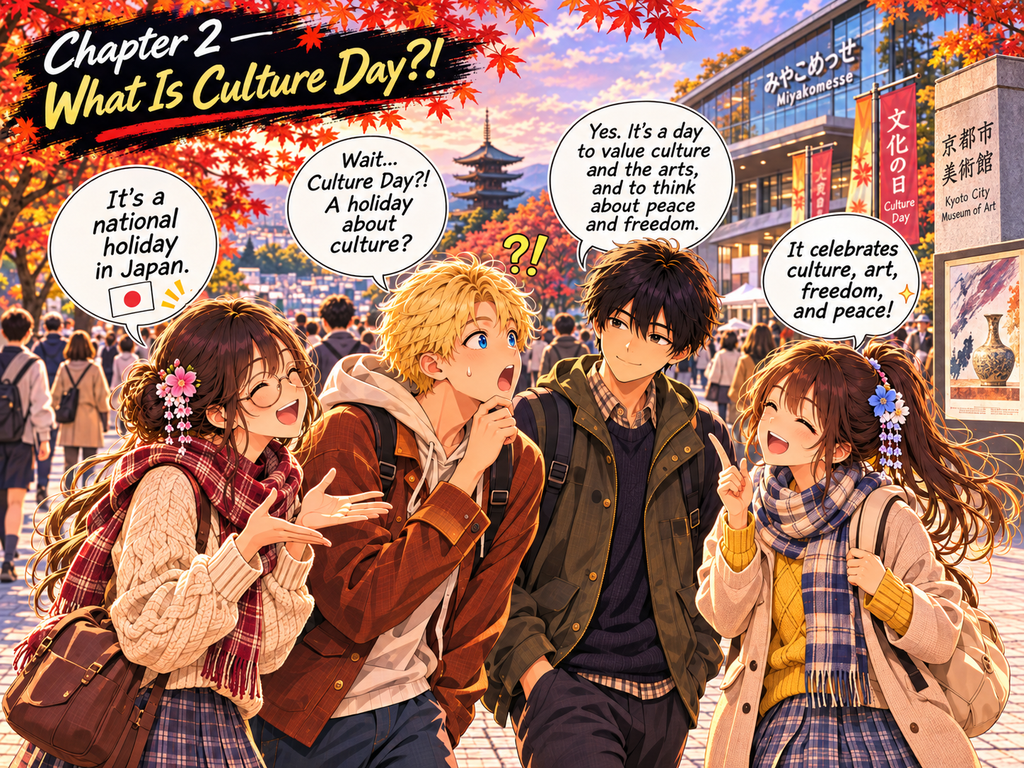
Later that morning, I met Haru, Mio, and Saki.
We were heading to Kyoto.
I looked at my friends.
“SO…”
Haru glanced at me.
Haru: “What?”
“WHAT EXACTLY IS CULTURE DAY?”
Mio smiled.
Mio: “It’s a Japanese national holiday on November third.”
Saki nodded.
Saki: “It’s a day associated with culture, freedom, and peace.”
I blinked.
“WAIT…”
Haru: “What?”
“JAPAN HAS A NATIONAL HOLIDAY FOR CULTURE?!”
Haru: “Yep.”
I thought about it.
“DOES THAT MEAN EVERYONE HAS TO BE CULTURED TODAY?!”
Mio laughed.
Mio: “No, Alex.”
“DO I HAVE TO READ A HUNDRED BOOKS?!”
Saki: “No!”
“LEARN THE VIOLIN?!”
Haru shook his head.
Haru: 「……一日で無理やろ。」
(…You couldn’t do that in one day.)
I folded my arms.
“THEN WHAT DO WE DO?!”
Haru smiled.
Haru: “Today, we’re going to learn about Kyoto’s traditional crafts.”
“CRAFTS?”
Mio: “Things people have made using special techniques passed down through generations.”
I looked curious.
“LIKE WHAT?”
Saki: “Kimono textiles, pottery, lacquerware, and lots more.”
I nodded slowly.
“SO TODAY…”
Haru: “Yeah?”
“WE’RE GOING TO LOOK AT BEAUTIFUL THINGS?!”
Haru smiled.
Haru: “That’s one way to put it.”
I grinned.
“AND NOBODY HAS TO RUN!”
Haru: 「……そこが一番大事なんやな。」
(…So that’s the most important part for you.)
Chapter 3 — Wait… SEVENTY-FOUR Different Crafts?!
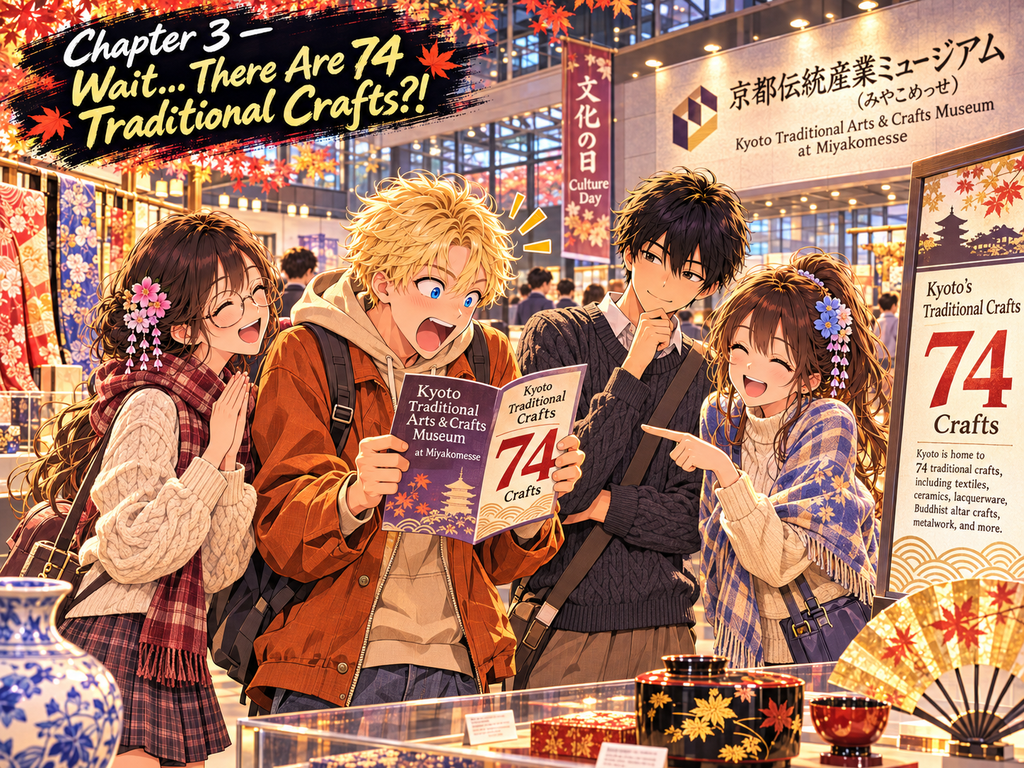
We arrived in Kyoto’s Okazaki area.
The autumn air was cool and refreshing.
Haru guided us toward a large building.
Haru: “Here we are. Miyako Messe.”
I looked up.
“MIYAKO MESSE?”
Haru: “It’s the Kyoto International Exhibition Hall. The museum is downstairs.”
We headed to the basement floor.
There, we found the Kyoto Museum of Crafts and Design.
I looked around in amazement.
Beautiful objects filled the exhibition space.
Colorful textiles.
Carefully made ceramics.
Delicate decorations.
Objects made from wood, metal, and other materials.
“WHOA…”
For a moment, I forgot about my sore legs.
Mio pointed toward a large display.
Mio: “Look, Alex. Kyoto has seventy-four traditional industries represented here.”
I froze.
“WAIT…”
Haru smiled.
Haru: “Here it comes.”
“SEVENTY-FOUR?!”
Saki: “Yes!”
“SEVEN?!”
Haru: “No.”
“FOURTEEN?!”
Haru: “No.”
“SEVENTY-FOUR?!”
Haru sighed.
Haru: 「……何回確認するねん。」
(…How many times are you going to check?)
I looked along the displays.
“How can one city have so many traditional crafts?!”
Mio explained that Kyoto had been an important cultural center for centuries.
Different crafts had developed to support everyday life, clothing, architecture, religious traditions, and the arts.
I looked at the exhibits again.
“SO THESE AREN’T JUST OLD OBJECTS?”
Haru shook his head.
Haru: “No. People still make many of them today.”
I stared.
“WAIT…”
Saki: “What now?”
“YOU MEAN PEOPLE ARE STILL MAKING THESE BY HAND?!”
Mio smiled.
Mio: “That’s one of the amazing things about traditional craftsmanship.”
For the first time that day, I felt genuinely excited.
I wasn’t just looking at history.
I was looking at something still alive.
Chapter 4 — Is That Really Made by Hand?!
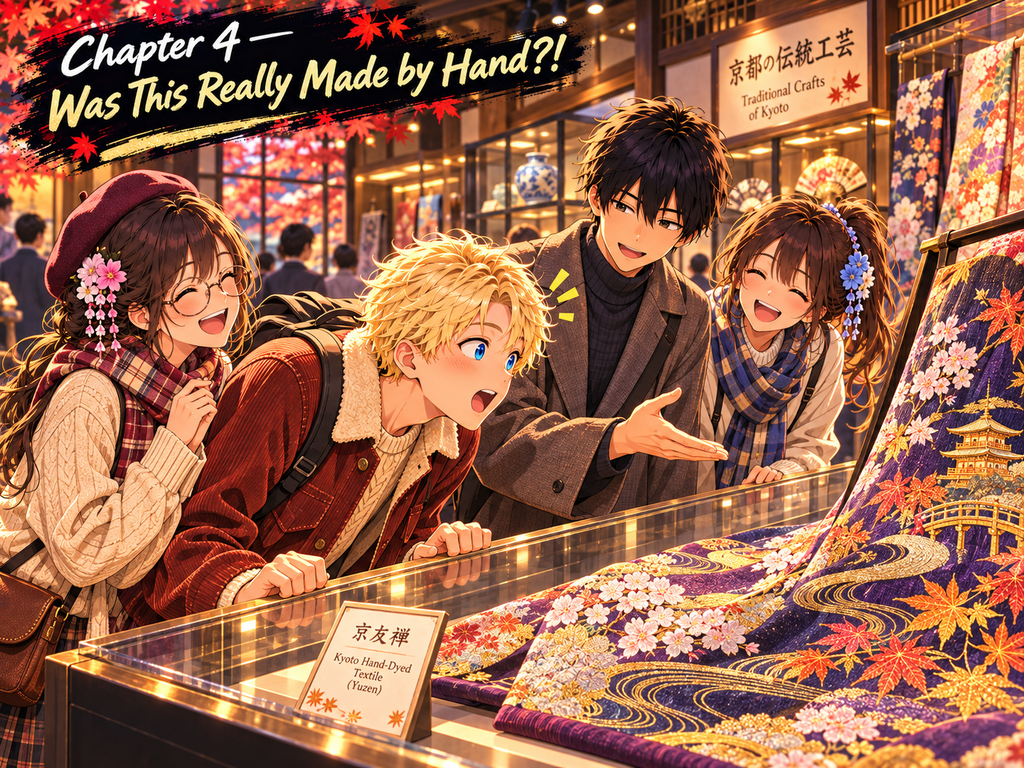
Our next stop was a display of traditional Kyoto textiles.
Mio pointed toward an elegant kimono.
Mio: “This is an example of Kyoto’s textile craftsmanship.”
I leaned closer to examine the patterns.
“WOW…”
The colors were beautiful.
The details were so delicate that I could hardly believe them.
Haru: “Kyoto is known for crafts such as Nishijin textiles and Kyo-yuzen dyeing.”
I stared at the fabric.
“WAIT…”
Haru looked at me.
Haru: “What?”
“SOMEONE ACTUALLY MADE ALL THESE DETAILS?!”
Haru: “Yes.”
“WITHOUT JUST PRESSING A PRINT BUTTON?!”
Mio laughed.
Mio: “Traditional techniques can involve many different steps and skilled craftspeople.”
I looked at my own T-shirt.
A plain white T-shirt.
Nothing special.
Then I looked at the beautiful kimono.
“MY SHIRT SUDDENLY FEELS VERY ORDINARY.”
Saki giggled.
Saki: “Your shirt is fine, Alex.”
“IT DOESN’T HAVE ANY OF THOSE BEAUTIFUL PATTERNS!”
We continued exploring.
There were ceramic pieces with elegant shapes and decorations.
Lacquerware with carefully finished surfaces.
And objects whose beauty came from years of practiced skill.
I studied an explanatory display showing how a craft was made.
Step after step.
Tool after tool.
So much patience.
So much precision.
“HARU…”
Haru: “Yeah?”
“HOW LONG DOES IT TAKE TO GET GOOD AT SOMETHING LIKE THIS?”
Haru thought for a moment.
Haru: “It depends on the craft, but developing advanced skills can take years.”
I stared at the display.
“YEARS?!”
Haru: “Yeah.”
I looked down at my hands.
Then smiled.
“I THINK I COULD DO IT.”
Haru raised an eyebrow.
Haru: “Really?”
“OF COURSE!”
Haru: “You couldn’t even catch a hanging bread roll on your first try.”
I froze.
“THAT WAS DIFFERENT!”
Haru: 「……まず落ち着く練習からやな。」
(…You should start by practicing how to stay calm.)
Everyone laughed.
Chapter 5 — The Smallest Knot, the Biggest Surprise
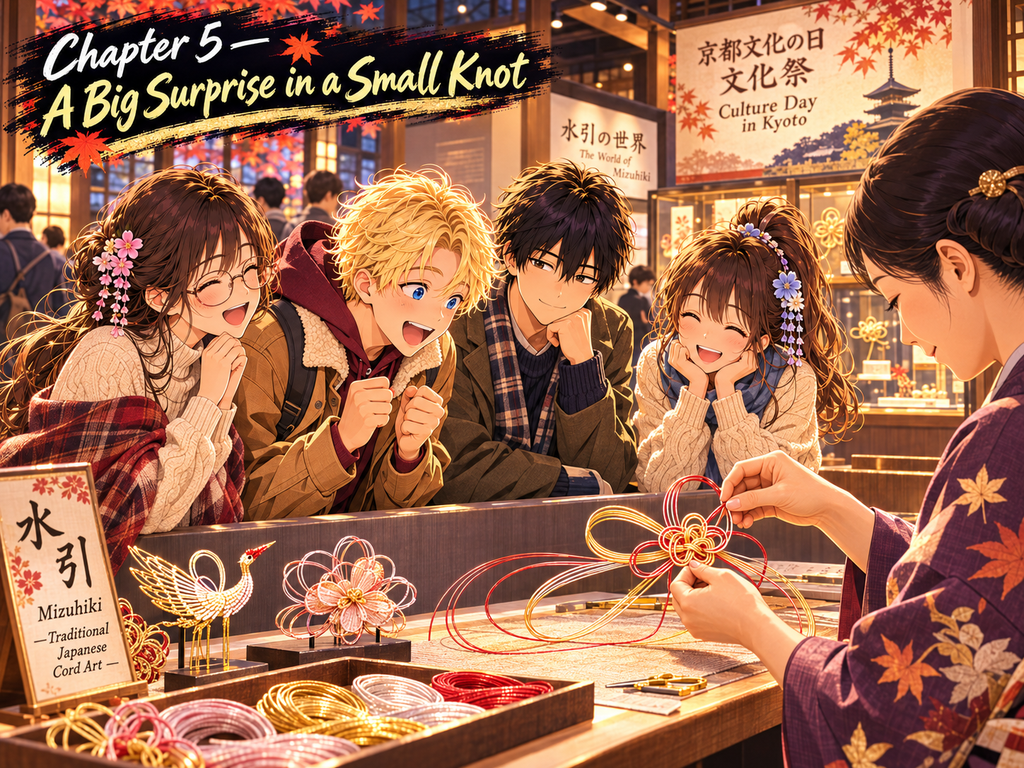
As we continued through the museum, we came across a craft demonstration.
A craftsperson was working carefully with decorative cords.
The technique was called mizuhiki.
I watched quietly.
For once, I wasn’t shouting.
The craftsperson arranged the thin cords.
Moved them into position.
And gradually formed a beautiful decorative shape.
I leaned forward.
“WAIT…”
Haru whispered.
Haru: “What’s wrong?”
“THAT’S MADE FROM CORDS?!”
Haru: “Yes.”
I looked again.
Something so simple.
A few thin strands.
And yet the result was incredibly elegant.
Mio explained that mizuhiki is often used for decorative arrangements associated with gifts and special occasions.
Different knot designs can carry different meanings.
I watched the craftsperson’s movements.
They looked effortless.
Precise.
Calm.
I imagined myself trying it.
The cords would probably end up around my fingers.
Possibly my wrists.
Maybe my entire body.
I whispered to Haru.
“I THINK I’D TURN MYSELF INTO A GIANT KNOT.”
Haru tried not to laugh.
Haru: 「……想像できるわ。」
(…I can picture that.)
Then I looked toward the craftsperson again.
“HEY…”
Haru: “Yeah?”
“THAT PERSON MAKES IT LOOK SO EASY.”
Haru nodded.
Haru: “That’s what happens when someone has practiced a skill for a long time.”
I thought about the neighborhood sports day.
Everyone trying their best.
Everyone helping one another.
And now, here in Kyoto, people were preserving incredible skills through practice.
I smiled.
“MAYBE CULTURE IS A LITTLE LIKE SPORTS.”
Haru looked surprised.
Haru: “How?”
“YOU PRACTICE.”
“YOU MAKE MISTAKES.”
“YOU LEARN.”
I looked at the intricate knot.
“AND EVENTUALLY, YOU CAN DO SOMETHING AMAZING.”
For a moment, Haru said nothing.
Then he smiled.
Haru: 「……今日はええこと言うやん。」
(…You’re saying some pretty good things today.)
I grinned.
“OF COURSE!”
Haru: 「……褒めたらすぐこれや。」
(…And this is what happens when I compliment you.)
Chapter 6 — Culture Isn’t Just Something Old
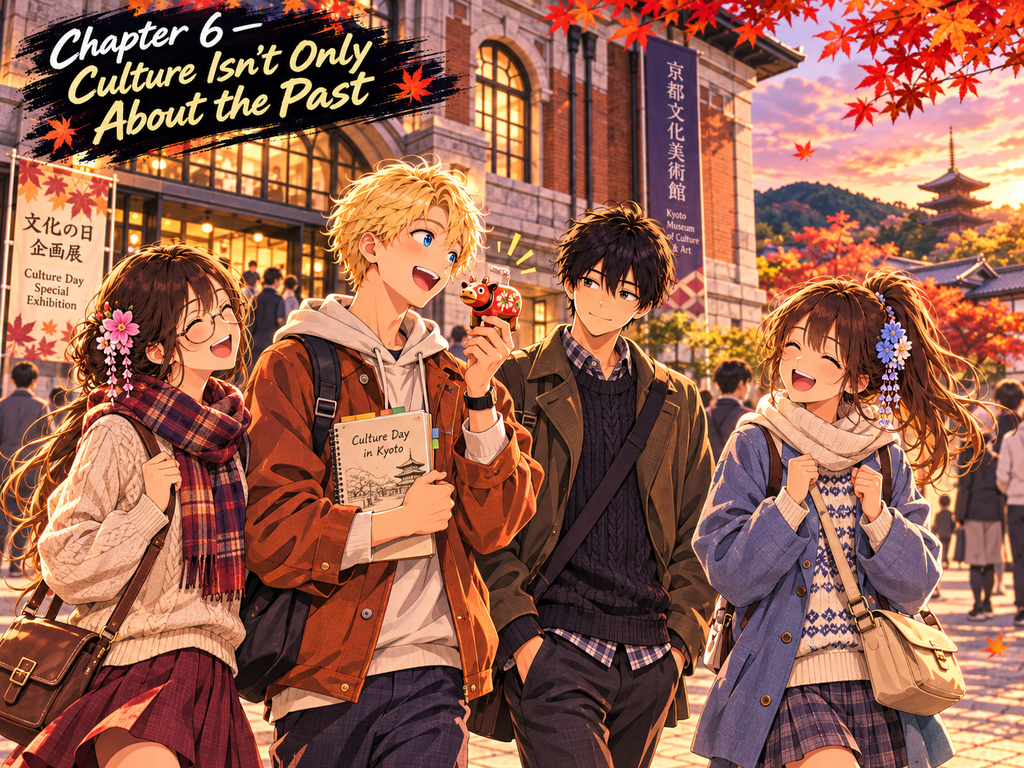
Before leaving, we stopped at the museum shop.
There were beautiful examples of Kyoto craftsmanship.
Small accessories.
Decorative objects.
Items for everyday life.
And carefully made gifts.
I looked around.
“WOW…”
Mio smiled.
Mio: “See anything you like?”
“EVERYTHING!”
Saki laughed.
Saki: “You can’t buy everything.”
“I KNOW!”
I examined a small craft item.
Then looked at the price.
Then back at the item.
“HARU…”
Haru: “What?”
“I THINK I FINALLY UNDERSTAND WHY HANDMADE THINGS CAN BE EXPENSIVE.”
Haru smiled.
Haru: “Why?”
“BECAUSE YOU’RE NOT JUST PAYING FOR THE MATERIAL.”
Mio nodded.
Mio: “Exactly.”
“YOU’RE PAYING FOR THE TIME…”
I looked at the craftsmanship.
“THE SKILL…”
Then I smiled.
“AND ALL THE PRACTICE THAT WENT INTO IT.”
Haru nodded.
Haru: 「……よう分かってきたやん。」
(…You’re starting to understand.)
I picked out a small souvenir.
Something I could keep as a memory of the day.
Not a trophy.
Not a medal.
Not even a ballpoint pen.
Something connected to Kyoto’s craftsmanship.
Outside, the autumn sky was turning a gentle shade of orange.
We walked together through the Okazaki area.
I looked at Haru.
“HEY…”
Haru: “Yeah?”
“I THOUGHT CULTURE DAY WOULD BE BORING.”
Saki laughed.
Saki: “Really?”
I nodded.
“I THOUGHT WE’D JUST LOOK AT OLD THINGS.”
Mio smiled.
Mio: “And now?”
I looked at the small souvenir in my hand.
“NOW I THINK CULTURE IS SOMETHING PEOPLE KEEP MAKING.”
Haru looked at me.
Haru: “What do you mean?”
“THE PEOPLE WHO MADE THOSE THINGS LONG AGO…”
I paused.
“THE PEOPLE MAKING THEM TODAY…”
“And THE PEOPLE LEARNING THOSE SKILLS FOR TOMORROW.”
I smiled.
“THEY’RE ALL CONNECTED!”
Haru smiled.
Haru: 「……せやな。受け継いでいくもんなんやろな。」
(…That’s right. It’s something people keep passing on.)
I looked toward the museum one last time.
A building full of beautiful objects.
But behind every object was something even more important.
A person.
A skill.
A story.
And a tradition someone had chosen to keep alive.
I took out the notebook I’d won at the neighborhood sports day.
On the next empty page, I wrote:
CULTURE DAY — KYOTO
Things I learned:
1. Kyoto has an incredible variety of traditional crafts.
2. Making beautiful things takes patience and skill.
3. Culture isn’t only about the past. It’s about what we pass on to the future.
I closed the notebook.
Then looked at my friends.
“HEY, GUYS!”
Haru sighed.
Haru: “What now?”
“CAN WE COME BACK AGAIN?!”
Mio smiled.
Mio: “Of course.”
Saki nodded.
Saki: “There are plenty of other things to discover in Kyoto.”
I grinned.
“GOOD!”
Then I took one step.
“OUCH!”
Everyone stopped.
Haru looked at me.
Haru: “Your legs again?”
I nodded.
“CULTURE DAY WAS AMAZING…”
I took another careful step.
“BUT I THINK MY LEGS WANT A HOLIDAY TOO!”
Haru burst out laughing.
Haru: 「……明日はほんまに休みやな。」
(…You really need to rest tomorrow.)
We all laughed.
And somewhere behind us, Kyoto’s craftspeople continued their work.
Creating.
Learning.
And carrying tradition into the future.
To be continued in Alex in Japan…
Alex’s Discovery — Culture Day and Kyoto’s Traditional Crafts
1. What Is Culture Day in Japan?
Culture Day (Bunka no Hi, 文化の日) is a Japanese national holiday celebrated every year on November 3.
The holiday promotes culture and the values of freedom and peace.
It is also associated with opportunities to appreciate art, education, and cultural achievements.
2. What Is the Kyoto Museum of Crafts and Design?
The Kyoto Museum of Crafts and Design is located on the basement floor of Miyako Messe in Kyoto’s Okazaki area.
The museum introduces 74 traditional industries associated with Kyoto.
Visitors can learn about craftsmanship through exhibits, materials, tools, and explanations of production processes.
Some days also feature demonstrations by skilled craftspeople.
3. What Are Nishijin Textiles?
Nishijin-ori (西陣織) is a traditional textile craft associated with Kyoto’s Nishijin area.
It is famous for sophisticated weaving techniques and decorative fabrics, including those used for kimono and obi.
4. What Is Kyo-yuzen?
Kyo-yuzen (京友禅) is a traditional Kyoto dyeing technique known for beautiful colors and intricate designs.
It is often associated with decorated kimono fabrics.
5. What Are Kyo-yaki and Kiyomizu-yaki?
Kyo-yaki (京焼) and Kiyomizu-yaki (清水焼) are names associated with Kyoto’s ceramic traditions.
These crafts include tea utensils, tableware, and decorative ceramics.
6. What Is Mizuhiki?
Mizuhiki (水引) is a Japanese decorative cord craft.
It is commonly associated with gift wrapping, celebrations, and ceremonial occasions.
Different knot designs can convey different meanings.
7. Can Visitors Watch Craftspeople at Work?
The museum offers scheduled demonstrations of traditional craft techniques.
The crafts demonstrated vary by day, so visitors should check the official schedule.
Hands-on activities, when available, may have separate conditions or schedules.
8. Why Are Traditional Crafts Important?
Traditional crafts connect generations through shared skills and knowledge.
They preserve techniques developed over long periods while allowing craftspeople to create objects for contemporary life.
Culture is not only something we remember.
It is also something people continue to make.
Japanese Words to Remember
| Japanese | English Meaning |
|---|---|
| 文化の日 (Bunka no Hi) | Culture Day |
| 伝統工芸 (Dentō kōgei) | Traditional crafts |
| 職人 (Shokunin) | Craftsperson / Artisan |
| 西陣織 (Nishijin-ori) | Nishijin textiles |
| 京友禅 (Kyo-yuzen) | Kyoto traditional dyeing |
| 京焼 (Kyo-yaki) | Kyoto ceramics |
| 清水焼 (Kiyomizu-yaki) | Kiyomizu ceramics |
| 水引 (Mizuhiki) | Decorative cord craft |
| 技術 (Gijutsu) | Technique / Skill |
| 受け継ぐ (Uketsugu) | To inherit or pass down |
| ものづくり (Monozukuri) | Craftsmanship / Making things |
Planning a Visit to the Kyoto Museum of Crafts and Design
Location: Miyako Messe, Basement Floor 1, Okazaki, Sakyo Ward, Kyoto
Access: Approximately 10 minutes on foot from Higashiyama Station on the Kyoto Municipal Subway Tozai Line.
What to see: Traditional Kyoto textiles, ceramics, lacquerware, decorative crafts, and exhibitions introducing the city’s 74 traditional industries.
Before visiting: Confirm opening hours, admission fees, demonstrations, and temporary closures on the museum’s official website.
Official museum website: https://kmtc.jp/
About Alex in Japan
Alex in Japan is an original illustrated fiction series about Alex, a 16-year-old American high school student discovering Japanese culture in Osaka.
Alongside his Japanese classmate Haru and their friends Mio and Saki, Alex explores everyday life, traditional festivals, local customs, food, and surprising cultural differences.
Each episode brings laughter, friendship, and a new discovery.
Read the complete illustrated series:

Episode 10 — The End
Culture isn’t only something we inherit from the past. It’s something we keep alive for the future.
Two cultures. One unforgettable friendship. A new discovery every day.