Alex in Japan — Episode 09
A Japanese Neighborhood Sports Day — Where Everyone Competes, Everyone Eats, and Everyone Belongs
- Chapter 1 — Wait… The WHOLE Neighborhood Is Here?!
- Chapter 2 — The Opening Ceremony and the Bread-Eating Challenge
- Chapter 3 — Grandpa vs. a Two-Year-Old?!
- Chapter 4 — Eat! Eat! EAT!
- Chapter 5 — The Final Relay: Everyone Wants to WIN!
- Chapter 6 — We Lost… So Why Is Everyone Smiling?!
- 1. What Is a Neighborhood Sports Day?
- 2. Who Organizes It?
- 3. Why Does Everyone Exercise Together Before the Games?
- 4. What Is a Bread-Eating Race?
- 5. Who Makes the Lunch?
- 6. What Is a Neighborhood Relay?
- 7. What Does Otsukare Mean?
- 8. What Makes These Events Special?
- Japanese Words to Remember
- About Alex in Japan
Chapter 1 — Wait… The WHOLE Neighborhood Is Here?!
It was Sunday morning in Osaka.
I had been looking forward to sleeping in.
Then my phone buzzed.
Haru: Morning, Alex! Ready for the neighborhood sports day?
I stared at the message.
Sports day?
On a SUNDAY?!
I called him immediately.
“HARU!”
Haru: “Morning, Alex.”
“DID YOU SAY SPORTS DAY?!”
Haru: “Yeah. Remember? I invited you.”
“BUT WE’RE NOT GOING TO SCHOOL!”
Haru: “It’s a neighborhood event, not a school event.”
I sat up.
“SO WHO’S COMPETING?!”
Haru: “Everyone. Kids, adults, grandparents…”
“GRANDPARENTS?!”
Haru: “Yeah.”
“LITTLE KIDS TOO?!”
Haru: “Of course.”
I stared at my phone.
“JAPAN HAS A SPORTS DAY FOR EVERYONE?!”
Haru laughed.
Haru: 「……朝から元気やなぁ。」
(…You’ve got a lot of energy this morning.)
“YOU HAVEN’T SEEN ANYTHING YET!”
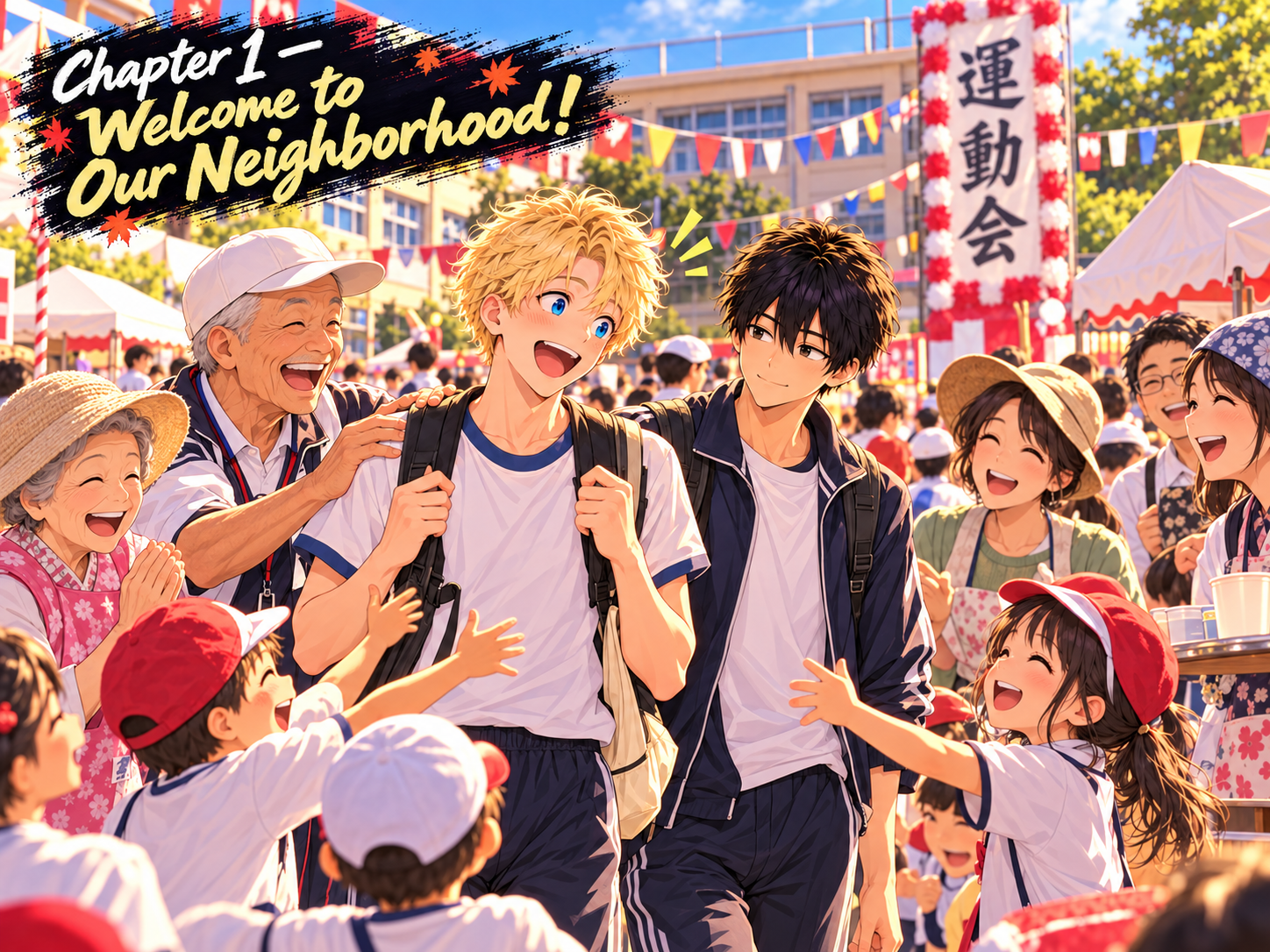
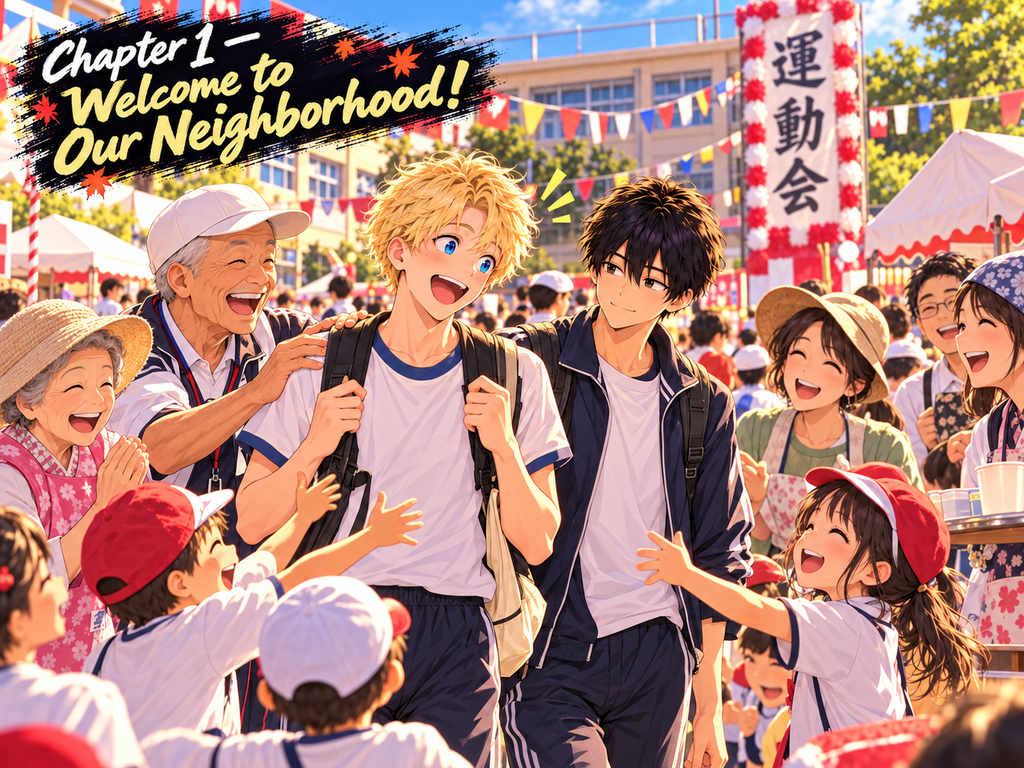
When I arrived at the local school playground, I stopped in surprise.
Colorful flags fluttered above the field.
Large tents stood along the edges.
Families were sitting together.
Children were running around.
And adults were stretching with the seriousness of professional athletes.
“WHOA…”
Haru waved from beneath a tent.
Haru: “Alex! Over here!”
I hurried toward him.
But before I could say anything, an older woman smiled at me.
Woman: 「あら、ハルくんのお友達?」
(Oh, are you Haru’s friend?)
Haru: 「そうです! アメリカから来たAlexです。」
(Yes! This is Alex. He’s from America.)
The woman smiled.
Woman: 「よう来てくれたねぇ! 楽しんでいきや!」
(We’re so glad you came! Have a wonderful time!)
I bowed.
“THANK YOU!”
Another man waved.
Man: 「おっ、Alexくんか! よろしくな!」
(Oh, you must be Alex! Nice to meet you!)
A grandmother patted an empty chair.
Grandmother: 「ここ座り! 荷物置いてええで!」
(Sit here! You can put your bag down!)
I looked at Haru.
“HARU…”
Haru: “What?”
“EVERYONE IS SO NICE!”
Haru smiled.
Haru: 「……うちの町内、ええ人多いやろ?」
(…We’ve got a lot of good people in our neighborhood, don’t we?)
I grinned.
“I ALREADY LOVE THIS PLACE!”
Chapter 2 — The Opening Ceremony and the Bread-Eating Challenge
Suddenly, a voice came over the loudspeaker.
Announcer: 「皆さん、お集まりください! これより町内運動会の開会式を始めます!」
(Everyone, please gather! We’re about to begin the opening ceremony!)
People moved toward the center of the playground.
I looked around.
“AN OPENING CEREMONY?!”
Haru: “Yep.”
“LIKE THE OLYMPICS?!”
Haru smiled.
Haru: “A much smaller version.”
A local organizer stepped up to the microphone.
He thanked the volunteers, welcomed the participants, and reminded everyone to enjoy themselves without getting hurt.
Then came something unexpected.
Announcer: 「それでは皆さん、準備体操を始めましょう!」
(Now, everyone, let’s begin our warm-up exercises!)
Music started playing.
People spread out across the playground.
Children.
Parents.
Grandparents.
Everyone raised their arms together.
I stared.
“HARU…”
Haru: “What?”
“THE ENTIRE NEIGHBORHOOD IS EXERCISING TOGETHER?!”
Haru: “Yeah. Follow along.”
Arms up.
Arms down.
Stretch to the side.
Bend forward.
I looked at the grandfather beside me.
His movements were perfectly controlled.
Mine were not.
“WHY IS GRANDPA BETTER AT THIS THAN ME?!”
Haru laughed.
Haru: 「……おじいちゃん、毎朝体操してるからな。」
(…He does these exercises every morning.)
I tried harder.
Then nearly lost my balance.
Saki, who had arrived with Mio, burst out laughing.
Saki: “Alex! It’s just the warm-up!”
“THIS IS ALREADY A CHALLENGE!”
After the opening ceremony, the games began.
A familiar man from Haru’s neighborhood approached us.
Man: 「Alexくん、元気いっぱいやなぁ!」
(Alex, you’re full of energy!)
I smiled.
“YES!”
The man laughed.
Man: 「ほな、パン食い競争に出てみいひんか?」
(Then how about joining the bread-eating race?)
I blinked.
“BREAD… EATING RACE?”
Haru translated.
Haru: “It’s called pan-kui kyōsō.”
I stared at him.
“WE HAVE TO EAT BREAD WHILE RACING?!”
Haru: “You usually try to catch a hanging piece of bread with your mouth, following the game’s rules.”
I froze.
“WITHOUT USING MY HANDS?!”
Haru: “That’s the idea.”
I slowly smiled.
“A COMPETITION INVOLVING FOOD?!”
Haru sighed.
Haru: 「……絶対参加すると思ったわ。」
(…I knew you’d want to join.)
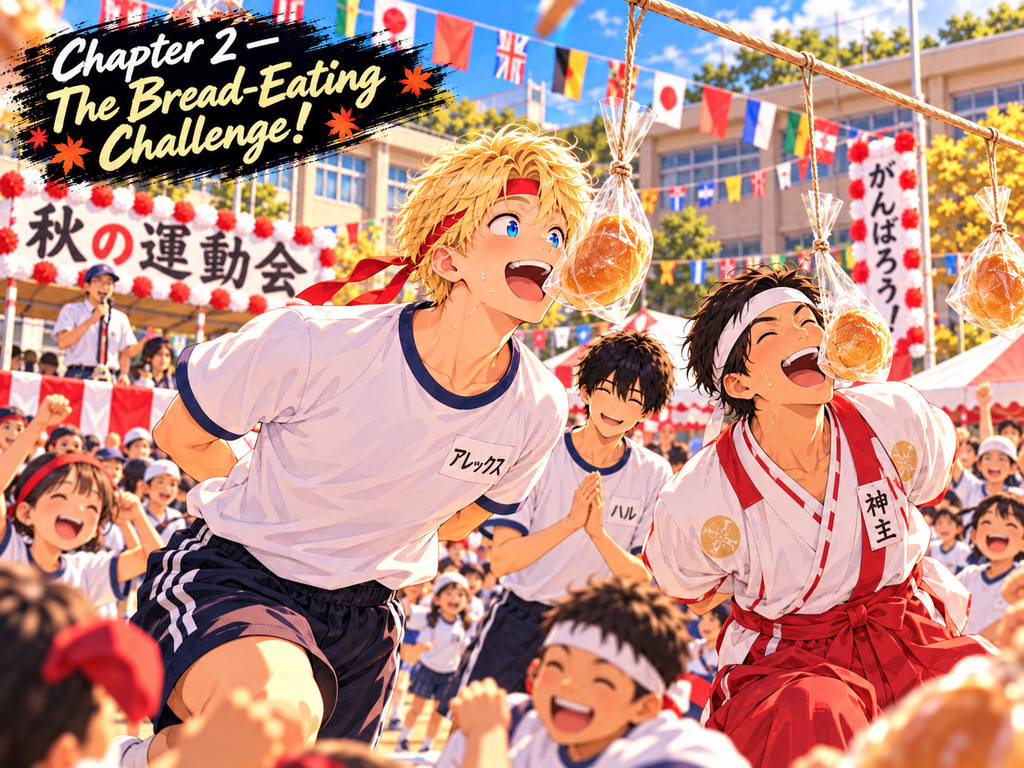
The competitors gathered at the starting line.
I looked to my left.
Then froze.
“WAIT…”
Standing beside me was a familiar face.
The Shinto priest we’d met at the autumn festival.
Today, he wore comfortable sports clothes.
I pointed at him.
“HARU!”
Haru: “What?”
“ISN’T THAT THE PRIEST?!”
Haru smiled.
Haru: “Yeah. He lives in the community too.”
The priest laughed.
Priest: 「Alexくん、今日は負けへんで!」
(Alex, I’m not going to lose today!)
I gasped.
“HE’S CHALLENGING ME?!”
Haru translated.
I turned toward the priest.
“CHALLENGE ACCEPTED!”
The whistle blew.
We ran toward the hanging bread.
I opened my mouth.
Missed.
Jumped.
Missed again.
The bread swung away every time I approached.
“COME BACK, BREAD!”
Beside me, the priest calmly caught his bread.
The crowd cheered.
I stared.
“HE’S TOO GOOD!”
Haru was laughing so hard he could barely speak.
Haru: 「……宮司さん、めっちゃ上手いやん!」
(…The priest is incredibly good at this!)
Finally, I caught my bread.
I ran toward the finish line with the wrapped prize held between my teeth.
The priest finished first.
I came in later.
Breathless.
Defeated.
But smiling.
The priest gave me a thumbs-up.
Priest: 「よう頑張ったな!」
(You did a great job!)
I raised my bread.
“I LOST…”
Haru smiled.
Haru: “Yeah?”
“BUT I WON BREAD!”
Everyone laughed.
Chapter 3 — Grandpa vs. a Two-Year-Old?!
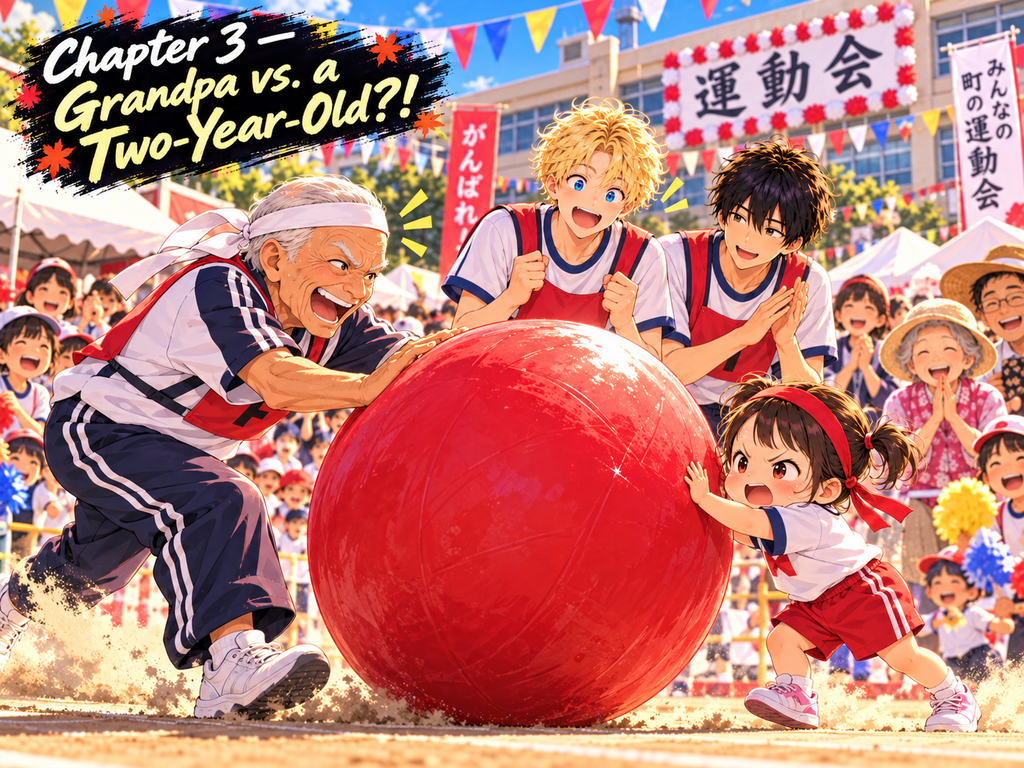
The next activity brought together participants of different ages.
It was a friendly ball-rolling game.
A giant colorful ball sat at the starting line.
A small girl, about two years old, stood beside her mother.
Nearby, an elderly man was preparing for his turn.
I looked at Haru.
“WAIT…”
Haru: “What?”
“IS THAT A TWO-YEAR-OLD?!”
Haru: “Looks like it.”
“AND THAT’S A GRANDFATHER?!”
Haru: “Yep.”
“THEY’RE BOTH COMPETING?!”
Haru nodded.
Haru: “Different ages can join. The younger kids get help.”
I watched the grandfather stretch.
Very seriously.
Then he smiled at the little girl.
Grandfather: 「負けへんで〜!」
(I’m not going to lose!)
The girl raised her tiny fist.
Little Girl: 「まけない!」
I grabbed Haru’s shoulder.
“THIS IS THE GREATEST RIVALRY IN SPORTS HISTORY!”
Haru burst out laughing.
Haru: 「……大げさすぎや!」
(…You’re exaggerating way too much!)
The grandfather took his turn.
He pushed the giant ball carefully.
His expression was unbelievably serious.
It looked like he was competing for an Olympic gold medal.
“GO, GRANDPA!”
Then came the little girl’s turn.
Her mother helped her guide the ball.
She took three tiny steps.
Stopped.
Looked at the crowd.
And waved.
I gasped.
“SHE’S GREETING HER FANS!”
Everyone laughed.
She continued.
Then suddenly hugged the giant ball.
“NOOO! SHE’S FALLEN IN LOVE WITH THE BALL!”
Haru bent over laughing.
Haru: 「……もう競技になってへんやん!」
(…It’s not even a competition anymore!)
Finally, the little girl reached the finish line.
The grandfather clapped louder than anyone.
Grandfather: 「よう頑張ったなぁ!」
(You did so well!)
I watched them smiling together.
“HEY, HARU…”
Haru: “Yeah?”
“HE WAS TRYING TO WIN…”
Haru: “Right?”
“BUT HE’S HAPPIER THAT SHE FINISHED!”
Haru smiled.
Haru: “That’s part of the fun.”
I looked around the playground.
People were cheering for everyone.
Even people from other teams.
And I began to understand something.
This sports day wasn’t only about winning.
It was about having everyone here.
Chapter 4 — Eat! Eat! EAT!
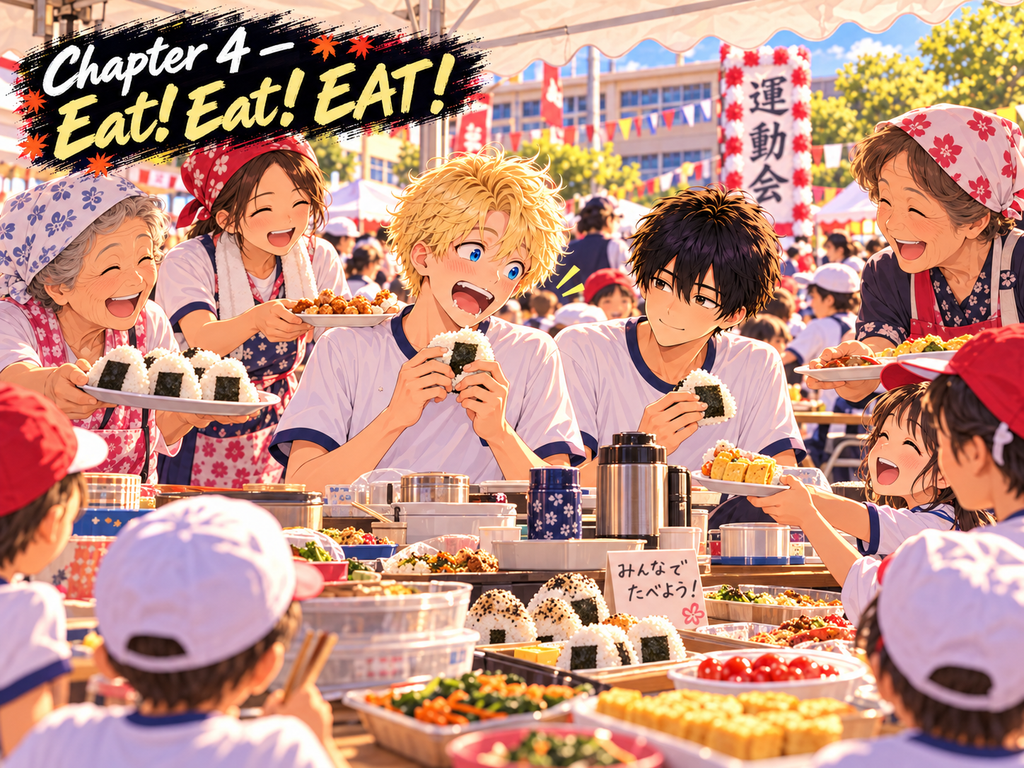
By lunchtime, I was starving.
Completely starving.
I sat beneath our neighborhood tent and held my stomach.
“HARU…”
Haru: “What?”
“I THINK MY STOMACH HAS DISAPPEARED.”
Haru smiled.
Haru: “You’re just hungry.”
“EXTREMELY HUNGRY!”
Just then, several women approached carrying large trays and food containers.
They were members of the neighborhood women’s association.
They had prepared rice balls for the participants.
Woman: 「みんな、お昼やで! おにぎり食べや!」
(Everyone, it’s lunchtime! Come have some rice balls!)
My eyes widened.
“ONIGIRI?!”
Haru smiled.
Haru: “Rice balls.”
I looked at the trays.
Beautiful triangular rice balls were arranged neatly.
Some were wrapped with nori seaweed.
Others had different fillings.
I took one.
“ITADAKIMASU!”
I bit into it.
The rice was soft.
The filling was delicious.
And after a morning of running, it tasted absolutely incredible.
“WHOA…”
Haru looked at me.
Haru: “Good?”
“THIS IS THE BEST RICE BALL I’VE EVER EATEN!”
The women laughed.
Woman: 「そらよかった! もっと食べ!」
(I’m glad you like it! Have some more!)
Another woman appeared.
Another Woman: 「Alexくん、これも食べ!」
(Alex, try this too!)
She offered me some homemade side dishes.
Then a grandfather arrived with another container.
Grandfather: 「こっちも食べ! いっぱいあるで!」
(Have some of this too! There’s plenty!)
I looked at Haru.
“HARU…”
Haru: “Yeah?”
“WHY DOES EVERYONE KEEP FEEDING ME?!”
Haru grinned.
Haru: 「……気に入られたんちゃう?」
(…I guess they’ve taken a liking to you.)
I smiled.
“THAT’S AMAZING!”
Then another plate arrived.
And another.
And another.
Everyone had brought food to share.
Rice balls.
Side dishes.
Fruit.
Small homemade treats.
And every few minutes, someone would say—
「食べ! 食べ!」
(Eat! Eat!)
I laughed.
“I’M TRYING!”
Then I remembered something.
“WAIT!”
Haru looked at me.
Haru: “What?”
“I BROUGHT FOOD TOO!”
I opened my backpack.
Inside was a carefully packed box of sandwiches.
“I MADE SANDWICHES!”
Haru looked impressed.
Haru: “Oh, nice!”
I proudly opened the container.
But then I looked at all the food in front of me.
My stomach was already completely full.
I froze.
“OH NO…”
Haru: “What?”
“I’M TOO FULL TO EAT MY OWN SANDWICHES!”
Haru burst out laughing.
Haru: 「……そら、あんだけ食べたらな。」
(…Well, after eating that much, of course you are.)
One of the women noticed.
Woman: 「あら、サンドイッチもあるん? おいしそうやね!」
(Oh, you brought sandwiches too? They look delicious!)
I smiled.
“PLEASE HAVE SOME!”
Haru translated.
Soon, the sandwiches were being shared around the tent.
The women smiled.
The grandfather took one.
A little boy asked for another.
And people began talking about the different foods.
I looked around.
People I’d barely known that morning were now sharing lunch with me.
Nobody seemed worried about whether I belonged here.
They just kept offering me food.
I smiled.
“HEY, HARU…”
Haru: “What?”
“I THINK YOUR NEIGHBORHOOD IS TRYING TO MAKE ME EXPLODE.”
Haru laughed.
Haru: 「……食べすぎでな!」
(…From eating too much!)
Chapter 5 — The Final Relay: Everyone Wants to WIN!
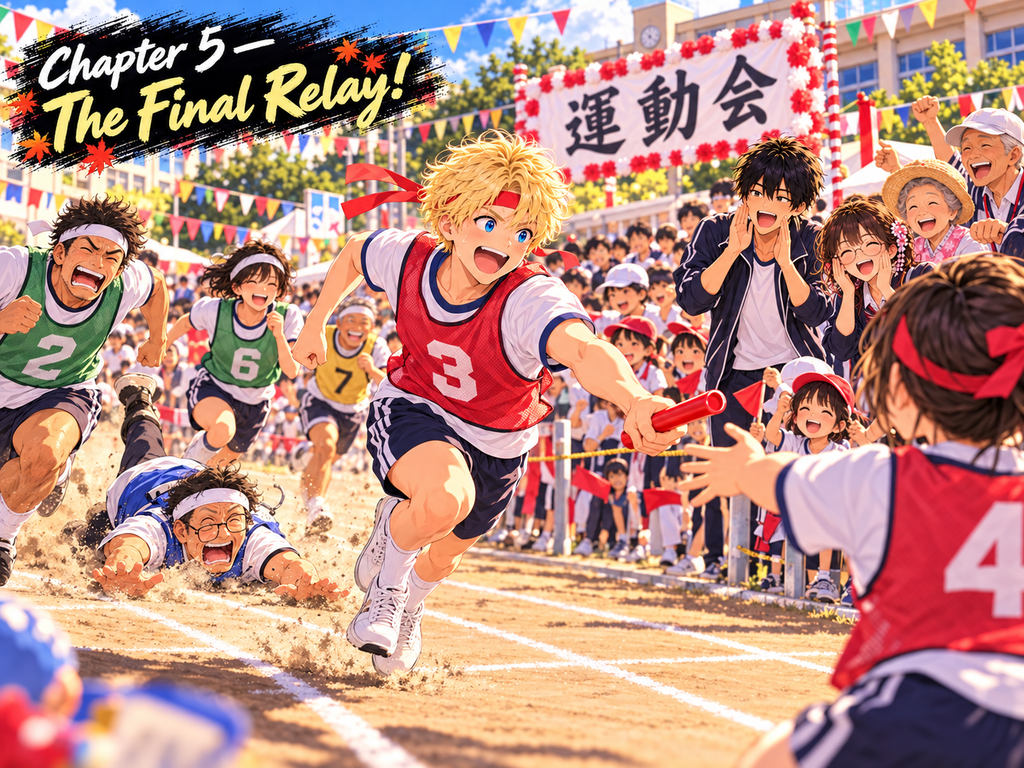
The afternoon was filled with more competitions.
Some were silly.
Some were easy.
Some were surprisingly difficult.
And throughout the day, participants received small prizes.
Ballpoint pens.
Notebooks.
Tissues.
Useful everyday items.
I stared at the prize table.
“HARU…”
Haru: “What?”
“PEOPLE ARE COMPETING THIS HARD FOR BALLPOINT PENS?!”
Haru laughed.
Haru: 「……景品より勝負が大事なんやろ。」
(…I guess the competition matters more than the prizes.)
I nodded slowly.
“THAT MAKES SENSE.”
Then I clenched my fists.
“I WANT A PEN!”
Haru sighed.
Haru: 「……お前もかい!」
(…You too?!)
Finally, it was time for the last event.
The neighborhood relay race.
An announcement echoed across the playground.
Announcer: 「それでは、本日最後の競技、町内対抗リレーを始めます!」
(Now, it’s time for today’s final event: the neighborhood relay race!)
The atmosphere changed immediately.
People gathered along the track.
Families stood up.
Teams began discussing their running order.
I looked at the different groups.
One neighborhood had several young adults.
They looked fast.
Very fast.
Another team had a mixture of younger and older participants.
And our team…
Well.
We had enthusiasm.
Lots of enthusiasm.
I looked at Haru.
“HEY…”
Haru: “Yeah?”
“THAT TEAM HAS A LOT OF YOUNG RUNNERS!”
Haru nodded.
Haru: “Yeah. Their neighborhood has more young people.”
“THAT’S AN ADVANTAGE!”
Haru: “Probably.”
“ISN’T THAT UNFAIR?!”
Haru shrugged.
Haru: “Maybe they’re stronger. But it’s the same relay rules for everyone, and we all agreed to race.”
I looked at the other teams.
Nobody was complaining.
Instead, they were stretching.
Encouraging one another.
Laughing.
And preparing to give everything they had.
I smiled.
“OKAY.”
Haru looked at me.
Haru: “What?”
“THEN WE’LL DO OUR BEST TOO!”
Haru grinned.
Haru: 「……せやな!」
(…That’s right!)
The starting signal sounded.
The first runners took off.
The crowd erupted.
“GO! GO! GO!”
The younger runners from the other neighborhood quickly pulled ahead.
Our team chased them.
One baton passed.
Then another.
The crowd was shouting.
Grandparents stood up to cheer.
Children waved their arms.
Even people from other neighborhoods were encouraging the runners.
Then—
One adult runner stumbled near a turn.
He fell onto the track.
“OH NO!”
The nearby staff checked on him.
He sat up, looking embarrassed.
Fortunately, he appeared able to stand, though the volunteers made sure he was okay before he moved away from the track.
He looked at his teammates and gave a sheepish smile.
Runner: 「いやぁ、気持ちは若いんやけどな!」
(Well, I still feel young in my head!)
The crowd laughed with relief.
I looked at Haru.
“HE REALLY GAVE IT EVERYTHING!”
Haru nodded.
Haru: 「……本気やったな。」
(…He really was giving it his all.)
Finally, the baton came to me.
I grabbed it.
And ran.
As fast as I safely could.
The wind rushed past my face.
My legs were moving.
My heart was pounding.
And everyone was shouting.
“GO, ALEX!”
“頑張れー!”
(Keep going!)
I ran toward the next runner.
Reached forward.
And passed the baton.
Our team kept going.
But the neighborhood with the younger runners was too strong.
They crossed the finish line first.
We didn’t win.
Not even close enough to pretend.
I bent forward, catching my breath.
“HARU…”
Haru: “Yeah?”
“WE LOST…”
Haru smiled.
Haru: “Yeah.”
I looked down.
Then I heard a voice.
“おつかれー!”
(Great job!)
Another voice answered.
“おつかれさん!”
(Well done!)
The winning team was smiling.
The losing teams were smiling too.
People were shaking hands.
Patting each other’s shoulders.
Congratulating the winners.
And thanking everyone for running.
I looked around in surprise.
“WAIT…”
Haru looked at me.
Haru: “What?”
“EVERYONE IS SAYING GOOD JOB!”
Haru nodded.
Haru: “Of course.”
“EVEN TO THE TEAMS THAT LOST?!”
Haru smiled.
Haru: “Everyone worked hard.”
I looked at the runners.
Tired.
Sweaty.
Smiling.
For some reason, losing didn’t feel so bad anymore.
Chapter 6 — We Lost… So Why Is Everyone Smiling?!
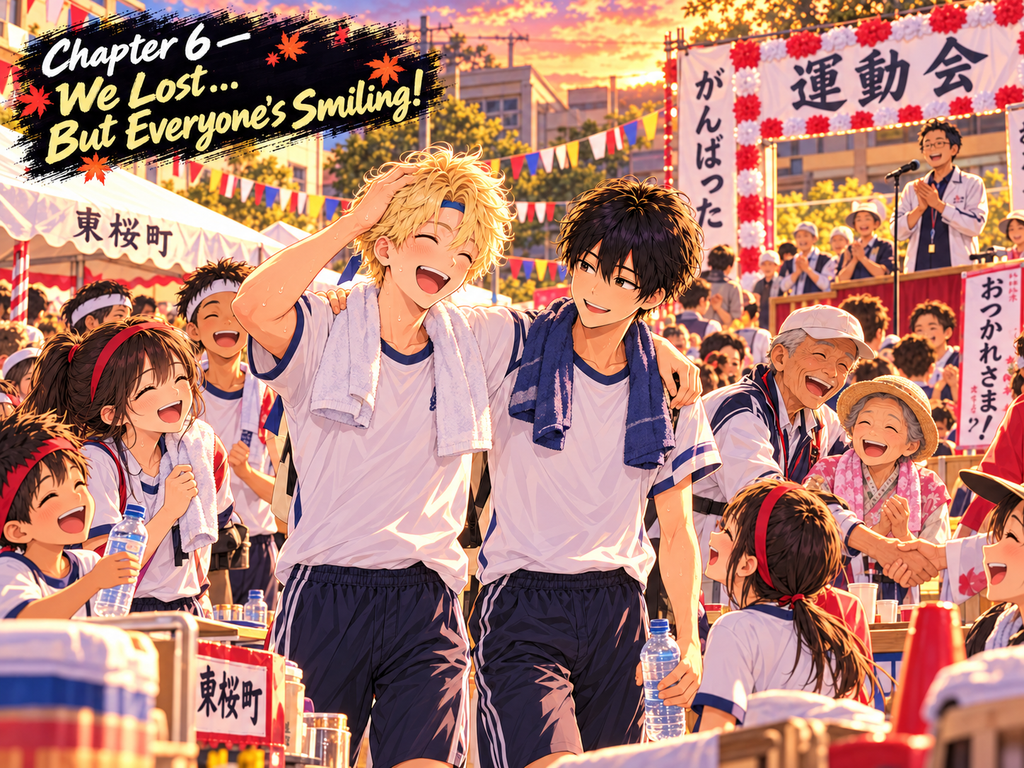
We returned to our neighborhood tent.
I was still disappointed.
Just a little.
The adults were sitting in folding chairs.
Some were drinking water.
Others were talking about the relay.
An older man looked at us.
Man: 「いやぁ、惜しかったなぁ!」
(Ah, that was close!)
Another man nodded.
Another Man: 「でも、よう頑張ったで!」
(But you all did a great job!)
A grandmother smiled.
Grandmother: 「Alexくん、ええ走りやったやん!」
(Alex, that was a great run!)
I looked at Haru.
“BUT WE LOST!”
Haru smiled.
Haru: “They know.”
“THEN WHY ARE THEY COMPLIMENTING US?!”
Haru looked around the tent.
Haru: “Because we tried our best.”
An older man raised his bottle of water.
Man: 「来年は勝とうな!」
(Let’s win next year!)
Someone laughed.
Another Man: 「その前に、ちゃんと練習せなあかんな!」
(Before that, we’d better actually practice!)
Everyone burst out laughing.
I smiled.
Then I laughed too.
Maybe the competition mattered.
But the result wasn’t everything.
Later, the loudspeaker called everyone together.
Announcer: 「皆さん、閉会式を始めます!」
(Everyone, we’ll now begin the closing ceremony!)
People gathered once more.
The organizers thanked the participants.
They thanked the volunteers.
And they thanked everyone who had helped prepare the food and run the event.
The winning team received applause.
So did the other teams.
The final announcement encouraged everyone to return safely and look forward to the next community event.
Then the sports day was officially over.
But something interesting happened.
Nobody rushed away immediately.
People stayed.
They talked.
Grandparents spoke with young parents.
Children showed their prizes to older neighbors.
Adults who had been competing fiercely an hour earlier were now laughing together.
I looked at Haru.
“HEY…”
Haru: “What?”
“DO THESE PEOPLE ALL KNOW EACH OTHER?”
Haru thought for a moment.
Haru: “Some do. Some don’t know each other very well.”
“THEN WHY IS EVERYONE TALKING?!”
Haru smiled.
Haru: “That’s one of the reasons we have events like this.”
I looked around.
The woman who had made the rice balls was chatting with a young father.
The grandfather from the ball game was laughing with some children.
The priest from the bread-eating race was talking with Mr. Tanaka.
And several residents were already discussing next year’s event.
Haru: “People of different ages don’t always get many chances to talk. But today, they can.”
I watched them.
Two-year-olds.
Teenagers.
Parents.
Grandparents.
People who had lived here for decades.
People who had only recently moved in.
All sharing the same playground.
The same food.
The same laughter.
And the same memories.
I smiled.
“HARU…”
Haru: “Yeah?”
“I THINK I FINALLY UNDERSTAND.”
Haru: “Understand what?”
“WHY EVERYONE TAKES THIS SO SERIOUSLY.”
Haru looked curious.
I held up my ballpoint pen.
“IT’S NOT REALLY ABOUT THE PEN.”
Haru laughed.
Haru: 「……やっと気づいたんか。」
(…You finally figured that out?)
I grinned.
“IT’S ABOUT EVERYONE BEING HERE TOGETHER!”
Haru smiled.
Haru: 「……せやな。」
(…That’s right.)
Before leaving, I looked at the prizes I’d collected.
A small notebook.
A ballpoint pen.
Nothing expensive.
Nothing extraordinary.
But today, they felt special.
I remembered the priest smiling after the bread-eating race.
The little girl hugging the giant ball.
The women saying, “Eat! Eat!”
The delicious homemade rice balls.
My sandwiches being shared with new friends.
The adults sprinting as though the whole world depended on it.
And the runners from every neighborhood calling out—
“Otsukare!”
Great job!
I turned toward Haru.
“HEY, HARU!”
Haru: “What now?”
“CAN WE COME AGAIN NEXT YEAR?!”
Haru laughed.
Haru: “Of course.”
I raised my fist.
“NEXT YEAR, WE’RE WINNING THE RELAY!”
Haru grinned.
Haru: 「……ほな、ちゃんと練習せなな!」
(…Then we’d better practice properly!)
I nodded.
“AND I’M BRINGING MORE SANDWICHES!”
Haru laughed.
Haru: 「……まず食べすぎんようにせな。」
(…First, you need to stop eating so much.)
I smiled.
As we left the playground, I looked back one last time.
The tents were being taken down.
The flags were coming down.
The day’s competitions were over.
But people were still chatting.
Still laughing.
Still waving goodbye.
Today, I hadn’t won the final relay.
But I’d gained something much better.
A place where people knew my name.
Where strangers shared their lunches.
Where grandparents cheered for toddlers.
And where even the losing team was welcomed back with a smile.
I looked at my little notebook.
Then wrote:
MY FIRST NEIGHBORHOOD SPORTS DAY IN JAPAN
Result: We lost the relay.
Prize: One ballpoint pen.
Best memory: Everyone made me feel like I belonged.
I closed the notebook.
And smiled.
To be continued in Alex in Japan…
Alex’s Discovery — What Is a Japanese Neighborhood Sports Day?
1. What Is a Neighborhood Sports Day?
A chōnai undōkai (町内運動会) is a community sports event that brings local residents together.
Unlike school sports days, it may include people of many different ages.
Toddlers, schoolchildren, adults, and older residents can all take part in activities suited to their abilities.
Not every neighborhood in Japan holds this kind of event.
2. Who Organizes It?
Local organizations such as neighborhood associations, sports promotion groups, community volunteers, and sometimes taiiku shinkōkai (体育振興会) may help organize these events.
The organizing structure varies by area.
3. Why Does Everyone Exercise Together Before the Games?
Some Japanese community sports days begin with a group warm-up.
Participants may perform stretching or familiar exercises such as rajio taisō (ラジオ体操), a form of group calisthenics.
It helps prepare participants for physical activity and creates a shared starting moment.
4. What Is a Bread-Eating Race?
Pan-kui kyōsō (パン食い競争) is a traditional recreational game sometimes seen at Japanese sports days.
Participants attempt to catch hanging bread with their mouths, often without using their hands.
Rules vary by event.
Organizers should consider safe food handling, allergies, and avoiding choking hazards.
5. Who Makes the Lunch?
Some community events include food prepared or organized by local volunteers.
In this story, members of a neighborhood women’s association prepare onigiri for participants.
Other residents bring dishes to share.
This is one example of a community event, not a universal practice at all Japanese sports days.
6. What Is a Neighborhood Relay?
A neighborhood relay is a team running competition involving residents representing different local areas.
Depending on the rules, teams may have different age compositions.
Some neighborhoods may have more young runners, but participants often compete enthusiastically regardless.
Safety and appropriate participation are important.
7. What Does Otsukare Mean?
Otsukare (おつかれ) is a common Japanese expression used to recognize someone’s effort.
Depending on the situation, it can mean:
- Great job!
- Well done!
- Thanks for your hard work!
At the end of a community race, both winners and losers may say otsukare to one another.
8. What Makes These Events Special?
For many participants, the most valuable part of a community sports day is not the competition itself.
It’s the opportunity to meet neighbors, share food, cheer for one another, and connect across generations.
A simple local event can create lasting memories and friendships.
Japanese Words to Remember
| Japanese | English Meaning |
|---|---|
| 町内運動会 (Chōnai undōkai) | Neighborhood sports day |
| 体育振興会 (Taiiku shinkōkai) | Community sports promotion association |
| 開会式 (Kaikaishiki) | Opening ceremony |
| 閉会式 (Heikaishiki) | Closing ceremony |
| ラジオ体操 (Rajio taisō) | Group calisthenics |
| パン食い競争 (Pan-kui kyōsō) | Bread-eating race |
| 婦人会 (Fujinkai) | Women’s association |
| おにぎり (Onigiri) | Rice ball |
| 町内対抗リレー | Neighborhood relay competition |
| 景品 (Keihin) | Prize |
| おつかれ (Otsukare) | Great job / Well done |
| 食べ! (Tabe!) | Eat! / Have some! |
About Alex in Japan
Alex in Japan is an original illustrated fiction series about Alex, a 16-year-old American high school student discovering Japanese life in Osaka.
Together with his Japanese classmate Haru, Alex explores school traditions, neighborhood events, food culture, festivals, and surprising everyday experiences.
Every episode is an adventure in friendship, culture, and discovering what it means to belong.
Read the complete illustrated series:
Alex in Japan — Official Story Archive
Episode 09 — The End
Sometimes the greatest victory isn’t crossing the finish line first.
It’s finding a place where everyone cheers for you, even when you lose.
Two cultures. One unforgettable friendship. A new discovery every day.